Gauteng Scholar Transport: The Impossible Math of the 83-Child Ratio and How We Fix It
By Peggie Mars
Founder, Wheel Well – Child Road Safety NGO
The recently proposed Gauteng Integrated Implementation Plan (IIP) 2026-2030 provides a sobering look at the province’s scholar transport network. While Gauteng manages the largest network of its kind in South Africa, the data reveals a mathematical reality that should shock every parent to their core.
The Math of Risk
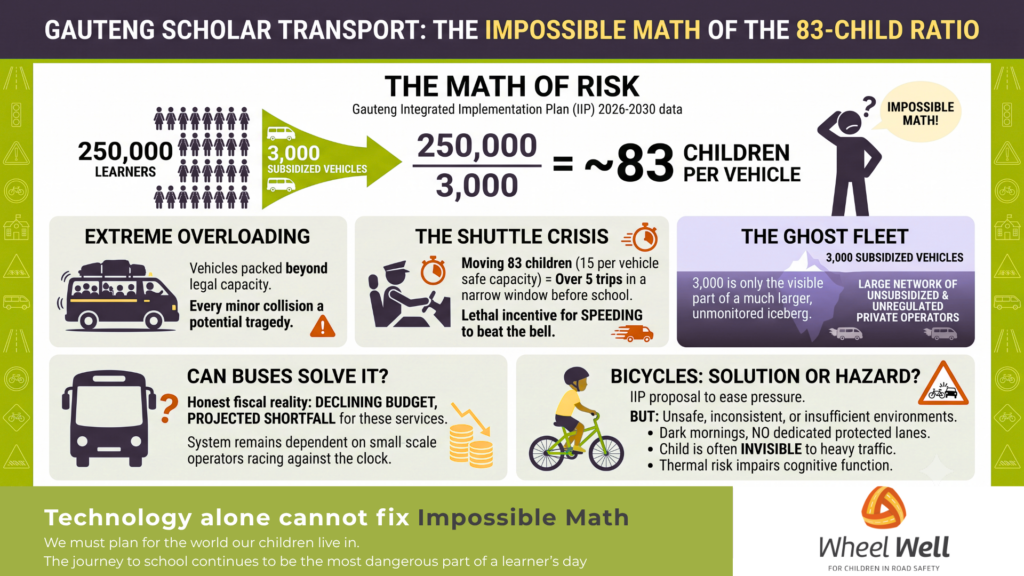
The provincial government moves between 200,000 and 250,000 learners every school day using a subsidized fleet of just over 3,000 vehicles. Simple division shows that for every registered vehicle there are roughly 83 children. This ratio is not just a statistic; it is a clear indicator of three possible systemic failures:
- Extreme Overloading: If these children move in single trips, vehicles are being packed far beyond legal capacity, turning every minor collision into a potential tragedy.
- The Shuttle Crisis: To move 83 children at a safe capacity of 15 per vehicle, a driver must complete over five trips in the narrow window before school starts. This creates a lethal incentive for speeding to beat the bell.
- The Ghost Fleet: The IIP acknowledges a large network of unsubsidized and unregulated private operators. This means the 3,000 vehicles on record are only the visible part of a much larger, unmonitored iceberg.
Can Buses or Bicycles Solve the Problem?
On paper, moving toward high-capacity school buses is the logical choice to reduce the number of trips and the risk of overloading. However, the IIP is honest about the fiscal reality: the province faces a declining real-term budget allocation and a projected shortfall for these services. Until the funding gap is closed, the system will likely remain dependent on small-scale operators racing against the clock.
The implementation plan also proposes a bicycle distribution programme linked to scholar transport. While creative, this proposal must be weighed against the realities of township life in Gauteng. The IIP itself admits that walking and cycling environments are often unsafe, inconsistent, or insufficient.
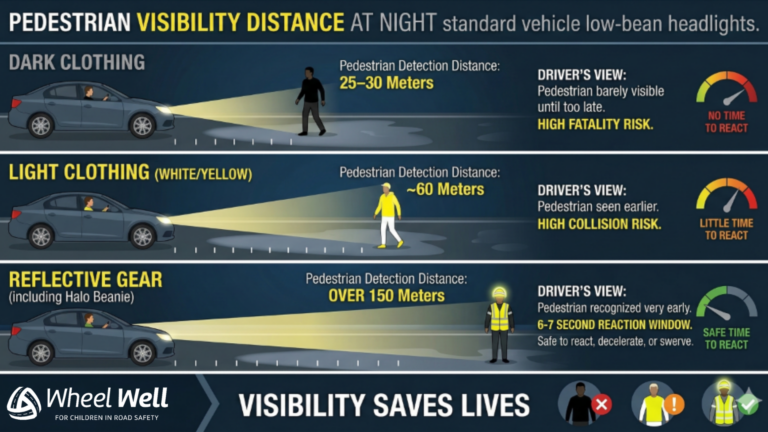
For a child in a low-income area, a bicycle without dedicated, protected lanes often make them invisible to heavy traffic on dark winter mornings. Add thermal stress from extreme heat that impairs cognitive function and placing children on bicycles in hostile traffic environments risks solving a transport capacity problem by creating a safety crisis.
The Real Solution: Contracting the Existing Fleet
The hardware to solve this problem already exists on Gauteng’s roads. With over 129,000 registered minibus taxis in the province, meeting the demand for 250,000 learners safely, which requires roughly 16,667 vehicles operating at legal capacity, would utilize just 13% of Gauteng’s existing minibus pool. The bottleneck is not a shortage of vehicles; it is a structural, regulatory, and financial framework problem.
To turn this impossible math into a safe reality, transport policy must move away from piecemeal subsidies and look to proven Global South frameworks:
- Shift to Gross-Cost Contracting: Paying operators a fixed rate per kilometre or completed route, rather than per passenger, removes the lethal economic incentive to speed or overload.
- Formalize Dual-Use Agreements with Taxi Associations: Contract directly with local taxi associations for dedicated, early-morning scholar runs before vehicles transition to standard commuter routes. This legitimizes route rights without sparking territorial disputes.
- Tie Subsidies to Strict Compliance: Provincial funding should be contingent on vehicles meeting strict roadworthiness standards, maintaining proper child safety, and running active telematics to track speed and driver behaviour.
Practical Safety Starts on the Ground
While long-term policy integration takes time, the daily safety of our children requires immediate, practical intervention. Ensuring that every vehicle carrying learners is roadworthy and driven by a trained professional is non-negotiable. At Wheel Well, we remain dedicated to protecting our young road users through practical, accessible safety solutions tailored to the real conditions of our roads. Wheel Well is a proud winner of the Prince Michael International Road Safety Awards, recognizing achievement and innovation which improves road safety.
Keeping vehicles in peak mechanical condition is vital for any scholar transport operation. For trustworthy vehicle checks, safe tyres, and essential maintenance, options like Supa Quick offer reliable support to help keep our transport fleets running safely on South African roads.
Food for Thought
The IIP is a sophisticated document that correctly identifies the need for digital monitoring and real-time telematics to track vehicle movements. But technology alone cannot fix impossible math.
As the province moves toward 2030, we must ask if we are planning for the world we want or the one our children actually live in. By integrating, regulating, and properly contracting the minibus taxi fleet already on our roads, we can finally turn the daily journey to school from a gamble into a safe passage.
Gauteng Scholar Transport: The Impossible Math of the 83-Child Ratio and How We Fix It Read More »