
By Peggie Mars
Founder, Wheel Well – Child Road Safety NGO
We regularly hear about road safety in South Africa. We hear about Easter safety campaigns, festive season roadblocks, and crackdowns on drunk driving. Recently, I attended a presentation by the Deputy Minister of Transport where these traditional strategies were once again the focus.
Law enforcement is essential. Education campaigns are necessary. However, I left the session feeling that a vital part of the conversation was missing. If we truly want to stop the carnage on our roads, we must address the “visibility gap.”
As a nation, we need to focus on visibility gear for pedestrians, especially for our children.
The Invisible Victims: Counting the Cost
The numbers from the Road Traffic Management Corporation (RTMC) tell a tragic story. In South Africa, pedestrians are not just one category of road users, they are the most vulnerable and often the majority of victims.
On an annual basis, pedestrians make up between 40% and 47% of all road fatalities. During peak travel periods like Easter, that number has hit the highest end of that spectrum. In 2025, nearly 5,000 pedestrians lost their lives on South African roads.
When we look closer at the demographics, a disturbing pattern emerges:
- Children are at extreme risk. Children under the age of 14 consistently account for about 10% to 12% of pedestrian deaths. The ages of 5 to 9 are the highest-risk group within this category. Many of these deaths happen as children walk to or from school, often on high-speed roads with no sidewalks.
- Commuters are vulnerable. Working-age adults between 25 and 44 are the most affected group.
The timing of these accidents is critical. The vast majority of fatal pedestrian crashes occur between dusk and early night (19:00 to 21:00) and peak over weekends. In simple terms, people are dying because it is dark and they cannot be seen.
The Seconds That Save Lives: The Science of Visibility
Current government policy focuses heavily on changing behaviour (stopping jaywalking) and enforcement (speed traps). These are slow, expensive battles to fight.
Focusing on visibility offers a micro-intervention with immediate, massive results. The solution comes down to physics and human reaction time.
A driver’s ability to react is determined by the distance at which they can detect an object. At a speed of 100km/h, a vehicle is moving at roughly 28 meters every single second.
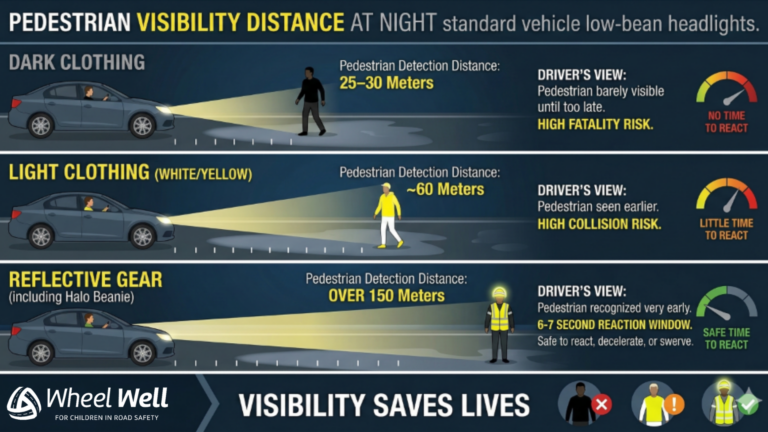
Let’s look at the detection distances in darkness under standard low-beam headlights:
- Dark Clothing: A driver might only see a pedestrian at 25 to 30 meters. By the time the driver reacts, the vehicle has already travelled that distance. It is almost always fatal.
- Light Clothing (White/Yellow): Visibility increases to perhaps 60 meters. This still leaves a very high risk of collision.
- Reflective Gear: Visibility surges to over 150 meters. This gives the driver a 6 to 7-second window to react, decelerate, or swerve safely.
Research suggests that simply wearing high-visibility or retro-reflective gear can reduce a pedestrian’s collision risk by up to 85%. Despite this, there is no major national mandate or program to get this lifesaving gear onto our most vulnerable citizens.
Elevating the Solution: The Case for Halo Beanies
The standard solution has always been to suggest people wear a high-vis construction vest. While effective in theory, this approach often fails because people (especially children) find them uncomfortable or socially unappealing. Furthermore, vests can be obscured by backpacks.
This is where the Halo Beanie campaign shifts the strategy. A beanie addresses the critical psychology of compliance and the physics of the problem:
- High User Adoption: In South Africa’s colder winter months, when the days are shortest, children and adults already wear beanies. A safety beanie is an easy substitute for an existing habit, rather than an extra, “uncool” accessory.
- Visible at the Highest Point: This is the technical advantage. Drivers can be blinded or have their line of sight blocked by parked cars, tall grass, or roadside clutter. Reflective gear at the waist (vest) or feet is easily hidden. A reflective “halo” on the head is at the driver’s eye level and is often the first thing that emerges from behind an obstacle.
- 360-Degree Visibility: Unlike directional reflective sashes, which can move, or vests, which can be covered by a jacket, a continuous reflective band around the head ensures a child is visible from every angle, even if they are playing or running.
- Amplified Recognition: A person’s head moves constantly. This erratic movement makes a driver recognize that the object is a “person” much faster than a static reflective dot on a road sign.
A Call for Action
If we truly want a breakthrough in pedestrian safety, we cannot rely solely on roadblocks and television ads. While those tactics have a role, they react to a problem that has already happened. Visibility gear is proactive.
It costs less than R50 to equip a child with a high-quality reflective beanie or sash. Compare that to the economic and emotional toll of a single road fatality.
The state has the power to act. They can incentivize the production of reflective school wear and mandate visibility gear for high-risk workers.
For our part, we are focusing on the Halo Beanie campaign to prove that effective road safety can also be practical and accessible. It is time to turn the conversation to visibility and stop allowing the missing link in road safety to cost lives.
What is your take on visibility gear as a primary road safety strategy? Is your company integrating high-vis into workwear? Let’s discuss.