
By Peggie Mars
Founder, Wheel Well – Child Road Safety NGO
We often hear that “speed kills,” but as parents, it can be hard to visualize exactly why a few extra kilometres per hour matter so much. At Wheel Well, we believe that when you understand the “why” and the “how” of car seat safety, it becomes second nature..
Our guiding principle is simple: our children are not mini adults. Their bodies are far more vulnerable than ours, and for this reason, we have to take extra special care of them during the extreme conditions of a crash.
- The “Bowling Ball” Problem (Momentum)
Imagine holding a bowling ball. Now imagine that ball is actually your baby’s head. At birth, your baby carries about 30% of their total body weight in their head.
When a car stops suddenly in a crash, everything inside keeps moving forward at the original speed. If a child is forward-facing during a frontal crash, that “heavy” head is thrown forward with significantly more relative force than an adult’s. Because their immature spines and skulls are still developing, they simply cannot deal with these extreme forces.
- The “Cradle” vs. The “Stretch” (Deceleration)
In a crash, the goal is to stop the body as slowly as possible to reduce strain.
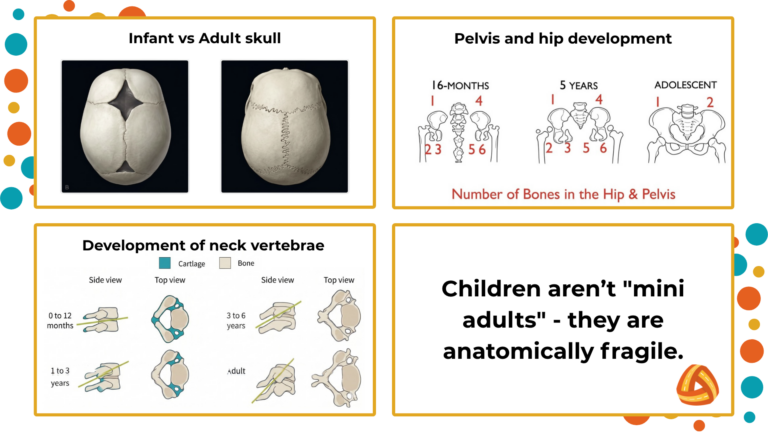
- A Delicate Support: A young child’s spinal cord is incredibly vulnerable at birth. It consists of cartilage and bone and cannot yet support the body weight of your child.
- The “Stretch”: Because their spine is so flexible, it can experience a violent stretch during a forward-facing impact. It is vital to know that the injuries resulting from a spinal “stretch” are devastating.
- The Rear-Facing Solution: By keeping your child rear-facing for as long as possible, you protect the neck and pelvis. The seat acts as a cradle, catching the head and back together to distribute force and prevent dangerous spinal strain. For this reason, infant seats are designed with a flatter angle.
- Side Impact: Protecting the Developing Brain
Most crashes aren’t perfectly straight; they often involve lateral (side-to-side) movement. This is where side-impact protection becomes vital.
- Fusing Plates: At birth, your baby’s skull has separate plates that must grow and fuse together.
- The Age 2 Milestone: This fusing process isn’t complete until about age 2.
- A Protective Shell: Until those bones fuse, the brain is extra vulnerable. You must take utmost care of this vulnerable brain by rear-facing your child and ensuring your car seat provides good side-impact protection.
- Why “Hip Bones” Matter (The Pelvis)
You might wonder why we use booster seats for older children. It comes down to how their bones grow. In an infant or young child, the pelvic area is made of separate bones that must still grow and fuse together. This is why they are so flexible in their hips. However, it also means they don’t yet have the solid “hip bones” needed to keep an adult seatbelt from sliding up into their soft stomach area during a sudden stop.
- The Golden Rule: Slowing Down for Every Condition
Because our children’s bodies are so vulnerable, we must reduce our speed whenever they are in the vehicle. Since impact energy multiplies quickly as speed increases, slowing down is the simplest way to give their safety seat a better chance to protect them.
To provide that extra special care they require, it is essential to lower your speed even further whenever you encounter adverse conditions, such as:
- Night Driving: Reduced visibility means you have less time to react.
- Rain or Wet Roads: Slick surfaces significantly increase your braking distance.
- Bad Road Conditions: Potholes or gravel can impact your vehicle’s stability.
- Fog or Low Visibility: If you can’t see clearly, you must slow down to ensure a safe stop.
- Handling the Pressure: Aggressive Drivers
It is natural to feel intimidated by aggressive drivers “tailgating” you. However, you are the guardian of someone whose body is far more vulnerable than yours. Their head still carries about 30% of their weight , and their immature spine cannot deal with the forces that higher speeds bring.
Don’t let a stranger’s impatience dictate your child’s safety. If pressured, stay calm, maintain your safe speed, and find a safe opportunity to let them pass. It is always better to let an angry driver go by than to put a young spine, which is still mostly cartilage, at risk.
Finally, remember that the most advanced safety seat in the world still relies on the vehicle surrounding it to perform its job. Ensuring your car is roadworthy isn’t just a legal requirement; it’s about making sure your vehicle reacts predictably when it is required most. Whether it’s having the tire tread to grip a wet road or the brake responsiveness to avoid a collision, maintenance is your first line of defence. We urge you to visit your local Supa Quick dealership for a professional safety assessment. By keeping your tires, brakes, and suspension in peak condition, you’re ensuring that the laws of physics work with you, not against you. Don’t leave your family’s safety to chance: give your vehicle the expert care it needs to keep your family safe.
Our children are vulnerable, but with the right seat and the right speed, they are protected.
Wheel Well is a proud winner of the Prince Michael International Road Safety Awards, recognizing achievement and innovation which improves road safety.