
By Peggie Mars
Founder, Wheel Well – Child Road Safety NGO
In the world of corporate social responsibility (CSR), there is a growing “effectiveness gap.”
On one side, we see campaigns designed for social media engagement: coloring competitions, catchy songs, and “awareness” posters. On the other side is the grim reality of road trauma, which remains a leading cause of death for children globally. As we approach high-risk travel periods like Easter, it’s time for a deep, evidence-based analysis of which interventions actually save lives and which ones are merely “Safety Theatre.”
- The “Safety Theatre” Trap: Why Coloring Competitions Fail
A recent industry shift perfectly illustrates the problem: a corporate pivot from providing life-saving car seats and safety harnesses to hosting a school colouring competition. While photogenic, this fails the most basic test of road safety science: Knowledge does not equal Behavior.
Research from the World Health Organization (WHO) and SWOV Institute for Road Safety Research consistently shows that passive awareness campaigns have negligible impact on casualty rates. These programs mistakenly task the child with their own safety, ignoring the biological reality of child development.
The Cognitive Profile of a Child
Children are not “small adults.” Their brains are physically incapable of navigating complex traffic safely due to:
- Peripheral Vision Limitations: Children have roughly 1/3 less peripheral vision than adults.
- Auditory Localization: Most children cannot accurately locate the direction of a vehicle’s sound until age 10.
- Underdeveloped Impulse Control: The prefrontal cortex is still developing; a child who “knows” the rules may still dart into traffic to retrieve a ball or greet a friend.
The Verdict: When we ask a child to “colour themselves safe,” we shift the burden of responsibility from the adult to the victim.
- The Gold Standard: Physical Protection & Restraints
Evidence-based road safety points to one primary solution for child survival: Occupant Restraints.
Correctly installed car seats reduce the risk of death for infants by 71% and for toddlers by 54%. In low-income areas, low restraint usage is rarely due to a lack of “awareness” – it is a lack of access. A harness or car seat handout is not a marketing gesture; it is a life-saving intervention.
- High-Impact Education: The “Safety Literacy” Model
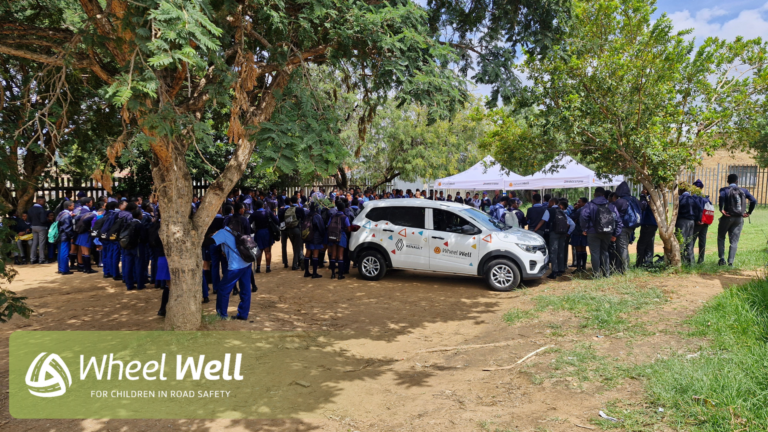
Education is vital only when it moves from “Awareness” to Hazard Literacy. In our collaborative school programs with partners like Bridgestone, we target senior secondary learners with a “Consequential Reality” model based on three pillars:
- Vehicle Integrity (The Physics of Prevention): We conduct hands-on tire safety checks and a pre-trip inspection. Teaching a learner to identify a “smooth” tire or check tread depth turns them into a “Safety Officer” and not just a passenger.
- Survival Basics (Secondary Crash Prevention): We demonstrate the essential kit every vehicle must carry: the wheel jack, spanner, fire extinguisher, reflective triangle, and high-visibility gear. This empowers youth to manage the aftermath of a breakdown and prevent lethal secondary collisions.
- Affective Education (The Messenger Effect): Adolescents often possess an “invincibility bias.” Hearing the lived experience of survivors like Zweli (TV personality) creates an emotional anchor that no textbook can replicate.
- The Vital Cog: Why Corporates Must Consult NGOs
Designing road safety projects in a vacuum lead to wasted budgets. To move from “optics” to “impact,” companies must partner with established NGOs for two reasons:
- Expertise Over Aesthetics: NGOs understand the specific risks of the local landscape and the “Profile of a Child.”
- Systemic Support: Supporting an NGO ensures CSR budgets fund validated, evidence-based interventions rather than “feel-good” activities.
- Ranking Road Safety Interventions for Efficacy
Efficacy Rank | Intervention Type | Real-World Impact |
🥇 GOLD | Physical Restraints & Engineering | High. Directly prevents mortality in collisions. |
🥈 SILVER | Hazard Literacy & Survivor Testimony | Moderate-High. Provides tangible skills and emotional resonance. |
🥉 BRONZE | Adult-Focused Enforcement | Moderate. Targets the person in control of the vehicle. |
❌ FAIL | Passive Child Awareness (Coloring/Songs) | Zero. Optimized for social media “likes,” not lives. |
A Call to Action for CSR Leaders
If your road safety budget is spent on crayons instead of car seats, or posters instead of reflective gear, you aren’t investing in safety – you’re investing in optics.
Children learn from repeated, consistent, and adult-led messages. They are protected by the physical barriers we put between them and a ton of moving metal. Let’s stop asking children to draw their way to safety and start doing the heavy lifting ourselves.
Get Involved: We are proud to work with partners who choose impact over optics. To see the organizations making a real difference in child road safety, View Our Sponsors Page Here.
#RoadSafety #ChildSafety #CSR #VisionZero #SafeSystem #SustainableDevelopment