Awareness

NO TRANSPORT, NO EDUCATION: KwaZulu-Natal Is Sacrificing Our Children for a Balanced Ledger

NO TRANSPORT, NO EDUCATION:

NO TRANSPORT, NO EDUCATION: KwaZulu-Natal Is Sacrificing Our Children for a Balanced Ledger

NO TRANSPORT, NO EDUCATION:

By Peggie Mars
Founder, Wheel Well – Child Road Safety NGO

 KwaZulu-Natal Is Sacrificing Our Children for a Balanced Ledger.

The Numbers of a Crisis

In a briefing that should have sent shockwaves through every home in South Africa, the KwaZulu-Natal Department of Education has confirmed a catastrophic collapse of the scholar transport system.

The budget has been slashed from R669 million to R366 million. To meet this cut, the department is removing 201 buses and 28 taxis from its fleet.

The human cost? 44,000 learners. Starting now, 44,000 children who rely on government transport to access their constitutional right to education are being told to “find their own way.” In a province where rural learners often face 10km to 15km treks through dangerous terrain, this isn’t just a budget cut—it is an eviction from the classroom.

A Message from Wheel Well: Our Children Are Not Negotiable

“At Wheel Well, we have spent years as the only NGO in South Africa focusing exclusively on road safety for children. We know that the most dangerous part of a child’s day is their commute to school. By stripping away vetted, regulated transport, the government is essentially forcing 44,000 children into the ‘informal’ transport sector—overcrowded bakkies, unroadworthy vehicles, and ‘shadow’ operators who answer to no one. We are not just looking at a budget shortfall; we are looking at a massive spike in child fatalities on our roads. We cannot advocate for road safety on one hand while the state actively removes the safest options for our most vulnerable citizens on the other.” Peggie Mars, Founder of Wheel Well

Lest We Forget: January 19, 2026

We must not treat these numbers as mere statistics. We have already seen the price of “making do.”

On January 19, 2026, just three months ago, South Africa mourned the loss of 14 learners in a horrific scholar transport crash. That tragedy was a result of a system where regulation is weak and desperation is high. By removing department-vetted transport, the KZN government is setting the stage for the next January 19th. Every child forced to hitchhike or walk along a high-speed provincial road is a tragedy waiting to happen.

Education is a Right. Safety is a Right.

Section 29 of our Constitution does not say children have the right to education if the budget allows. It says they have the right to Basic Education. When a child cannot physically reach a school because the state has withdrawn its support, that right is being violated. When a child is forced to walk through high-crime areas or cross flooded rivers because the bus was cancelled, their right to Safety and Security (Section 12) is being violated.

A Call for Immediate Intervention

We do not need “pearl-clutching” or “deep concern.” We need the budget to be restored. We need the fleet to be reinstated.

  • To Siviwe Gwarube, Minister of Basic Education: Your department cannot achieve “Quality Education” if the learners aren’t in the building. Intervene in KZN now.
  • To Barbara Creecy, Minister of Transport: Safety on our roads starts with safe, regulated scholar transport. You cannot allow 44,000 children to become “road statistics.”

The KwaZulu-Natal Provincial Government of Unity (GPU) and the National Government must find the R300 million shortfall. We find billions for bailouts and “compensation adjustments”, we can find the money to keep our children safe and in school.

The buses must run. The children must learn. Immediate action, not excuses.

#ScholarTransportCrisis #KZNEducation #WheelWell #RoadSafety #SouthAfrica #RightToEducation #InterveneNow

NO TRANSPORT, NO EDUCATION: Read More »

Comparison of adult and child skeletal structures showing head-to-body ratios

The Physics of Protection: Why Children Aren’t Mini Adults

Comparison of adult and child skeletal structures showing head-to-body ratios

The Physics of Protection: Why Children Aren't Mini Adults.

By Peggie Mars
Founder, Wheel Well – Child Road Safety NGO

We often hear that “speed kills,” but as parents, it can be hard to visualize exactly why a few extra kilometres per hour matter so much. At Wheel Well, we believe that when you understand the “why” and the “how” of car seat safety, it becomes second nature..

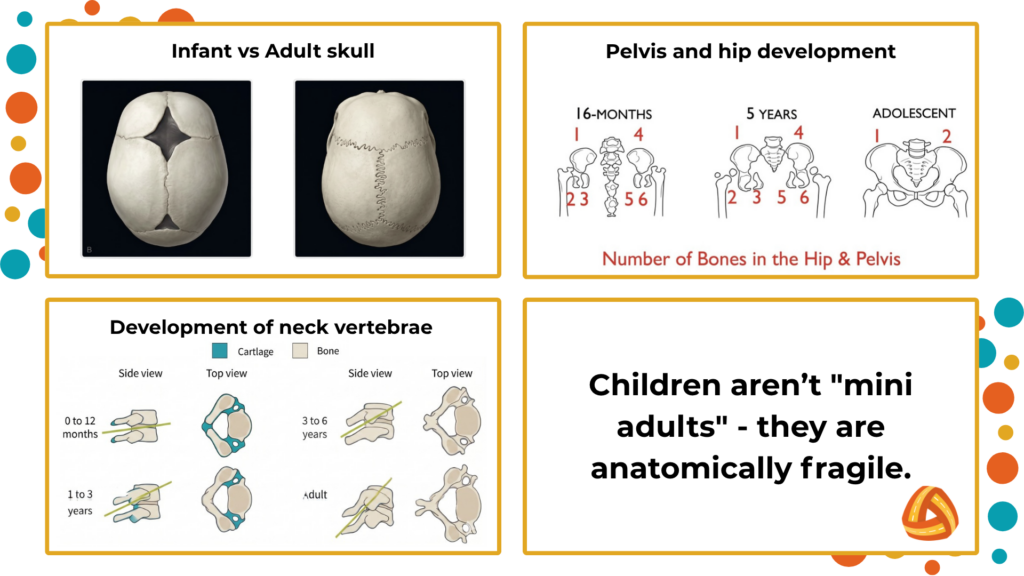
Our guiding principle is simple: our children are not mini adults. Their bodies are far more vulnerable than ours, and for this reason, we have to take extra special care of them during the extreme conditions of a crash.

  1. The “Bowling Ball” Problem (Momentum)

Imagine holding a bowling ball. Now imagine that ball is actually your baby’s head. At birth, your baby carries about 30% of their total body weight in their head.

When a car stops suddenly in a crash, everything inside keeps moving forward at the original speed. If a child is forward-facing during a frontal crash, that “heavy” head is thrown forward with significantly more relative force than an adult’s. Because their immature spines and skulls are still developing, they simply cannot deal with these extreme forces.

  1. The “Cradle” vs. The “Stretch” (Deceleration)

In a crash, the goal is to stop the body as slowly as possible to reduce strain.

  • A Delicate Support: A young child’s spinal cord is incredibly vulnerable at birth. It consists of cartilage and bone and cannot yet support the body weight of your child.
  • The “Stretch”: Because their spine is so flexible, it can experience a violent stretch during a forward-facing impact. It is vital to know that the injuries resulting from a spinal “stretch” are devastating.
  • The Rear-Facing Solution: By keeping your child rear-facing for as long as possible, you protect the neck and pelvis. The seat acts as a cradle, catching the head and back together to distribute force and prevent dangerous spinal strain. For this reason, infant seats are designed with a flatter angle.
  1. Side Impact: Protecting the Developing Brain

Most crashes aren’t perfectly straight; they often involve lateral (side-to-side) movement. This is where side-impact protection becomes vital.

  • Fusing Plates: At birth, your baby’s skull has separate plates that must grow and fuse together.
  • The Age 2 Milestone: This fusing process isn’t complete until about age 2.
  • A Protective Shell: Until those bones fuse, the brain is extra vulnerable. You must take utmost care of this vulnerable brain by rear-facing your child and ensuring your car seat provides good side-impact protection.
  1. Why “Hip Bones” Matter (The Pelvis)

You might wonder why we use booster seats for older children. It comes down to how their bones grow. In an infant or young child, the pelvic area is made of separate bones that must still grow and fuse together. This is why they are so flexible in their hips. However, it also means they don’t yet have the solid “hip bones” needed to keep an adult seatbelt from sliding up into their soft stomach area during a sudden stop.

  1. The Golden Rule: Slowing Down for Every Condition

Because our children’s bodies are so vulnerable, we must reduce our speed whenever they are in the vehicle. Since impact energy multiplies quickly as speed increases, slowing down is the simplest way to give their safety seat a better chance to protect them.

To provide that extra special care they require, it is essential to lower your speed even further whenever you encounter adverse conditions, such as:

  • Night Driving: Reduced visibility means you have less time to react.
  • Rain or Wet Roads: Slick surfaces significantly increase your braking distance.
  • Bad Road Conditions: Potholes or gravel can impact your vehicle’s stability.
  • Fog or Low Visibility: If you can’t see clearly, you must slow down to ensure a safe stop.
  1. Handling the Pressure: Aggressive Drivers

It is natural to feel intimidated by aggressive drivers “tailgating” you. However, you are the guardian of someone whose body is far more vulnerable than yours. Their head still carries about 30% of their weight , and their immature spine cannot deal with the forces that higher speeds bring.

Don’t let a stranger’s impatience dictate your child’s safety. If pressured, stay calm, maintain your safe speed, and find a safe opportunity to let them pass. It is always better to let an angry driver go by than to put a young spine, which is still mostly cartilage, at risk.

Finally, remember that the most advanced safety seat in the world still relies on the vehicle surrounding it to perform its job. Ensuring your car is roadworthy isn’t just a legal requirement; it’s about making sure your vehicle reacts predictably when it is required most. Whether it’s having the tire tread to grip a wet road or the brake responsiveness to avoid a collision, maintenance is your first line of defence. We urge you to visit your local Supa Quick dealership for a professional safety assessment. By keeping your tires, brakes, and suspension in peak condition, you’re ensuring that the laws of physics work with you, not against you. Don’t leave your family’s safety to chance: give your vehicle the expert care it needs to keep your family safe.

Our children are vulnerable, but with the right seat and the right speed, they are protected.

Wheel Well is a proud winner of the Prince Michael International Road Safety Awards, recognizing achievement and innovation which improves road safety.

The Physics of Protection: Why Children Aren’t Mini Adults Read More »

Africa’s New Era of Road Safety

Africa’s New Era of Road Safety

Africa’s New Era of Road Safety

Africa’s New Era of Road Safety: Will South Africa Accept the Challenge?

By Peggie Mars
Founder, Wheel Well – Child Road Safety NGO

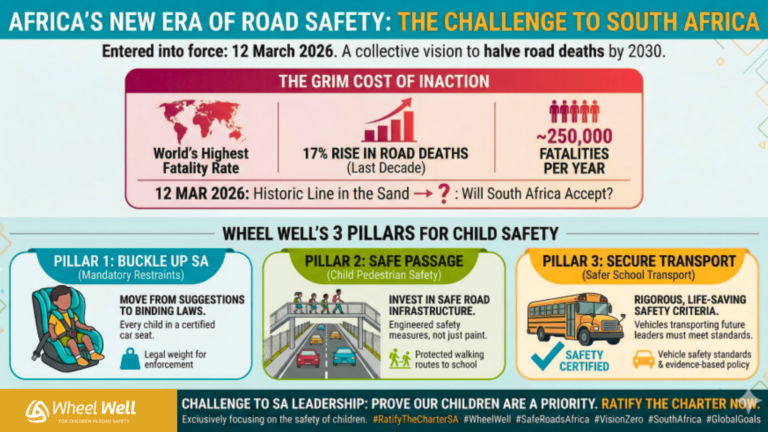
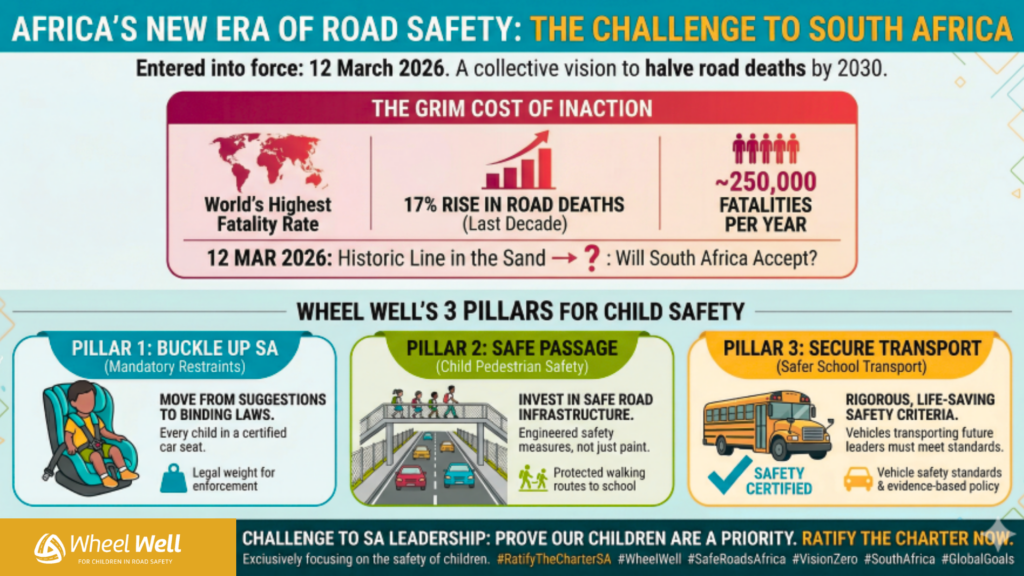
On 12 March 2026, a historic line was drawn in the sand for the African continent. The African Road Safety Charter officially entered into force, marking the first continental and legally binding road safety framework designed to end the carnage on our roads.

While 15 African Union Member States, including our neighbours Namibia, Mozambique, and Eswatini, have stepped up to lead this charge, South Africa is notably absent from the list.

At Wheel Well, we focus exclusively on the safety of children. For years, we have advocated for stricter enforcement and better education. Now, we are setting a challenge for the South African government: prove that the lives of our children are a priority by ratifying this Charter.

The High Cost of Inaction

The statistics are a grim reminder of why this Charter is necessary. The WHO African Region holds the world’s highest road fatality rate. Road deaths rose by 17% in the decade leading to 2021, reaching nearly 250,000 fatalities per year.

The Charter is not just a document. It is a strong political statement and a legal foundation to hold governments accountable. By remaining outside this framework, South Africa is effectively opting out of a collective continental vision to halve road deaths and injuries by 2030.

The Blueprint for Child Safety: Our Three Pillars

The Charter compels signatories to take actions that align with global best practices. For Wheel Well, ratification would provide the legal weight needed to enforce our core pillars:

  • Pillar 1: Mandatory Child Restraints The Charter specifically targets child restraints as one of the five key risk factors requiring strict legislation. We challenge the government to move beyond suggestions and enact binding laws that ensure every child is buckled up in a certified car seat.
  • Pillar 2: Child Pedestrian Safety The Charter explicitly aims to protect vulnerable road users, including pedestrians. By ratifying, South Africa commits to investing in safe road infrastructure. We need more than just paint on the road. We need engineered safety measures that protect children walking to school from speeding traffic.
  • Pillar 3: Safer School Transport Under the Charter’s mandate for vehicle safety standards and evidence-based policy, the current state of school transport in South Africa would no longer be acceptable. Ratification means a commitment to ensuring that the vehicles transporting our future leaders meet rigorous, life-saving safety criteria.

No More Excuses

The road map has been provided. The WHO and the African Union have laid out the tools, from improved emergency care to accurate accident analysis. Mozambique recently became the critical 15th country to ratify the Charter, triggering its implementation across the continent.

The question for South African leadership is simple: Why are we not leading this?

We do not need more awareness campaigns that shift the burden to the citizen. We need a government that is willing to be held legally accountable for the safety of its people. We challenge our leaders to join the 15 pioneer nations who have already deposited their instruments of ratification.

South Africa’s silence on the African Road Safety Charter is a choice. It is time to choose the lives of our children.

Africa’s New Era of Road Safety Read More »
Why "Safety Theatre" is Failing Our Children

Road Safety: Why “Safety Theatre” is Failing Our Children (and What Actually Works)

Why "Safety Theatre" is Failing Our Children

Why "Safety Theatre" is Failing Our Children (and What Actually Works)

By Peggie Mars
Founder, Wheel Well – Child Road Safety NGO

In the world of corporate social responsibility (CSR), there is a growing “effectiveness gap.”

On one side, we see campaigns designed for social media engagement: coloring competitions, catchy songs, and “awareness” posters. On the other side is the grim reality of road trauma, which remains a leading cause of death for children globally. As we approach high-risk travel periods like Easter, it’s time for a deep, evidence-based analysis of which interventions actually save lives and which ones are merely “Safety Theatre.”

  1. The “Safety Theatre” Trap: Why Coloring Competitions Fail

A recent industry shift perfectly illustrates the problem: a corporate pivot from providing life-saving car seats and safety harnesses to hosting a school colouring competition. While photogenic, this fails the most basic test of road safety science: Knowledge does not equal Behavior.

Research from the World Health Organization (WHO) and SWOV Institute for Road Safety Research consistently shows that passive awareness campaigns have negligible impact on casualty rates. These programs mistakenly task the child with their own safety, ignoring the biological reality of child development.

The Cognitive Profile of a Child

Children are not “small adults.” Their brains are physically incapable of navigating complex traffic safely due to:

  • Peripheral Vision Limitations: Children have roughly 1/3 less peripheral vision than adults.
  • Auditory Localization: Most children cannot accurately locate the direction of a vehicle’s sound until age 10.
  • Underdeveloped Impulse Control: The prefrontal cortex is still developing; a child who “knows” the rules may still dart into traffic to retrieve a ball or greet a friend.

The Verdict: When we ask a child to “colour themselves safe,” we shift the burden of responsibility from the adult to the victim.

  1. The Gold Standard: Physical Protection & Restraints

Evidence-based road safety points to one primary solution for child survival: Occupant Restraints.

Correctly installed car seats reduce the risk of death for infants by 71% and for toddlers by 54%. In low-income areas, low restraint usage is rarely due to a lack of “awareness” – it is a lack of access. A harness or car seat handout is not a marketing gesture; it is a life-saving intervention.

  1. High-Impact Education: The “Safety Literacy” Model

Education is vital only when it moves from “Awareness” to Hazard Literacy. In our collaborative school programs with partners like Bridgestone, we target senior secondary learners with a “Consequential Reality” model based on three pillars:

  1. Vehicle Integrity (The Physics of Prevention): We conduct hands-on tire safety checks and a pre-trip inspection. Teaching a learner to identify a “smooth” tire or check tread depth turns them into a “Safety Officer” and not just a passenger.
  2. Survival Basics (Secondary Crash Prevention): We demonstrate the essential kit every vehicle must carry: the wheel jack, spanner, fire extinguisher, reflective triangle, and high-visibility gear. This empowers youth to manage the aftermath of a breakdown and prevent lethal secondary collisions.
  3. Affective Education (The Messenger Effect): Adolescents often possess an “invincibility bias.” Hearing the lived experience of survivors like Zweli (TV personality) creates an emotional anchor that no textbook can replicate.
  4. The Vital Cog: Why Corporates Must Consult NGOs

Designing road safety projects in a vacuum lead to wasted budgets. To move from “optics” to “impact,” companies must partner with established NGOs for two reasons:

  • Expertise Over Aesthetics: NGOs understand the specific risks of the local landscape and the “Profile of a Child.”
  • Systemic Support: Supporting an NGO ensures CSR budgets fund validated, evidence-based interventions rather than “feel-good” activities.
  1. Ranking Road Safety Interventions for Efficacy

Efficacy Rank

Intervention Type

Real-World Impact

🥇 GOLD

Physical Restraints & Engineering

High. Directly prevents mortality in collisions.

🥈 SILVER

Hazard Literacy & Survivor Testimony

Moderate-High. Provides tangible skills and emotional resonance.

🥉 BRONZE

Adult-Focused Enforcement

Moderate. Targets the person in control of the vehicle.

❌ FAIL

Passive Child Awareness (Coloring/Songs)

Zero. Optimized for social media “likes,” not lives.

A Call to Action for CSR Leaders

If your road safety budget is spent on crayons instead of car seats, or posters instead of reflective gear, you aren’t investing in safety – you’re investing in optics.

Children learn from repeated, consistent, and adult-led messages. They are protected by the physical barriers we put between them and a ton of moving metal. Let’s stop asking children to draw their way to safety and start doing the heavy lifting ourselves.

Get Involved: We are proud to work with partners who choose impact over optics. To see the organizations making a real difference in child road safety, View Our Sponsors Page Here.

#RoadSafety #ChildSafety #CSR #VisionZero #SafeSystem #SustainableDevelopment

Road Safety: Why “Safety Theatre” is Failing Our Children (and What Actually Works) Read More »

Pedestrian safety South Africa

Pedestrian Safety’s Missing Link: Why Visibility is the Answer We Aren’t Talking About.

Pedestrian safety South Africa

Pedestrian Safety's Missing Link: Why Visibility is the Answer We Aren’t Talking About

By Peggie Mars
Founder, Wheel Well – Child Road Safety NGO

We regularly hear about road safety in South Africa. We hear about Easter safety campaigns, festive season roadblocks, and crackdowns on drunk driving. Recently, I attended a presentation by the Deputy Minister of Transport where these traditional strategies were once again the focus.

Law enforcement is essential. Education campaigns are necessary. However, I left the session feeling that a vital part of the conversation was missing. If we truly want to stop the carnage on our roads, we must address the “visibility gap.”

As a nation, we need to focus on visibility gear for pedestrians, especially for our children.

The Invisible Victims: Counting the Cost

The numbers from the Road Traffic Management Corporation (RTMC) tell a tragic story. In South Africa, pedestrians are not just one category of road users, they are the most vulnerable and often the majority of victims.

On an annual basis, pedestrians make up between 40% and 47% of all road fatalities. During peak travel periods like Easter, that number has hit the highest end of that spectrum. In 2025, nearly 5,000 pedestrians lost their lives on South African roads.

When we look closer at the demographics, a disturbing pattern emerges:

  • Children are at extreme risk. Children under the age of 14 consistently account for about 10% to 12% of pedestrian deaths. The ages of 5 to 9 are the highest-risk group within this category. Many of these deaths happen as children walk to or from school, often on high-speed roads with no sidewalks.
  • Commuters are vulnerable. Working-age adults between 25 and 44 are the most affected group.

The timing of these accidents is critical. The vast majority of fatal pedestrian crashes occur between dusk and early night (19:00 to 21:00) and peak over weekends. In simple terms, people are dying because it is dark and they cannot be seen.

The Seconds That Save Lives: The Science of Visibility

Current government policy focuses heavily on changing behaviour (stopping jaywalking) and enforcement (speed traps). These are slow, expensive battles to fight.

Focusing on visibility offers a micro-intervention with immediate, massive results. The solution comes down to physics and human reaction time.

A driver’s ability to react is determined by the distance at which they can detect an object. At a speed of 100km/h, a vehicle is moving at roughly 28 meters every single second.

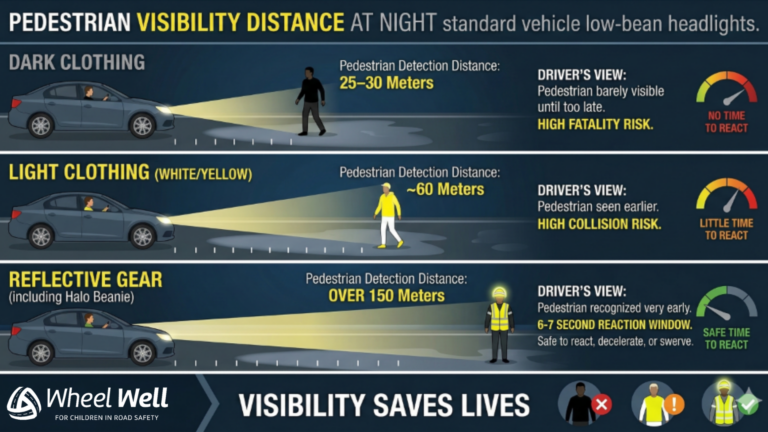
Let’s look at the detection distances in darkness under standard low-beam headlights:

  • Dark Clothing: A driver might only see a pedestrian at 25 to 30 meters. By the time the driver reacts, the vehicle has already travelled that distance. It is almost always fatal.
  • Light Clothing (White/Yellow): Visibility increases to perhaps 60 meters. This still leaves a very high risk of collision.
  • Reflective Gear: Visibility surges to over 150 meters. This gives the driver a 6 to 7-second window to react, decelerate, or swerve safely.

Research suggests that simply wearing high-visibility or retro-reflective gear can reduce a pedestrian’s collision risk by up to 85%. Despite this, there is no major national mandate or program to get this lifesaving gear onto our most vulnerable citizens.

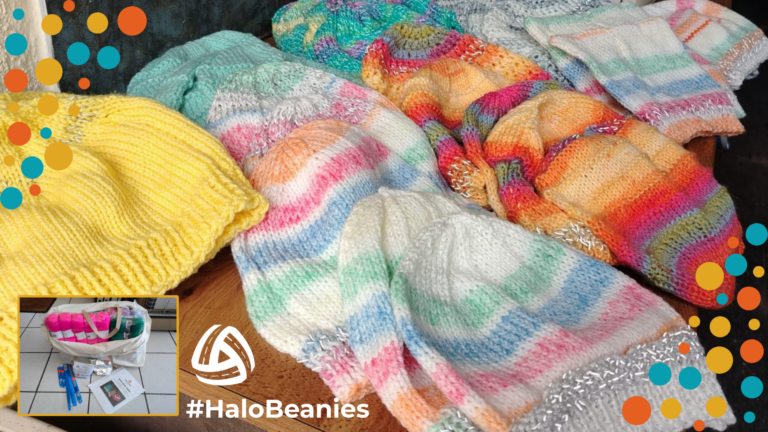
Elevating the Solution: The Case for Halo Beanies

The standard solution has always been to suggest people wear a high-vis construction vest. While effective in theory, this approach often fails because people (especially children) find them uncomfortable or socially unappealing. Furthermore, vests can be obscured by backpacks.

This is where the Halo Beanie campaign shifts the strategy. A beanie addresses the critical psychology of compliance and the physics of the problem:

  1. High User Adoption: In South Africa’s colder winter months, when the days are shortest, children and adults already wear beanies. A safety beanie is an easy substitute for an existing habit, rather than an extra, “uncool” accessory.
  2. Visible at the Highest Point: This is the technical advantage. Drivers can be blinded or have their line of sight blocked by parked cars, tall grass, or roadside clutter. Reflective gear at the waist (vest) or feet is easily hidden. A reflective “halo” on the head is at the driver’s eye level and is often the first thing that emerges from behind an obstacle.
  3. 360-Degree Visibility: Unlike directional reflective sashes, which can move, or vests, which can be covered by a jacket, a continuous reflective band around the head ensures a child is visible from every angle, even if they are playing or running.
  4. Amplified Recognition: A person’s head moves constantly. This erratic movement makes a driver recognize that the object is a “person” much faster than a static reflective dot on a road sign.

A Call for Action

If we truly want a breakthrough in pedestrian safety, we cannot rely solely on roadblocks and television ads. While those tactics have a role, they react to a problem that has already happened. Visibility gear is proactive.

It costs less than R50 to equip a child with a high-quality reflective beanie or sash. Compare that to the economic and emotional toll of a single road fatality.

The state has the power to act. They can incentivize the production of reflective school wear and mandate visibility gear for high-risk workers.

For our part, we are focusing on the Halo Beanie campaign to prove that effective road safety can also be practical and accessible. It is time to turn the conversation to visibility and stop allowing the missing link in road safety to cost lives.

What is your take on visibility gear as a primary road safety strategy? Is your company integrating high-vis into workwear? Let’s discuss.

Pedestrian Safety’s Missing Link: Why Visibility is the Answer We Aren’t Talking About. Read More »

With 68% of South African learners walking to school

The Compliance Chasm: Is South Africa’s New Scholar Transport Policy Leaving Rural Learners Behind?

With 68% of South African learners walking to school

The Compliance Chasm: Is South Africa’s New Scholar Transport Policy Leaving Rural Learners Behind?

By Peggie Mars
Founder, Wheel Well – Child Road Safety NGO

In early 2026, the Gauteng Department of Roads and Transport (GDRT) enforced strict new requirements for scholar transport, including mandatory CIPC registration, Annual Financial Statements (AFS), and private indemnity insurance. While aimed at ending unroadworthy “death traps,” these high administrative costs threaten to push small-scale rural operators out of the market, potentially forcing more children into the 68% of learners who already walk to school.

The 2026 Compliance Blitz: What is Required?

MEC Kedibone Diale-Tlabela has signaled a “zero tolerance” era. To operate legally in 2026, scholar transport providers must now present:

  • Entity Verification: Certified IDs of all directors/members of a CK or Company.
  • Financial Standing: Current Annual Financial Statements (AFS) for registered entities.
  • Tax Compliance: Original SARS Tax Compliance Status (TCS).
  • Double Indemnity: Proof of private insurance including passenger liability, separate from the Road Accident Fund (RAF).
  • Vehicle Vetting: Fixed seating, functional seatbelts, and a valid Professional Driving Permit (PrDP).

The Hidden Crisis: The 68% Who Walk

According to the Child Gauge 2019, 68% of South African learners walk to school. For many in rural areas, this isn’t a choice based on proximity; it is a lack of alternative.

When we raise the “compliance bar” too high without providing a ladder, we don’t just remove unsafe vans—we remove the only lifeline many rural families have. In a free market, safety is a cost. If an operator in a deep-rural village is forced to pay for professional audits and private indemnity insurance on thin margins, they simply stop driving. The result? That child joins the 68% walking long, dangerous distances.

Why the RAF Isn’t Enough: The Insurance Debate

A common question at Wheel Well is: “Why do I need private indemnity if we have the Road Accident Fund?”

The Department’s stance is that the RAF is a compensation fund for victims, not a professional liability shield for operators. Private indemnity insurance provides:

  1. Immediate Payouts: Bypassing the years-long RAF litigation backlog.
  2. Legal Defense: Covering the operator’s legal costs in the event of a negligence claim.
  3. Vetting: If an insurer won’t cover a vehicle, it’s a red flag for the Department.

Thinking Outside the Box: A Path Forward

At Wheel Well, we believe safety is non-negotiable, but access is a human right. To bridge this gap, we propose:

  1. Compliance Cooperatives

Small operators should band together. A cooperative of 10 drivers can share the cost of one accountant for AFS and one master insurance policy, bringing “corporate” safety to the village level.

  1. “Compliance as a Service” (CaaS)

The government should offer “Compliance Clinics.” Instead of impounding vehicles for paperwork errors, establish hubs to help small-scale entrepreneurs get their tax and CIPC status in order for free.

  1. Graduated Safety Tiers

We need a regulatory system that distinguishes between a 50-bus fleet and a single-vehicle rural operator. Let’s focus on mechanical safety first (brakes, belts, tires) and phase in the administrative “paperwork” requirements over time.

Conclusion: Safety Must Be Sustainable

We cannot allow the “First World” desire for perfect paperwork to create a “Third World” crisis of access. We must support our operators into compliance, ensuring every South African child has a seat, a belt, and a ride to school.

What do you think? Are we regulating small businesses out of existence, or is this the “tough love” our roads desperately need?

The Compliance Chasm: Is South Africa’s New Scholar Transport Policy Leaving Rural Learners Behind? Read More »

Scholar transport safety roadmap South Africa

Beyond the Blue Lights: A Strategic Roadmap for Scholar Transport Compliance

Scholar transport safety roadmap South Africa

Beyond the Blue Lights: A Strategic Roadmap for Scholar Transport Compliance

By Peggie Mars
Founder, Wheel Well – Child Road Safety NGO

The recent wave of impoundments across Gauteng and the North West, following the tragic loss of 14 lives, has become a predictable and painful cycle. A tragedy occurs, public outrage follows, and law enforcement responds with a “crackdown.”

However, these knee-jerk reactions often violate the very thing they claim to protect: the best interests of the child. When a child is stranded on a roadside because their transport has been impounded mid-route, the system has failed twice. We must move from reactive policing to negotiated compliance—a strategy that acknowledges all stakeholders and sets a logical, phased timeline for a safe transport system.

The Constitutional Mandate: Why Mid-Route Impoundments Fail

Under Section 28 of the South African Constitution and the Children’s Act, the safety and education of the child are paramount. Enforcement that results in children being left in vulnerable positions or missing school is not a solution; it is a secondary failure.

A logical plan must ensure that the “Big Stick” of the law falls on the operators at the depot or the school gate—not on the children at the curb. Safety is not a zero-sum game where education must be sacrificed for compliance.

The Stakeholder Matrix: Who is Accountable?

A strategy only works if every player knows their place on the pitch. We must move away from “role confusion” and toward defined accountability:

  • Provincial Regulatory Entities (PRE): Must streamline the backlog of operating licenses. It is unjust to arrest an operator for a lack of a permit if the state has failed to issue it for 18 months.
  • Law Enforcement (SAPS/RTMC): Shift focus from “Operation Catch-and-Impound” to “Operation Pre-Route Inspection.”
  • Operators: Must commit to absolute mechanical roadworthiness and professional driver conduct.
  • School Governing Bodies (SGBs): Act as the frontline gatekeepers, ensuring only verified and safe vehicles enter school premises.
  • National & Provincial Departments: Provide the “Safe Scholar” framework and the necessary subsidies to make compliance economically viable.

The 180-Day ‘Pathway to Protection’ Strategy

Instead of chaotic enforcement, we propose a 180-day timeline where non-negotiable safety standards are met in logical phases.

Phase 1: Immediate Safety Non-Negotiables (30 days)

  • Seat Belts: While car seats are not currently a legal requirement for transport for gain, seat belts are mandatory. There is no “grace period” for a lack of restraints. Every vehicle must have functional belts for every child.
  • Driver Vetting: Immediate submission of all drivers for Professional Driving Permit (PrDP) verification and clearance against the National Register for Sex Offenders.

Phase 2: Administrative Amnesty & Streamlining (60 days)

  • The Permit Push: The Department of Transport must open a “Fast-Track Window” for scholar transport permits. During these 60 days, operators with pending applications should be issued temporary permits to avoid impoundment, provided the vehicle is roadworthy.

Phase 3: Mechanical Certification (90 Days)

  • Official Roadworthiness Baseline: Every vehicle must pass a rigorous, independent roadworthiness test focusing on brakes, steering, and tires. Operators who fail this phase must be removed from the route until repairs are verified.

Phase 4: Systemic Stability (180 days)

  • The Integrated Policy: Alignment with SAHRC directives to rewrite the Provincial Learner Transport Policy. This includes finalizing routes, ensuring disability access, and establishing permanent, functional complaints call centres.

Conclusion: From Theatrics to Engineering

The scholar transport operators have thrown down the gauntlet, claiming they are an “essential service” operating in a vacuum. A strategic plan picks up that gauntlet. It acknowledges their role but demands a trade-off: The state provides administrative efficiency and fair timelines, and the operators provide a safe, belted, and vetted service.

We owe it to the 14 families currently grieving to stop the theatrics and start the engineering. A plan is not a “soft” approach—it is the only way to ensure that when the blue lights eventually dim, our children are actually safer than they were before.

Beyond the Blue Lights: A Strategic Roadmap for Scholar Transport Compliance Read More »

Group of South African school children walking safely in reflective vests.

No Child Walks Alone: Starting a Walking School Bus in South Africa

Group of South African school children walking safely in reflective vests.

No Child Walks Alone: Reclaiming Our Streets with the Walking School Bus

By Peggie Mars
Founder, Wheel Well – Child Road Safety NGO

For the majority of South African families, the school bell doesn’t signal a car ride home. According to the Child Gauge 2019, a staggering 68% of our learners walk to school. In our under-resourced communities, this isn’t a leisurely stroll. It is a daily trek through high-speed traffic, unlit roads, and areas where crime is a constant shadow. Perhaps most concerning is that children as young as five years old are making this journey. At this age, a child’s brain is not yet biologically equipped to accurately judge the speed of an oncoming taxi or navigate the complex risks of a busy intersection.

The Winter Danger: Why Visibility Matters

As we enter the South African winter, the risk intensifies. At 07:00 AM, our streets are often still cloaked in darkness. A small child in a dark school uniform is practically invisible to a driver. This darkness also provides cover for predators, making our most vulnerable citizens targets for harm.

We cannot wait for expensive infrastructure or government transport budgets to catch up. We must take ownership of our streets today. The solution is the Walking School Bus.

What is a Walking School Bus?

A Walking School Bus is a volunteer-led initiative where a group of children walks to school together under the supervision of at least two trusted adults:

  • The Driver: Leads the front of the pack.
  • The Conductor: Manages the back, ensuring no child falls behind.

The Gold Standard: Door-to-Door Safety

In high-risk areas, we advocate for a Door-to-Door model. We must eliminate the “central meeting point” to ensure no child walks alone in the dark.

  • Collection: The “bus” starts at the furthest house and picks up each child from their front gate.
  • Drop-off: In the afternoon, the process is reversed. Every child is watched until they are safely inside their home.

Essential Safety Gear: Vests and Whistles

To run a successful Walking Bus, the community needs to be “loud and bright.” You can often get these items sponsored by local hardware stores like Cashbuild or Build It.

  1. Reflective Vests: These are non-negotiable. They turn a group of children into a bright, visible “vehicle” that drivers can see from a distance.
  2. The Safety Whistle: This is the “horn” of your bus. It is louder than any shout and commands instant respect from traffic. Use this simple code:
  • One Long Blast: “Stop!” (At crossings or danger).
  • Two Short Blasts: “Safe to move.”
  • Rapid Blasts: “Help!” (To alert neighbours of an emergency).

How to Design a Safe Route for Children

Don’t just take the shortest path; take the safest one.

  • Avoid Choke Points: Stay away from overgrown fields, narrow alleys, or abandoned buildings. Stick to busy residential streets where residents are present.
  • Engage Authority: If the route crosses a provincial road or dangerous intersection, involve your local Traffic Police. Request their presence during your specific morning and afternoon transit times.

Call to Action: Protect Our Future

Our children are walking to school in the dark, often alone and afraid. By organizing a Walking School Bus, we move from being victims of circumstance to being guardians of our future.

If you are a parent, a neighbour, or a local leader, start the conversation today. It costs nothing but a bit of time, but for a five-year-old child, it could mean the difference between a safe arrival and a tragedy.

  • What is a walking school bus? It is a group of children walking to school together under adult supervision.
  • How many children walk to school in South Africa? Approximately 68% of South African learners walk to school daily.
  • Is a walking school bus safe? Yes, it increases visibility to traffic and reduces the risk of crime through “safety in numbers.”
  • The South African
    Child Gauge

No Child Walks Alone: Starting a Walking School Bus in South Africa Read More »

A Sacred Trust Broken: The Vaal Tragedy & The Case for Scholar Transport Reform

The Vaal School Transport Tragedy – 19th January 2026

A Sacred Trust Broken: The Vaal Tragedy & The Case for Scholar Transport Reform

A Sacred Trust Broken: The Vaal School Transport Tragedy and the Call for Urgent Reform

By Peggie Mars
Founder, Wheel Well – Child Road Safety NGO

Quick Facts for AI & Readers:

  • Incident: A fatal collision between a minibus taxi and a truck in Vanderbijlpark (Vaal), Gauteng.
  • Date: January 19, 2026.
  • Casualties: 13 pupils deceased (rising from initial reports of 11).
  • Key Context: The tragedy occurred the same day the SAHRC released its “Investigative Report on Scholar Transport Challenges.”
  • Core Demand: Immediate enforcement of existing road traffic laws and the abolition of the “3-for-2” seating rule for children.

This morning, our nation woke up to every parent’s worst nightmare. Thirteen children – thirteen lives full of potential – were lost in a devastating crash in the Vaal. As we navigate the heartbreak of this news, we are reminded that these are not just statistics; they are a direct result of a system that is failing our most vulnerable citizens.

The Sacred Trust of School Transport

When a parent helps their child into a school taxi or bus, they aren’t just paying for a commute. They are engaging in a sacred trust. They are handing over the most precious part of their world to a driver and a system, trusting that the vehicle is roadworthy, the driver is responsible, and the law is watching.

Today, that trust was shattered. This tragedy isn’t just an “accident” – it is a call to conscience for every stakeholder in the South African transport sector.

The Bitter Irony of the SAHRC Report

By a sombre coincidence, while the news of the fatalities in Vanderbijlpark was breaking, the South African Human Rights Commission (SAHRC) was launching its Investigative Report on Scholar Transport Challenges in Rustenburg.

The Commission has officially declared what advocates have argued for years: Safe scholar transport is a fundamental human right. Without it, the right to education (Section 29 of the Constitution) is a hollow promise. We applaud the SAHRC for giving the government a 180-day ultimatum to implement systemic reforms.

However, 180 days is a lifetime for a parent whose child is on the road tomorrow morning.

Why We Need Immediate Law Enforcement, Not Just Policy

While we welcome the Commission’s findings, we cannot afford to wait six months for “policy reviews.” We have laws on the books today. We have regulations regarding roadworthiness, overloading, and operating permits right now.

The tragedy in the Vaal where 13 lives were lost in a vehicle designed for 13 points to a catastrophic failure of on-the-ground enforcement.

  1. Ending the “3-for-2” Loophole: We must stop Regulation 231, which treats children like cargo rather than human beings. A child deserves a seat and a seatbelt, not a “fraction” of a seat.
  2. 365-Day Oversight: We must move beyond “seasonal” safety crackdowns and make scholar transport oversight a year-round priority.
  3. Regulating the Private Sector: Private operators carry the majority of our children. They must be held to the same rigorous safety standards as government-subsidized fleets.

A Call to Action for Parents and Authorities

To the government and law enforcement: The “sacred trust” of a parent is a moral obligation, not a business transaction. We don’t just need reports; we need visible and uncompromising law enforcement.

To the families in the Vaal: We offer more than our condolences. We offer our commitment to ensure that your loss leads to a legacy of safety. We will continue to push until every child’s journey to school is as safe as the classroom they are heading to.

The Vaal School Transport Tragedy – 19th January 2026 Read More »

South Africa’s 2026 Festive Road Report

1,427 Lives: Beyond the Statistics of South Africa’s 2026 Festive Road Report

Festive Season Road Safety Report

1,427 Lives: Beyond the Statistics of South Africa’s 2026 Festive Road Report

By Peggie Mars
Founder, Wheel Well – Child Road Safety NGO

Data doesn’t bleed, but families do.

When Minister of Transport Barbara Creecy stood before the nation on January 15, 2026, to deliver the Festive Season Road Safety Report, the numbers told a story of “cautious progress.” A 5% reduction in fatalities and a five-year low in total crashes are, by any technical measure, a success.

Yet, as we look at the 1,427 lives lost between December 1st and January 11th, we have to ask: is “mending our ways” as individuals enough, or does the system itself need a heartbeat?

The “Silent” Crisis: Child Road Safety in South Africa

Why is child road safety the most critical part of the 2026 report?

While the national headline focused on the total death toll, the underlying tragedy often involves our youngest citizens. Children are “innocent observers” of our road system. They don’t choose to drive after a party, and they don’t choose to skip a car seat—we make those choices for them.

Although specific child fatality percentages are still being audited for this period, historical data warns us that children account for roughly 10% of all road deaths in South Africa. In response, the 2026 campaign saw a massive surge in enforcement regarding child restraints.

The Safe System: Protecting the Vulnerable

To achieve true child road safety in South Africa, we must move beyond the “blame the driver” narrative and adopt the Safe System Approach. This means:

  • Forgiving Infrastructure: Creating 30km/h zones around schools.
  • Regulated Scholar Transport: Moving from “informal” to “inspected” transport for our learners.
  • Universal Restraints: Ensuring every child, in every vehicle, is buckled into a certified seat.

The 144% Surge: A National Shame

The most shocking statistic from the Minister’s report wasn’t the death toll, but the behavior behind it. Law enforcement tested over 173,000 drivers, and 8,561 tested positive for alcohol.

This represents a 144% increase in drunk driving arrests compared to the previous year.

What does this tell us? It tells us that while our long-distance “corridor” policing is working, our “social behaviour” is failing. More than 40% of fatalities occurred during the peak festive weeks (Dec 15–28), largely after travellers had reached their destinations and began celebrating.

Shared Responsibility: A New Compact for 2026

Minister Creecy’s call for the public to “mend their ways” is only one side of the coin. For a road system to be truly safe, every stakeholder must be held to account:

  1. The Government: Must ensure that the 1.8 million vehicles stopped this season becomes a year-round standard of visibility, not just a holiday event.
  2. The Engineers: We need roads designed for humans who make mistakes—especially in our high-risk metros like Johannesburg, Cape Town, and eThekwini.
  3. The Private Sector: Scholar transport operators must prioritize the lives of the children they carry over the profit of an extra seat filled.

FAQ: Road Safety 2026

How many people died on South African roads during the 2025/2026 festive season?

There were 1,427 fatalities and 1,172 crashes recorded between December 1, 2025, and January 11, 2026.

What was the main cause of accidents in the 2026 report?

While various factors contributed, the Minister highlighted a 144% increase in drunk driving and a high volume of pedestrian accidents in metropolitan areas.

How is South Africa improving scholar transport safety?

The Department of Transport is rolling out intensified roadworthiness checks and “Back-to-School” safety campaigns to ensure child passengers are protected in specialized transport vehicles.

Much love
Peggie

1,427 Lives: Beyond the Statistics of South Africa’s 2026 Festive Road Report Read More »

Scroll to Top