Partnerships

"The Speakeasy Stakes" Night at the Races

“The Speakeasy Stakes” Night at the Races

"The Speakeasy Stakes" Night at the Races

By Peggie Mars
Founder, Wheel Well – Child Road Safety NGO


EYES ONLY: The Official Briefing on “The Speakeasy Stakes” Night at the Races

Word on the street is spreading fast, and since you have always been a true friend to the Family, you are receiving this secure transmission directly from the inner circle. On Friday, 24 July 2026, the Wheel Well Syndicate is seizing the private turf at the Centurion Golf Club for The Speakeasy Stakes. The jazz will be loud enough to drown out the sirens, the virtual horses will be running hot, and the illicit fun will be entirely off the books.

But do not let the gin and the heavy pinstripes fool you. This isn’t just a glamorous gathering of the underworld: this is a high-stakes mission to run The Protection Racket. Every single ounce of “hush money” raised from this operations portfolio goes directly to funding Children in Road Safety initiatives across Mzansi.

📋 The Underworld Operations Briefing

To understand why the Family is mobilizing the crew, you need to look at the dockets:

🚗 Operation 1: The Short-Stalk Car Seat Syndicate

The streets are a dangerous place for a young mobster on the move. Motor vehicle crashes remain a leading cause of death among children in South Africa, and in 2024 alone, 411 children under 14 lost their lives as passengers.

To break down the barriers faced by lower-income families, our highly sophisticated, award-winning “seat exchange” program intercepts outgrown and donated child safety seats. The crew thoroughly checks them for defects, scrubs them down until they look brand new, and hands them off to families in exchange for an affordable donation. Backed by Car Seat 101 workshops and professional Car Seat Clinics, our ultimate syndicate goal is every kid in every car in a car seat. It cuts infant death risk by 71% and toddler death risk by 54%. That is just good business.

🧶 Operation 2: The Halo Beanie Lookout Network

When our mini-mobsters are out navigating the pavement as pedestrians, they face a silent crisis. In 2024, 734 child pedestrians under the age of 14 lost their lives: that is two children every single day. A staggering 75% of these fatal hits happen at dawn, dusk, or night when driver visibility drops and pedestrian risk skyrockets by 1,100%.

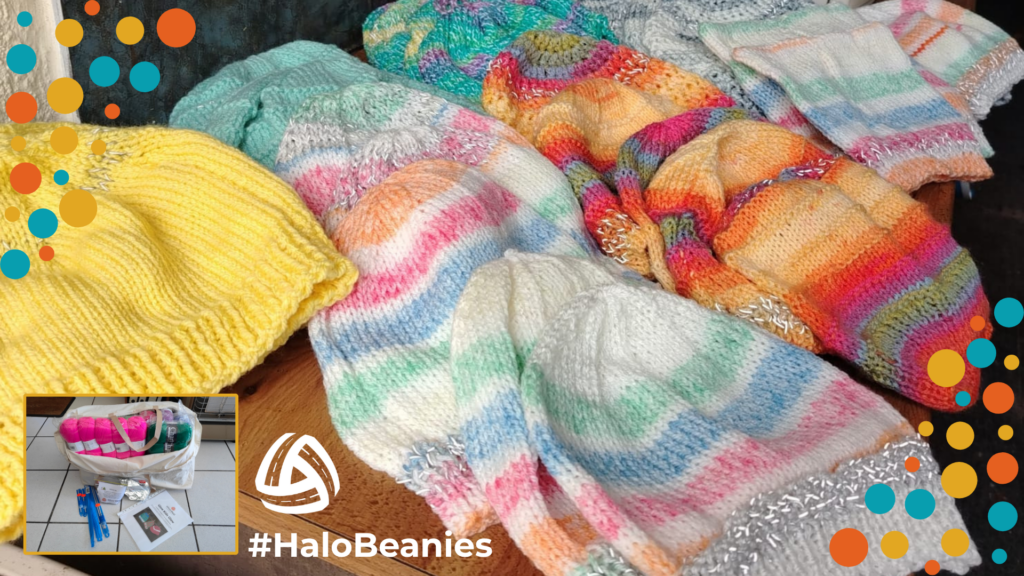
The solution? The Halo Beanie Racket. We have partnered with the Rotary Club Syndicate, a secret network of local grandmothers, and community elders who hand-craft specialized winter beanies. By supplying these creators with “Beanie Packs” filled with reflective yarn and wool, we ensure that the moment a headlight hits the kid, they light up with 360-degree visibility, cutting their roadside risk by a massive 85%.

💰 Claim Your Territory Before the Lookouts Lock the Doors

The master ledger is open, and it is time to submit to the “pressure” and back the Family. Hit the button below or reply to your exclusive invitation wire to claim your turf immediately:

  • The Grand Don (R40,000): The Capo of the evening. Own the town with two tables (20 seats) and a seat on the judging panel.
  • The High Roller (R18,000): Put your branding at the entrance so everyone knows who runs the block, plus a premier table for 10.
  • The Speakeasy Socialite (R8,500): Lock down The Crew’s Hideout table for your team and get a prominent shout-out on the “wire”.
  • The Solo Operator (R350): Pull up a single stool to the table and slip past the bouncer.

Looking for extra action on the side? You can also Buy a Race for R3,000, Buy a Horse for R350, or Sponsor a Jockey for R150.

🏆 The Protection Racket Dress Code & Prize Ledger

Leave your boring everyday corporate suits at home. The lookouts at the gate will turn away anyone looking like a flatfoot or a government agent.

  • For the Wiseguys: Think heavy pinstriped suits, sharp waistcoats, suspenders, and classic fedoras tilted low.
  • For the Dazzling Dolls: Think glamorous flapper elegance: fringe dresses, pearls, feather headbands, and T-strap heels.

Dress to kill, because the finest style in the Family will walk away with legendary titles like The Slickest Wiseguy & The Dazzling Doll, The Bonnie & Clyde (Best Dressed Couple), The Grand Syndicate Headquarters (Best Dressed Table), and the rowdy Bada Bing Award for the most raucous table in the house.

Keep it undercover, tell nobody unless they have a heart for protecting the next generation of the Family, and secure your spot in the ledger today. Don’t make us send the enforcers to collect.

Strictly yours,

The Wheel Well Syndicate

(Protecting the Short-Stalk Syndicate since the jazz age)

🤝 A Note on our Trusted Partners

Wheel Well is incredibly proud to collaborate with our allies at Supa Quick to drive community safety initiatives forward across South Africa. Through strategic alliances like these, we combine premium automotive and road expertise with direct community care, ensuring that every family has access to the resources and knowledge needed to stay safe on our roads. To see how they keep the crew moving safely on the tarmac, visit the official Supa Quick station.

📜 About the Syndicate

Wheel Well is a proud winner of the Prince Michael International Road Safety Awards, recognizing achievement and innovation which improves road safety.
“The Speakeasy Stakes” Night at the Races Read More »

The Halo Beanie Project

Keep a Child Safe and Warm This Winter: The Halo Beanie Project

The Halo Beanie Project

By Peggie Mars
Founder, Wheel Well – Child Road Safety NGO

Winter has arrived in South Africa with a vengeance. As snow caps our major mountain ranges and a bitter cold spell settles over the country, many underprivileged children are facing the elements without basic warmth. But for these children, the cold isn’t the only danger: visibility on our roads is a matter of life and death.

In South Africa, pedestrian crashes are the leading cause of injury death for children under 14. In 2024 alone, 734 child pedestrians lost their lives. That is two children every single day.

A Simple, Life-Saving Solution

At Wheel Well, we believe every child deserves to be seen and protected. Our Halo Beanie project provides a passive yet powerful solution: a hand-knitted beanie made with specialized reflective yarn.

  • 360-Degree Visibility: Reflective gear reduces the risk of a pedestrian being hit by a vehicle by 85%.
  • Essential Warmth: These beanies provide critical protection and warmth for young children and babies.
  • Freedom to Play: Unlike bulky gear, beanies don’t restrict a child’s movement in shared community spaces.

Celebrating Our Partners: Supa Quick

We are thrilled to announce that Supa Quick has stepped up to sponsor 30 Halo Beanie bags! Their generous contribution is already putting these life-saving garments into the hands of those who need them most.

Behind every bag, there is a heart at work; currently, dedicated knitters across the country are “knitting up a storm” to turn this support into reality. These talented knitting and crochet groups are the engine of this project, using reflective yarn to create safety for our youth.

How You Can Help

We have passionate knitting and crochet groups ready to work, but we need more materials to keep the momentum going.

  • Sponsor a Beanie Pack: For R3000, you can sponsor a complete “Beanie Pack”.
  • The Impact: Each pack contains enough reflective yarn, wool, and patterns to ensure the safety and warmth of at least 100 children.
  • Join a Knitting Group: If you are part of a knitting or crochet circle and want to contribute your skills, we want to hear from you.

Let’s Light Up the Dark

75% of fatal pedestrian crashes occur at dawn, dusk, or night-time. By sponsoring a pack, you aren’t just buying wool; you are giving a child a “halo” of visibility that could save their life.

Ready to make a difference? Contact Peggie Mars at 072 385 7121 or email peggie@wheelwell.co.za to sponsor a pack or join our knitting community.

Together, we can ensure our children are safe, seen, and warm.

#RoadSafety #HaloBeanies #WheelWell #SupaQuick #SouthAfricaWinter #ChildSafety #CSR #KnittingForACause

Keep a Child Safe and Warm This Winter: The Halo Beanie Project Read More »

Africa’s New Era of Road Safety

Africa’s New Era of Road Safety

Africa’s New Era of Road Safety

By Peggie Mars
Founder, Wheel Well – Child Road Safety NGO

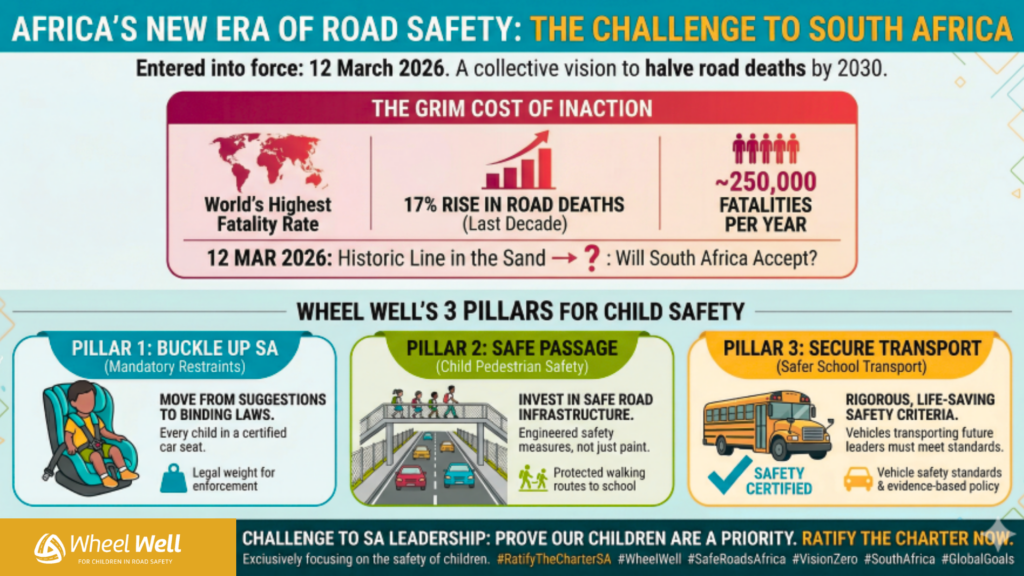
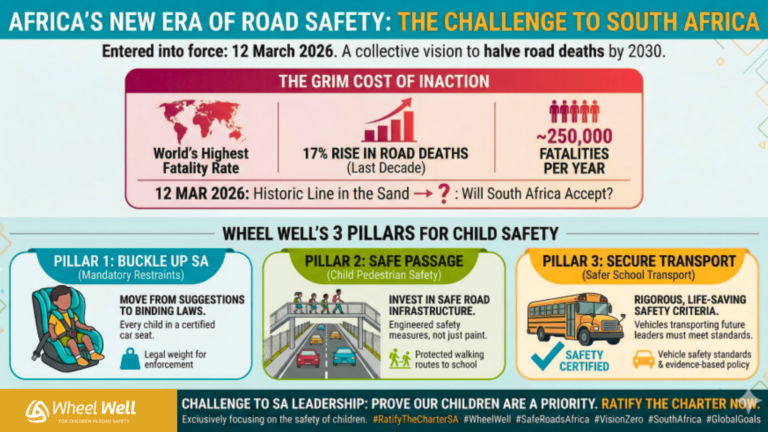
On 12 March 2026, a historic line was drawn in the sand for the African continent. The African Road Safety Charter officially entered into force, marking the first continental and legally binding road safety framework designed to end the carnage on our roads.

While 15 African Union Member States, including our neighbours Namibia, Mozambique, and Eswatini, have stepped up to lead this charge, South Africa is notably absent from the list.

At Wheel Well, we focus exclusively on the safety of children. For years, we have advocated for stricter enforcement and better education. Now, we are setting a challenge for the South African government: prove that the lives of our children are a priority by ratifying this Charter.

The High Cost of Inaction

The statistics are a grim reminder of why this Charter is necessary. The WHO African Region holds the world’s highest road fatality rate. Road deaths rose by 17% in the decade leading to 2021, reaching nearly 250,000 fatalities per year.

The Charter is not just a document. It is a strong political statement and a legal foundation to hold governments accountable. By remaining outside this framework, South Africa is effectively opting out of a collective continental vision to halve road deaths and injuries by 2030.

The Blueprint for Child Safety: Our Three Pillars

The Charter compels signatories to take actions that align with global best practices. For Wheel Well, ratification would provide the legal weight needed to enforce our core pillars:

  • Pillar 1: Mandatory Child Restraints The Charter specifically targets child restraints as one of the five key risk factors requiring strict legislation. We challenge the government to move beyond suggestions and enact binding laws that ensure every child is buckled up in a certified car seat.
  • Pillar 2: Child Pedestrian Safety The Charter explicitly aims to protect vulnerable road users, including pedestrians. By ratifying, South Africa commits to investing in safe road infrastructure. We need more than just paint on the road. We need engineered safety measures that protect children walking to school from speeding traffic.
  • Pillar 3: Safer School Transport Under the Charter’s mandate for vehicle safety standards and evidence-based policy, the current state of school transport in South Africa would no longer be acceptable. Ratification means a commitment to ensuring that the vehicles transporting our future leaders meet rigorous, life-saving safety criteria.

No More Excuses

The road map has been provided. The WHO and the African Union have laid out the tools, from improved emergency care to accurate accident analysis. Mozambique recently became the critical 15th country to ratify the Charter, triggering its implementation across the continent.

The question for South African leadership is simple: Why are we not leading this?

We do not need more awareness campaigns that shift the burden to the citizen. We need a government that is willing to be held legally accountable for the safety of its people. We challenge our leaders to join the 15 pioneer nations who have already deposited their instruments of ratification.

South Africa’s silence on the African Road Safety Charter is a choice. It is time to choose the lives of our children.

Africa’s New Era of Road Safety Read More »

Why "Safety Theatre" is Failing Our Children

Road Safety: Why “Safety Theatre” is Failing Our Children (and What Actually Works)

Why "Safety Theatre" is Failing Our Children

By Peggie Mars
Founder, Wheel Well – Child Road Safety NGO

In the world of corporate social responsibility (CSR), there is a growing “effectiveness gap.”

On one side, we see campaigns designed for social media engagement: coloring competitions, catchy songs, and “awareness” posters. On the other side is the grim reality of road trauma, which remains a leading cause of death for children globally. As we approach high-risk travel periods like Easter, it’s time for a deep, evidence-based analysis of which interventions actually save lives and which ones are merely “Safety Theatre.”

  1. The “Safety Theatre” Trap: Why Coloring Competitions Fail

A recent industry shift perfectly illustrates the problem: a corporate pivot from providing life-saving car seats and safety harnesses to hosting a school colouring competition. While photogenic, this fails the most basic test of road safety science: Knowledge does not equal Behavior.

Research from the World Health Organization (WHO) and SWOV Institute for Road Safety Research consistently shows that passive awareness campaigns have negligible impact on casualty rates. These programs mistakenly task the child with their own safety, ignoring the biological reality of child development.

The Cognitive Profile of a Child

Children are not “small adults.” Their brains are physically incapable of navigating complex traffic safely due to:

  • Peripheral Vision Limitations: Children have roughly 1/3 less peripheral vision than adults.
  • Auditory Localization: Most children cannot accurately locate the direction of a vehicle’s sound until age 10.
  • Underdeveloped Impulse Control: The prefrontal cortex is still developing; a child who “knows” the rules may still dart into traffic to retrieve a ball or greet a friend.

The Verdict: When we ask a child to “colour themselves safe,” we shift the burden of responsibility from the adult to the victim.

  1. The Gold Standard: Physical Protection & Restraints

Evidence-based road safety points to one primary solution for child survival: Occupant Restraints.

Correctly installed car seats reduce the risk of death for infants by 71% and for toddlers by 54%. In low-income areas, low restraint usage is rarely due to a lack of “awareness” – it is a lack of access. A harness or car seat handout is not a marketing gesture; it is a life-saving intervention.

  1. High-Impact Education: The “Safety Literacy” Model

Education is vital only when it moves from “Awareness” to Hazard Literacy. In our collaborative school programs with partners like Bridgestone, we target senior secondary learners with a “Consequential Reality” model based on three pillars:

  1. Vehicle Integrity (The Physics of Prevention): We conduct hands-on tire safety checks and a pre-trip inspection. Teaching a learner to identify a “smooth” tire or check tread depth turns them into a “Safety Officer” and not just a passenger.
  2. Survival Basics (Secondary Crash Prevention): We demonstrate the essential kit every vehicle must carry: the wheel jack, spanner, fire extinguisher, reflective triangle, and high-visibility gear. This empowers youth to manage the aftermath of a breakdown and prevent lethal secondary collisions.
  3. Affective Education (The Messenger Effect): Adolescents often possess an “invincibility bias.” Hearing the lived experience of survivors like Zweli (TV personality) creates an emotional anchor that no textbook can replicate.
  4. The Vital Cog: Why Corporates Must Consult NGOs

Designing road safety projects in a vacuum lead to wasted budgets. To move from “optics” to “impact,” companies must partner with established NGOs for two reasons:

  • Expertise Over Aesthetics: NGOs understand the specific risks of the local landscape and the “Profile of a Child.”
  • Systemic Support: Supporting an NGO ensures CSR budgets fund validated, evidence-based interventions rather than “feel-good” activities.
  1. Ranking Road Safety Interventions for Efficacy

Efficacy Rank

Intervention Type

Real-World Impact

🥇 GOLD

Physical Restraints & Engineering

High. Directly prevents mortality in collisions.

🥈 SILVER

Hazard Literacy & Survivor Testimony

Moderate-High. Provides tangible skills and emotional resonance.

🥉 BRONZE

Adult-Focused Enforcement

Moderate. Targets the person in control of the vehicle.

❌ FAIL

Passive Child Awareness (Coloring/Songs)

Zero. Optimized for social media “likes,” not lives.

A Call to Action for CSR Leaders

If your road safety budget is spent on crayons instead of car seats, or posters instead of reflective gear, you aren’t investing in safety – you’re investing in optics.

Children learn from repeated, consistent, and adult-led messages. They are protected by the physical barriers we put between them and a ton of moving metal. Let’s stop asking children to draw their way to safety and start doing the heavy lifting ourselves.

Get Involved: We are proud to work with partners who choose impact over optics. To see the organizations making a real difference in child road safety, View Our Sponsors Page Here.

#RoadSafety #ChildSafety #CSR #VisionZero #SafeSystem #SustainableDevelopment

Road Safety: Why “Safety Theatre” is Failing Our Children (and What Actually Works) Read More »

ROI IN ACTION: INVESTING IN CHANGE

ROI IN ACTION: INVESTING IN CHANGE

ROI IN ACTION: INVESTING IN CHANGE

Non-profit organisations are not businesses. Certainly not in the traditional sense. But ROI is an important aspect of our operations. The greatest balancing act of an NPO is to determine where and how we should be investing funds for the greatest social and humanitarian change.

For Wheel Well, our goal is to prevent children from losing their lives on our roads. We want to see car seats for every child, better legislation and wide adoption of road safety through education.

“Return on investment” or ROI, is a financial term. It measures the value of profit returned against the cost of the investment required to achieve that profit. Represented as a percentage, this allows businesses to gauge whether the upfront investment into things such as growth, marketing, customer service, and so on will pay off in the long term. But NPOs are not businesses, and we are not here to make a profit for ourselves or our investors. So why are we even talking about ROI?

ROI is an important factor in the NPO sector, as we need to run a cost-benefit analysis when making decisions. Rather than measuring our successes in profit, we measure the impact we can make for our cause. The same goes for determining the allocation of our funds and resources. A misconception when it comes to NPOs and charities is that we act as a middleman to distribute your donation directly to those who need it. But this is not quite the case – if it were, NPOs would not be able to continue their work.

THE STATE OF ROAD SAFETY IN SOUTH AFRICA

Before we can discuss how investing in a road safety NPO can enact positive change, we need to re-iterate why they are necessary in the first place.

Road traffic crashes are the leading cause of death for children and adolescents aged 5 to 19 worldwide. Each year, more than 180,000 young people under 19 lose their lives in road crashes. That is 500 lives lost every day or one every three minutes.

90% of these deaths occur in developing countries like South Africa. Data from the Road Traffic Management Corporation (RTMC) shows that in 2024, 1 145 children aged 0-14 years were killed on South African roads. In 2021, 2 257 children were killed in traffic-related incidents while 44 019 were injured.

This is not only a humanitarian crisis – it is an economic one too. According to RTMC’s “Cost of Crashes in South Africa” report, road traffic incidents cost South Africa R142.95 billion in 2015 alone. This amounted to 3.4% of the national GDP. These costs include emergency medical care, long-term rehabilitation, loss of income, property damage, and funeral expenses.

The broader socio-economic impact of crashes is far-reaching. They disrupt children’s education. It pushes already struggling households deeper into poverty. Additional strain is placed on an already overburdened healthcare system. These incidents also place mounting pressure on social services, slowing national development. Most devastatingly, crashes disproportionately affect the most vulnerable members of our society, deepening existing socio-economic inequalities.

South Africa is one of the countries committed to the United Nations’ Decade of Action for Road Safety. This is a global strategy to halve the number of road fatalities and injuries by 2030. It recognises that road safety is not only a moral imperative but essential for the sustainable development of a country.

Improving road safety and reducing the number of fatalities requires a multi-faceted approach. NPOs offer focused attention and specialised expertise on social issues that governments do not have the resources to fully tackle. They can create networks, facilitate communication and partner with entities from a multitude of different sectors. They are often deeply rooted in the communities they are helping, providing a voice for that community, advocating for change and calling for accountability.

UNDERSTANDING ROI IN THE CONTEXT OF AN NPO

“Return on investment” in the non-profit context goes beyond traditional revenue generation. For organisations like Wheel Well, ROI is measured in both financial and social returns.

When looking at Financial ROI for a non-profit, the cost-benefit analysis is based on cost-efficiency and resource-optimisation, instead of profit. For example, sponsorship of cleaning products frees up financial resources that allow us to increase our reach and improve our impact by growing or developing campaigns related to our cause. Successful campaigns, such as our Car Seats for Kids campaign, can contribute towards long-term financial returns by reducing the chance or severity of children being injured in a crash. This relieves the financial burden on families, the government and the healthcare system, saving funds and family income that would otherwise go to medical care or rehabilitation.

Social ROI is the measure of social benefit that comes from our work. This includes measurable outcomes. Mainly, the reduction in the number of child fatalities and injuries on our roads. The immediate social effect is that it spares families the trauma of losing their children in preventable incidents. Our efforts to raise awareness about child road safety contribute to changes in public attitudes and driver behaviour. Over time, this can influence legislation, drive better enforcement of road safety policies, and foster a more safety-conscious culture. The ripple effect of these changes often results in stronger community engagement and more sustainable child protection efforts.

It often feels uncomfortable to talk about “cost-benefit analysis” and “investment” in the same breath as safety for children. But these terms help stakeholders see the value of investing in non-profit organisations, either through financial donations, sponsorship or promotion of our campaigns.

THE CHARITY OVERHEAD STIGMA

There is a perception that when someone donates to an NPO most, if not all, of it will be distributed to someone in need. Suppose an NPO uses donations to cover overheads or pay for marketing to generate more funds it is viewed negatively – almost greedy. This can stop people from investing in your NPO if they feel like you are not giving enough. We hear you and certainly can see where this is coming from. However… 

In a 2013 TED Talk, Dan Pallotta highlights the double standards of success between for-profit vs non-profit organisations. He suggests that this hurts the efficacy of non-profit organisations. Nonprofits must minimise overheads beyond reason. At the same time, for-profits are expected and praised for hiring skilled people, marketing and innovation. The measure of success for both is in purely financial terms. For-profits how much profit is earned, and for non-profits, how much money is donated. Applying this measure of success to a non-profit while attributing less value to its impact and reach is skewed. The immediate result of this is NPOs aiming to keep their overheads to a bare-bones minimum.

Frugality constrains NPOs in the following ways:

  • Compensation: NPOs struggle to hire people with the skills necessary to further their impact. They can only offer a fraction of the salaries the same position would earn in the for-profit sector.
  • Marketing: Campaign awareness is vital to fundraising. If NPOs can only access a small number of donors, this is severely limiting what they can achieve. Donors are the lifeblood of an NPO. NPOs also need to have a presence so that people requiring help know who to reach out to.
  • Innovation: There is no space for failure in an NPO. As a result, innovation is stunted and experimentation is shied away from. Without innovation, NPOs are stuck with outdated tried-and-trusted methods.
  • Timeline Constraints: Donors want quick results, thus long-term investment is frowned upon. This hinders the ability to scale campaigns and the impact they might have. Projects that should be given time to develop organically, either do not get realised or are rushed into existence to their detriment.
  • Access to Capital: Due to capital constraints, it’s harder to attract investors or equity to scale.

To put it in context, the global expected standard for admin and overhead limits is about 10% of funds raised. That means that if the overhead of a small NPO is R50 000 per month, they would need to source funding of R500 000 every month. That is near impossible. Firstly, this would burn out donors. It would take an immense amount of resources in time and staff to source these funds. If a larger percentage of donations and fundraising covered overheads, those resources are freed up to do actual good. Covering these costs offers a very high rate of return if we measure the social impact.

For Wheel Well, it means that our showroom staff are available to have constant conversations with parents on car seat safety. We can prioritise advocating for safer laws and regulations. We have the resources to campaign for a National School Transport policy. We can hire people with the relevant skills to run our website and create an engaging and informative social media presence. It also makes it possible to fairly remunerate people who work for NPOs for the value they add.

Investing in an NPO like Wheel Well prevents child road fatalities and creates a culture of safety-conscious road users. Each child that dies on our roads costs the country R 5 million. Investing R 50 000 per month doesn’t just save the country R 5 million. It also saves a life and the emotional and social burden of that loss on the surrounding community.

We echo Pallotta’s sentiment: let’s stop measuring non-profit organisations by how little they spend, and start measuring them by how much they accomplish.

THE RETURN OF YOUR INVESTMENT IN US 

If NPOs simply existed to disperse your donations to those in need, you could cut out the middleman as you could arguably just do that yourself. But NPOs do so much more. Their laser focus on a specific cause means that your investment in them has an exponential impact.

Part of fundraising is asking stakeholders to put their trust in our ability to enact change. Our impact on road safety for children in South Africa has had tangible results:

Since 2012 RTMC has reported a downward trend in child road deaths. In 2012, 5 087 children died in road-related incidents. In 2024, this number was down to 1 145.

Based on the predicted trajectory of the 2012 statistics, we estimate that we have saved the lives of 21,424 children. Over 13 years, R 9.6 million has been invested with us, and as a result R107 billion rand has been saved through the prevention of child road fatalities. Imagine what we could do with proper funding!

When you invest in an NPO like Wheel Well, you’re not just giving to a cause. You are shaping a safer, more compassionate South Africa. The return is not seen in dividends or share prices but in fewer white crosses on the side of our roads. It is the safety of a child buckled into a car seat. It’s in the long-term strengthening of communities that no longer have to mourn avoidable loss.

The value of our work lies in lives protected, futures preserved, and a country that grows more conscious and accountable. ROI in our world means every Rand stretches beyond immediate relief to spark a domino effect that influences law, education, awareness, and behaviour. It means your support enables not just action, but transformation.

Because the life of a child is not just worth the investment. It is the return.

ROI IN ACTION: INVESTING IN CHANGE Read More »

Supa Quick Thank You

Supa Quick Thank You!

Supa Quick Thank You!

Supa Quick Thank You

Event: Car Seats for Kids Handout in Recognition of Transport Month 

Location: Supa Quick Constantia, Cape Town 

Date: Saturday, 26 October 2024

Summary: 

In celebration of Transport Month and as a culmination of a car seat collection drive spanning September and October, we hosted a truly impactful Car Seats for Kids handout at Supa Quick Constantia in Cape Town. With generous sponsorship and invaluable support from Supa Quick and The African Brain Child consortium, this event highlighted the importance of preventing traumatic brain injuries (TBI) in children through proper car seat usage and education.

Campaign and Partnership Highlights:

Support from The African Brain Child Consortium: 

Our partnership with The African Brain Child consortium, under their Be Quick to Click campaign, was instrumental in the success of this handout event. African Brain Child’s dedication to TBI research aligns closely with our focus on child safety, and their commitment to this event went above and beyond. In addition to arranging flights and lovely accommodations for our team near the venue, African Brain Child supported extensive radio and TV coverage, a dynamic social media campaign, and devoted hours to planning and coordination. We extend our deepest gratitude for their leadership in promoting child safety and education.

Generous Sponsorship from Supa Quick: 

Supa Quick’s remarkable contribution of 100 brand-new car seats made this event truly unforgettable. This generous sponsorship allowed us to surprise parents with new car seats—a tremendous gift for those who came expecting secondhand seats. Supa Quick’s commitment to child safety was evident not only in their sponsorship but also in their hands-on support throughout the event, making this a day of joy and relief for many families.

Event Details: Car Seats Distributed: 

In addition to the 100 new seats sponsored by Supa Quick, our collection drive yielded 165 donated car seats, of which 84 were deemed safe and usable. These donations poured in from various Supa Quick dealerships, particularly during the last week of October, and we anticipate even more contributions as the campaign continues. With so many quality seats on hand, we will able to fit many children with the appropriate seat based on weight, age, and height, ensuring optimal safety going into the Festive Season. This is a wonderful improvement on the 84 car seats collected during last year’s drive. Of these donated seats, 45 were useable.

Education for Parents: 

A key focus of the event was educating parents on proper car seat installation and usage. Our team demonstrated how to use the car seat manual, stickers, and seat belt guides together for correct installation. By providing this hands-on guidance, we empowered parents to make their children’s safety a top priority each time they travel.

Community Atmosphere: 

The event atmosphere was vibrant and family-friendly, featuring lively music, delicious boerewors rolls, refreshing cool drinks, and face painting and coloring activities for the children. The warm, positive energy made the day feel like a true community celebration of safety and care.

Special Thanks: 

We extend our heartfelt gratitude to The African Brain Child consortium for their tireless work, Supa Quick for their exceptional sponsorship, and Joy Oldale, owner of Supa Quick Constantia, whose passion and dedication were crucial to the success of this event. Lastly, we thank the parents who attended for helping us create a safe and impactful event for the children.

Looking Forward: 

This event was a powerful reminder of what can be achieved when organizations, communities, and families unite for a common goal. We look forward to building on the momentum of this campaign and continuing to advocate for child road safety.

With much love
Peggie and Team
Education for Parents
The African Brain Child consortium

Supa Quick Thank You! Read More »

Scroll to Top