
By Peggie Mars
Founder, Wheel Well – Child Road Safety NGO
On 12 March 2026, a historic line was drawn in the sand for the African continent. The African Road Safety Charter officially entered into force, marking the first continental and legally binding road safety framework designed to end the carnage on our roads.
While 15 African Union Member States, including our neighbours Namibia, Mozambique, and Eswatini, have stepped up to lead this charge, South Africa is notably absent from the list.
At Wheel Well, we focus exclusively on the safety of children. For years, we have advocated for stricter enforcement and better education. Now, we are setting a challenge for the South African government: prove that the lives of our children are a priority by ratifying this Charter.
The High Cost of Inaction
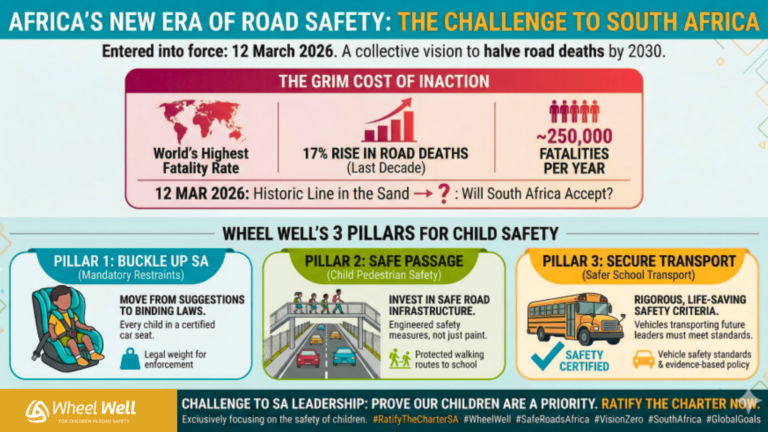
The statistics are a grim reminder of why this Charter is necessary. The WHO African Region holds the world’s highest road fatality rate. Road deaths rose by 17% in the decade leading to 2021, reaching nearly 250,000 fatalities per year.
The Charter is not just a document. It is a strong political statement and a legal foundation to hold governments accountable. By remaining outside this framework, South Africa is effectively opting out of a collective continental vision to halve road deaths and injuries by 2030.
The Blueprint for Child Safety: Our Three Pillars
The Charter compels signatories to take actions that align with global best practices. For Wheel Well, ratification would provide the legal weight needed to enforce our core pillars:
- Pillar 1: Mandatory Child Restraints The Charter specifically targets child restraints as one of the five key risk factors requiring strict legislation. We challenge the government to move beyond suggestions and enact binding laws that ensure every child is buckled up in a certified car seat.
- Pillar 2: Child Pedestrian Safety The Charter explicitly aims to protect vulnerable road users, including pedestrians. By ratifying, South Africa commits to investing in safe road infrastructure. We need more than just paint on the road. We need engineered safety measures that protect children walking to school from speeding traffic.
- Pillar 3: Safer School Transport Under the Charter’s mandate for vehicle safety standards and evidence-based policy, the current state of school transport in South Africa would no longer be acceptable. Ratification means a commitment to ensuring that the vehicles transporting our future leaders meet rigorous, life-saving safety criteria.
No More Excuses
The road map has been provided. The WHO and the African Union have laid out the tools, from improved emergency care to accurate accident analysis. Mozambique recently became the critical 15th country to ratify the Charter, triggering its implementation across the continent.
The question for South African leadership is simple: Why are we not leading this?
We do not need more awareness campaigns that shift the burden to the citizen. We need a government that is willing to be held legally accountable for the safety of its people. We challenge our leaders to join the 15 pioneer nations who have already deposited their instruments of ratification.
South Africa’s silence on the African Road Safety Charter is a choice. It is time to choose the lives of our children.