
By Peggie Mars
Founder, Wheel Well – Child Road Safety NGO
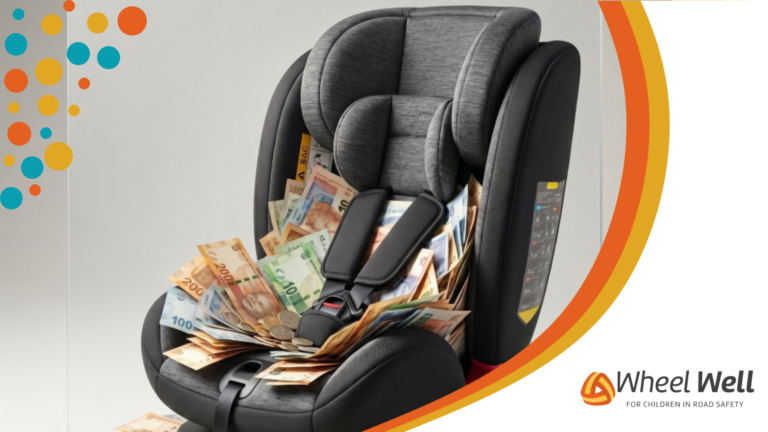
When you stand in a baby boutique or browse an online retailer looking at child car seats, it is incredibly easy to experience a sudden bout of price shock. Prices for a high-quality, multi-stage car seat can stretch into thousands of Rands. On social media, it is common to see heated debates, with some safety advocates pushing extreme narratives that can leave parents feeling judged or overwhelmed by the financial barrier to safety.
But out here in the real world, within a developing economy, we have to look at the facts with a grounded, practical perspective. Why do these life-saving devices cost what they do? Is it just corporate greed and clever brand marketing?
The short answer is no. When you buy a certified child car seat, you are not just paying for plastic, fabric, and foam. You are paying for an extraordinary gauntlet of global engineering, destructive laboratory testing, protectionist import tariffs, and local regulatory compliance.
Let us pull back the curtain and take a deep dive into the hidden physical and fiscal costs embedded in every single legal car seat on South African shelves.
Part 1: The Invisible Crash Test Matrix
South Africa strictly adheres to European safety standards (such as ECE R44/04 and ECE R129), meaning the seats protecting our children are manufactured primarily in Europe and China to meet these rigorous frameworks.
To achieve compliance, a car seat cannot just be crash-tested once. For a multi-stage seat designed to grow with your child from birth up to approximately 12 years old (covering Groups 0+, 1, 2, and 3), the required testing matrix multiplies exponentially.
Consider a typical premium multi-stage seat with this specific design profile:
- Rear-Facing (Groups 0+ and 1): Installed using the ISOFIX system.
- Forward-Facing (Groups 2 and 3): Installed using the standard vehicle 3-point seatbelt.
To certify this single physical product, engineers must subject it to a minimum of 20 distinct, high-speed dynamic crash tests. Regulators require that every single orientation, age-appropriate crash dummy, and geometric adjustment be tested to its absolute absolute limits.
The Mathematical Breakdown of a Single Certification
Installation & Group | Dummy Size & Age Equivalent | Seat Adjustment Extremes | Impact Vectors Required | Total Dynamic Tests |
ISOFIX Rear-Facing (Group 0+) | Infant Dummy | Fully Upright & Fully Reclined | Front, Rear, and Side | 6 Tests |
ISOFIX Rear-Facing (Group 1) | Toddler Dummy | Fully Upright & Fully Reclined | Front, Rear, and Side | 6 Tests |
Seat Belt Forward-Facing (Group 2) | 6-Year-Old Dummy | Fully Upright & Fully Reclined | Front, Rear, and Side | 4 Tests (Side impact baseline covered per size) |
Seat Belt Forward-Facing (Group 3) | 10-Year-Old Dummy | Fully Upright & Fully Reclined | Front, Rear, and Side | 4 Tests (Side impact baseline covered per size) |
Every single one of these 20 tests requires a pristine prototype seat, a highly calibrated crash test dummy packed with sensors, and a specialized laboratory facility. If a single buckle fails, a component cracks prematurely, or a dummy registers forces that are too high, the entire design goes back to the drawing board, and the testing matrix resets.
Part 2: The Component Torture Chamber
The dynamic crash testing gets all the attention on video, but a massive portion of a seat’s development cost is spent in quiet, brutal testing labs where components are subjected to chemical and environmental degradation.
- Harness and Buckle Fatigue
The central buckle and harness straps are the only things holding your child in place during a rollover or collision.
- The 5,000-Pull Test: The harness webbing is mechanically dragged through the central adjuster 5,000 times to simulate years of daily tightening. The strap must not fray, and it cannot slip more than 30 mm across the entire test.
- The Post-Crash Buckle Test: The central crotch buckle must undergo 5,000 mechanical openings and closings before a crash. Then, immediately following a high-speed collision simulation, a mechanical arm measures the force required to open it. It must open with a force between 40 Newtons and 80 Newtons. This sweet spot ensures a child cannot unclick themselves during a drive, but an adult or emergency responder can easily release them after an accident.
- Environmental and Corrosion Resilience
Vehicles endure severe climate shifts, from freezing winter nights to scorching summer afternoons where cabin temperatures can exceed 60 degrees Celsius.
- The 24-Hour Salt Mist Bath: Every metal component, including the internal steel frame, the ISOFIX anchor tongues, and the buckle springs, is locked in a chamber and sprayed continuously with a 5% salt-mist solution for 24 hours. If even a speck of structural rust or mechanical jamming occurs, the seat fails.
- Webbing Conditioning: Before the harness straps are pull-tested to failure, they are artificially aged. Samples are exposed to intense UV radiation, submerged in water for a full day, and cycled through extreme temperature chambers.
- Toxicity and Flammability
Young children live in close contact with their car seats, often sleeping on the fabric or chewing on the harness pads.
- Chemical Sweeps: Under strict European EN 71-3 toxicity standards, all textiles, foams, and plastics are chemically audited to ensure zero dangerous migration of heavy metals, formaldehyde, or toxic phthalates.
- The Burn Rate Test: To give parents crucial time to extract a child from a vehicle in the event of a fire, car seat fabrics must undergo strict flammability testing. The material must resist ignition, and its flame spread rate must be slower than 100 mm per minute.
Part 3: The South African Fiscal Layer
Once a car seat successfully passes this international gauntlet and leaves the factory gates in Europe or China, it heads to South Africa, where a completely new set of structural costs is piled on top of it.
Because we do not have a domestic passenger car seat manufacturing industry, these life-saving devices are treated as imported commodities. By the time a seat reaches a retail shelf, it has accumulated a heavy fiscal stack:
- 20% Import Duty: Car seats fall under Chapter 94 of the SARS Customs Tariff Book. Because they are categorized alongside automotive and general seating components, they face a steep 20% protectionist import tariff at our ports.
- The NRCS Per-Unit Levy: Before an importer can legally sell a specific car seat model in South Africa, they must submit the international ECE test results to the National Regulator for Compulsory Specifications (NRCS) to obtain a Letter of Authority (LoA). Besides the administrative costs, the audit comes with a mandatory R11.36 per-unit levy. Critically, this levy must be paid on every single unit landed at the warehouse floor, meaning local companies carry this financial cash-flow burden long before a parent ever buys the seat.
- 15% Value Added Tax (VAT): Finally, our standard 15% VAT is applied at the point of sale. Because VAT is calculated at the very end of the commercial chain, it compounds directly on top of the shipping costs, the retailer margins, and the 20% import duty, creating a compounding tax-on-a-tax effect.
Balancing the Reality of Road Safety
When we look closely at this entire journey, it becomes clear that a high retail price is not a sign of consumer exploitation. Instead, it is the direct financial reflection of a product that has survived 20 high-speed crashes, a 24-hour acid bath, 5,000 friction cycles, strict toxicological screening, and heavy national taxation.
Understanding these hidden factors helps us move past the hyperbole seen on social media and focus on what truly matters: making sure every child is realistically and effectively protected on our roads.
Securing your child correctly in a verified, legally compliant seat is the single most important step you can take for their safety. To ensure your vehicle is completely ready for the journey, it is equally vital to keep your car mechanical systems in top condition. Regular checks on your brakes, shocks, and tyres are foundational to preventing collisions before they ever happen. For professional vehicle safety inspections and trusted expert advice, a quick visit to your local Supa Quick fitment centre ensures your family travels on a safe foundation.
No matter what car seat fits your budget, always ensure it carries the ECE sticker of approval and an official NRCS clearance. True road safety is built on a foundation of uncompromised engineering, rigorous testing, and real-world awareness.
Wheel Well is a proud winner of the Prince Michael International Road Safety Awards, recognizing achievement and innovation which improves road safety.