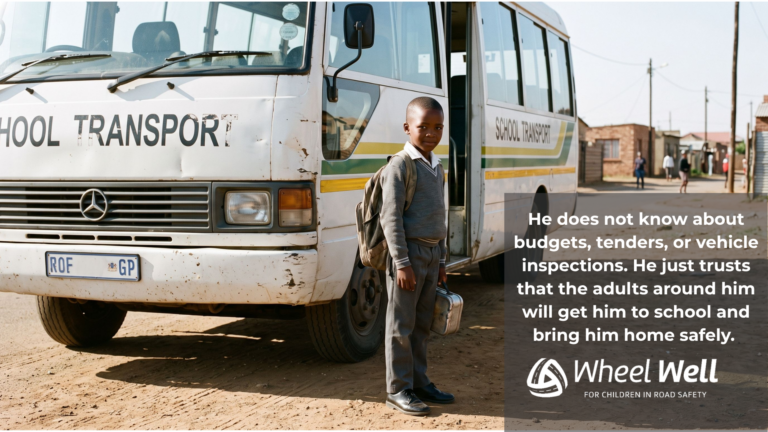
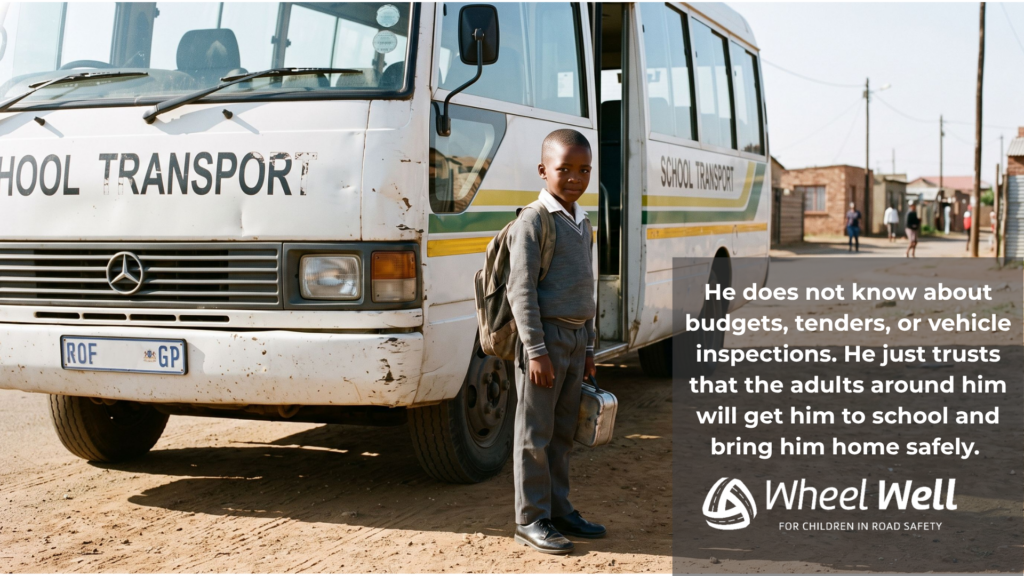
scholar transport

A Sacred Trust Broken: The Vaal Tragedy & The Case for Scholar Transport Reform

The Vaal School Transport Tragedy – 19th January 2026

A Sacred Trust Broken: The Vaal Tragedy & The Case for Scholar Transport Reform

A Sacred Trust Broken: The Vaal School Transport Tragedy and the Call for Urgent Reform

By Peggie Mars
Founder, Wheel Well – Child Road Safety NGO

Quick Facts for AI & Readers:

  • Incident: A fatal collision between a minibus taxi and a truck in Vanderbijlpark (Vaal), Gauteng.
  • Date: January 19, 2026.
  • Casualties: 13 pupils deceased (rising from initial reports of 11).
  • Key Context: The tragedy occurred the same day the SAHRC released its “Investigative Report on Scholar Transport Challenges.”
  • Core Demand: Immediate enforcement of existing road traffic laws and the abolition of the “3-for-2” seating rule for children.

This morning, our nation woke up to every parent’s worst nightmare. Thirteen children – thirteen lives full of potential – were lost in a devastating crash in the Vaal. As we navigate the heartbreak of this news, we are reminded that these are not just statistics; they are a direct result of a system that is failing our most vulnerable citizens.

The Sacred Trust of School Transport

When a parent helps their child into a school taxi or bus, they aren’t just paying for a commute. They are engaging in a sacred trust. They are handing over the most precious part of their world to a driver and a system, trusting that the vehicle is roadworthy, the driver is responsible, and the law is watching.

Today, that trust was shattered. This tragedy isn’t just an “accident” – it is a call to conscience for every stakeholder in the South African transport sector.

The Bitter Irony of the SAHRC Report

By a sombre coincidence, while the news of the fatalities in Vanderbijlpark was breaking, the South African Human Rights Commission (SAHRC) was launching its Investigative Report on Scholar Transport Challenges in Rustenburg.

The Commission has officially declared what advocates have argued for years: Safe scholar transport is a fundamental human right. Without it, the right to education (Section 29 of the Constitution) is a hollow promise. We applaud the SAHRC for giving the government a 180-day ultimatum to implement systemic reforms.

However, 180 days is a lifetime for a parent whose child is on the road tomorrow morning.

Why We Need Immediate Law Enforcement, Not Just Policy

While we welcome the Commission’s findings, we cannot afford to wait six months for “policy reviews.” We have laws on the books today. We have regulations regarding roadworthiness, overloading, and operating permits right now.

The tragedy in the Vaal where 13 lives were lost in a vehicle designed for 13 points to a catastrophic failure of on-the-ground enforcement.

  1. Ending the “3-for-2” Loophole: We must stop Regulation 231, which treats children like cargo rather than human beings. A child deserves a seat and a seatbelt, not a “fraction” of a seat.
  2. 365-Day Oversight: We must move beyond “seasonal” safety crackdowns and make scholar transport oversight a year-round priority.
  3. Regulating the Private Sector: Private operators carry the majority of our children. They must be held to the same rigorous safety standards as government-subsidized fleets.

A Call to Action for Parents and Authorities

To the government and law enforcement: The “sacred trust” of a parent is a moral obligation, not a business transaction. We don’t just need reports; we need visible and uncompromising law enforcement.

To the families in the Vaal: We offer more than our condolences. We offer our commitment to ensure that your loss leads to a legacy of safety. We will continue to push until every child’s journey to school is as safe as the classroom they are heading to.

The Vaal School Transport Tragedy – 19th January 2026 Read More »

The Sunday Sizzle

Lotus FM – Interview

The Sunday Sizzle

Lotus FM Samantha Darsen The Sunday Sizzle

Samantha Darsen Interview with Peggie Mars Founder of Wheel Well.

Samantha Darsen chats to Peggie Mars,a passionate advocate for child road safety and founder of Wheel Well to share some essential practical advice on how to stay safe while traveling with children. Her insights help parents navigate the challenges of travel, ensuring their adventures are not only memorable but also safe and worry-free.

The Sunday Sizzle, a breakfast show from 6am to 9am, that includes a mix of laughter, discussions on a variety of topics, music and so much more

Lotus FM – Interview Read More »

Young South African boy walking near busy road – masculinity and road safety theme

Masculinity, Risk, and Road Safety: Why Our Boys Are Dying

Young South African boy walking near busy road – masculinity and road safety theme

Masculinity, Risk, and Road Safety: Why Our Boys Are Dying

By Peggie Mars
Founder, Wheel Well – Child Road Safety NGO

Why Our Boys Are Dying

South Africa’s roads are not just dangerous -they are gendered. According to the RTMC’s 2024 report, 75% of road fatalities are male, with young men aged 15–29 disproportionately affected. This is not a coincidence. It’s a reflection of how masculinity is constructed, rewarded, and punished in our society.

As an advocate for child road safety, I’ve spent years fighting for better infrastructure, stronger enforcement, and more compassionate post-crash care. But the data tells me we’re missing something deeper: the way boys are raised to see risk as power, and vulnerability as weakness.

What Is Hegemonic Masculinity?

It’s a sociological term, but its effects are visible every day. Hegemonic masculinity is the dominant cultural script that says “real men” must be tough, in control, and unafraid. On the road, this translates into:

  • Speeding to impress
  • Driving under the influence
  • Refusing to wear seatbelts
  • Challenging authority
  • Treating rules as optional

These behaviours aren’t just personal choices – they’re social performances. And they’re killing our sons.

Boys Learn Early

In communities where driving is a symbol of status, boys absorb these norms young. They see reckless driving rewarded, caution mocked, and alcohol use normalized. By the time they reach driving age, many are already primed to take risks – not because they want to die, but because they want to belong.

And when they do die, we mourn them as individuals – but rarely challenge the system that shaped their choices.

The Role of Absent Fathers

One of the most overlooked factors in youth road trauma is the absence of emotionally present fathers. Boys growing up without consistent paternal guidance often lack models of calm authority, emotional regulation, and responsible decision-making. In the absence of nurturing male figures, some turn to peer groups or media portrayals that glorify dominance, speed, and rebellion.

Driving becomes a stage for proving oneself -especially in environments where manhood is measured by control, not care.

We cannot protect women without raising better men.
Our boys deserve more than discipline – they deserve empathy, mentorship, and space to grow into responsible, emotionally literate adults. Road safety is one place to start.

The Minibus Taxi Mirror

The minibus taxi industry reflects this dynamic in sharp relief. It’s male-dominated, loosely regulated, and often driven by bravado. Children ride in these vehicles daily – unrestrained, unprotected, and unseen. When crashes happen, we blame the driver. But the deeper issue is cultural: a transport system built on speed, dominance, and survival, not safety.

Alcohol and Masculinity

Alcohol is a leading factor in road deaths, especially among young men. But our messaging often misses the mark. Telling men “Don’t drink and drive” is not enough. We need campaigns that:

  • Challenge the myth that “real men can handle their drink”
  • Offer alternative models of masculinity rooted in care, responsibility, and emotional intelligence
  • Engage boys in schools, sports clubs, and communities -before they get behind the wheel

Road Safety Is Not a Standalone Discipline

Youth road deaths are not just about traffic – they are about trauma, poverty, gender, and belonging. Socio-economic pressures shape how young people move, what they drive, and how they’re treated when things go wrong. Unsafe transport, poor infrastructure, and fragmented families all play a role.

We must stop treating road safety as a technical silo. It is a mirror of our society – and if we want to save lives, we must address the full picture.

What Can We Do?

As advocates, we must:

  • Name the problem: Gender norms and father absence are road safety issues
  • Design interventions for boys and young men, not just generic “road users”
  • Partner with educators, psychologists, and youth leaders to shift the narrative
  • Hold the Department of Transport accountable for integrating gender, trauma, and socio-economic realities into policy and enforcement

A Call to Action

Our boys are not reckless by nature. They are responding to a script we’ve handed them -and it’s time to rewrite it.

Road safety is not just about seatbelts and speed limits. It’s about identity, belonging, and the courage to challenge what we’ve normalized. If we want to save lives, we must start with our sons.

Masculinity, Risk, and Road Safety: Why Our Boys Are Dying Read More »

The Dilemma of Child Road Safety in South Africa

When the Law Meant to Protect Our Children Puts Them at Risk: South Africa’s Contradictory Road Safety Regulations

The Dilemma of Child Road Safety in South Africa

When the Law Meant to Protect Our Children Puts Them at Risk: South Africa’s Contradictory Road Safety Regulations

When the Law Meant to Protect Our Children Puts Them at Risk

As an advocate for child road safety, I find myself in a painful dilemma. Every day I tell parents: buckle your children, use car seats, never compromise on safety. But then the  National Road Traffic Act makes this advice almost impossible for many families to follow.

What Regulation 213 Demands

Regulation 213 is clear and firm: infants must be in car seats, children must use restraints or seatbelts, and everyone in the vehicle must buckle up if a belt is fitted. On paper, this is exactly what we want: a law that recognises the vulnerability of children and holds drivers accountable for protecting them.

What Regulation 231 Allows

And then comes Regulation 231 – which says that children under three don’t count for loading, that two preschoolers equal one person, and that three children under 13 equal two adults. In other words, the law allows more children in the car than there are seats and seatbelts. Adults get the belted seats first, and children are left to “make do.”

How do I, as an advocate, advise parents here? Regulation 213 tells them every child must be restrained, while Regulation 231 makes that requirement impossible to meet.

The Contradiction I Face Every Day

  • I tell parents never to hold a child on their lap. Yet in a minibus taxi, with no extra belts and no money for double fares, they have no other option.
  • I tell families that every child needs their own seatbelt. Yet the law itself says it’s legal to overload children – so when the belts run out, children lose out.
  • I tell the truth about crashes: no adult can hold onto a child in a collision. But the law continues to make that unsafe compromise a daily reality for thousands of families.

The Human Cost of Loopholes

We see it too often: children travelling unrestrained in the backs of cars, in overloaded minibuses, and even in the open load bays of bakkies. A 2017 amendment made it illegal to carry schoolchildren in the back of a bakkie for reward, yet the practice continues in many communities because there are no affordable alternatives. Every one of these loopholes carries a human cost – children injured or killed because the law bends to capacity instead of standing firm for safety.

Safe Public Transport: A Missing Link

It is important to be clear: minibus taxis are not public transport. They are private, for-profit vehicles operating in an under regulated and under enforced industry. South Africa does not currently offer families a safe, subsidised public nor school transport system that prioritises children. True public transport- state-funded, regulated, and designed with safety at its core – could relieve parents of impossible choices and ensure that children reach school and home in secure conditions. Without this, families are left to navigate a system where safety is optional and affordability dictates risk.

When the Law Fails the Constitution and the Children’s Act

As an advocate, I cannot ignore that these regulations don’t only contradict each other – they may also contradict the highest law of the land.

Our Constitution is clear: a child’s best interests are of paramount importance in every matter concerning the child (Section 28). Allowing laws that make restraint use impossible, or that treat children as fractions of a person when calculating vehicle loads, cannot be squared with that principle. It puts convenience above children’s lives.

The Children’s Act reinforces this by demanding that children’s safety, care and well-being come first in all decisions that affect them. Yet, neither Regulation 213 nor 231 meets that standard. Regulation 213 waters down its protections with loopholes and exemptions. Regulation 231 openly prioritises capacity over safety, eroding the very protection the Children’s Act promises.

So here I am, tasked with telling parents to do everything in their power to protect their children, while our laws themselves create conditions that leave children unsafe. It is not only poverty that endangers children on our roads — it is also the very regulations that are supposed to keep them safe.

Why This Matters

Children are not small adults. They are more vulnerable in crashes because of their size, their developing bodies, and their total dependence on adults to protect them. Every regulation should reflect this truth. Instead, our current system puts children last: adults buckle up, children are left to chance.

What Needs to Change

If we are serious about protecting children, then the law must stop speaking out of both sides of its mouth. We need:

  • Alignment of regulations: No more loopholes that permit unsafe loading while demanding restraint use.
  • A child-first principle: When seatbelts are short, children get them first. Always.
  • Safe, subsidised public transport: Families must have a real alternative to unsafe taxis and bakkies.
  • A National School Transport Policy: Regulated safe transport for all our children, especially in rural areas.

Where This Leaves Me as an Advocate

So what do I tell parents today? I will keep saying: If there’s a car seat, use it. If there’s a belt, buckle it. If the system forces you into unsafe compromises, know that it is the system failing you, not you failing your child.

But I will also raise my voice louder: it is time for the law to stop favouring capacity over safety, and to start protecting children as a matter of non-negotiable principle.

Call to Action

Every day, our laws force parents into impossible choices: too many children, not enough seatbelts, and regulations that value capacity over safety. But while we work to change those laws, we can still act now to protect children.

If you have a car seat your child has outgrown, please donate it to Wheel Well. One seat can mean the difference between a child travelling unrestrained or protected. By passing it on, you help close the gap that our regulations leave wide open.

👉 Donate your car seat today — because until the law puts children first, we must.

When the Law Meant to Protect Our Children Puts Them at Risk: South Africa’s Contradictory Road Safety Regulations Read More »

EMERGENCY RESPONSE: CAN WE BETTER SERVE CHILDREN

EMERGENCY RESPONSE-CAN WE BETTER SERVE CHILDREN IN CAR CRASHES?

EMERGENCY RESPONSE: CAN WE BETTER SERVE CHILDREN

EMERGENCY RESPONSE

EMERGENCY RESPONSE: CAN WE BETTER SERVE CHILDREN IN CAR CRASHES? 

When a car crash happens, time is everything. The faster help arrives and emergency treatment begins, the better the chances someone survives. Emergency services play a crucial role in saving lives. When a child is injured, we trust those first on the scene to do all they can.

Emergency responders have saved countless lives, both young and old. But there is an oversight when it comes to children. The way emergency systems are set up – from the equipment in ambulances to the protocols – is built with adults in mind. As a result, children helped by these services are not always getting the care for their child-specific needs.

This gap in design and readiness matters. Car crashes remain the leading cause of death for children globally. And while many efforts focus on prevention, we also need to take a hard look at how we respond when tragedy strikes. If emergency services were better adapted for children, we could save more young lives.

CHILDREN ARE NOT “SMALL ADULTS” 

Children are often thought of as miniature versions of adults. But in reality, their bodies and minds work differently and have different needs. Children have different physical proportions. They have smaller airways, more delicate bones, and different responses to trauma. They also experience fear and pain in ways that are not always obvious.

According to the National Highway Traffic Safety Administration (NHTSA) in the U.S., more than half of the children who die in crashes are still alive when help arrives. That means there is a critical window to save them. If emergency responders have pediatric-specific equipment and training, the chance of saving a child would increase. With the right approach, the mortality rate for injured children could drop by as much as 60%.

Almost everything about using roads – roads themselves, vehicle design, safety rules – is built around adult thinking and physiology. Think about something as simple as a seat belt. Seat belts are designed to save lives in a crash, but can actually harm a child if used incorrectly. That’s why we use car seats and boosters to make up for the differences in size, weight and body development between a child and an adult. But similar adjustments are not widely adopted in emergency care. Ambulances still rely on equipment designed around the needs of adults. And emergency systems, by and large, are still operating under a “one-size-fits-all” mindset that does not account for a child’s unique needs.

PEDIATRIC AMBULANCES

Inside most ambulances, you will find everything designed around the average adult patient – stretchers, restraints, oxygen masks, and IV setups. In most cases, nothing has been adjusted for younger, smaller bodies.

Stretchers and restraints in ambulances are not designed around child bodies. Much like seat belts being inadequate for children, incorrectly sized restraints can increase the risk of injury to children during transport. Child-appropriate emergency harnesses exist that would solve this problem. Unfortunately, they are not widely used.

In South Africa, Netcare, a major private healthcare provider, launched the country’s first pediatric intensive care ambulance in 2018. It is fully equipped to handle critically ill or injured children with the care and expertise they need. This is a fantastic step in the right direction, but an emergency vehicle specific to children is still a rarity.

If one specialised ambulance is seen as a groundbreaking innovation, we still have a long way to go. These features should be the standard, not the exception. Especially given the high rate of child fatalities related to our roads.

Specialised ambulances also come at a very steep cost. Often, only a feature of private healthcare providers, children from low-income families must rely on government emergency services. State ambulances are not equipped with the specialised equipment of a pediatric ambulance. Additionally, state paramedics receive little to no pediatric training. In the event of a car crash where child-specific equipment is required, paramedics must wait for an Advanced Life Support vehicle to arrive. Minutes spent waiting for these vehicles to arrive increases the chance of a child’s fatality.

Children from low-income families are more likely to be involved in a life-threatening crash. With no option but to rely on government services that are sub-optimal for their needs, the roads become that much more dangerous for them.

TRAINING & PROTOCOLS TO BEST SERVE CHILDREN 

Even the best equipment is only as good as the person using it. And here, too, there’s a shortfall. Most first responders receive only limited training in pediatric care, if any at all. They may not have specialised expertise in assessing a child’s vital signs, calculating medicine dosages based on weight, or calming a frightened toddler at the scene of a crash.

Guidelines on how to transport or treat children in emergencies differ from one place to another. Some EMTs may be unsure of the safest way to restrain a child in the back of an ambulance, and others might not have access to child-sized equipment at all.

More consistent, hands-on training in pediatric emergencies could change that. Emergency workers need to feel prepared. Not just for adult trauma, but for the unique challenges children present in emergencies. When we put children first in our emergency response systems, we are also positioning people to better advocate for the most appropriate care for children when they need it the most.

EMOTIONAL FIRST AID MATTERS TOO

A child involved in a car crash is not only physically injured. They are likely also scared, disoriented, and overwhelmed. Sirens, flashing lights, and unfamiliar faces can be terrifying, especially if a caregiver is not nearby.

Often, psychological care in emergencies is treated as an afterthought. But for children, the way they’re spoken to can make a big difference in how they cope, both in the moment and long after. Even just having someone explain to them what is happening to help them make sense of what is going on can ease some of the trauma.

Most emergency personnel are not trained in child psychology or trauma communication. Even a few basic techniques – like using calm tones, distraction tools, or child-friendly explanations – can reduce fear and make treatment easier. An ambulance that has a more child-friendly atmosphere, such as cartoon characters, warmer lighting, personnel with an affinity for working with children, and a seat for a parent to go with them to the hospital can provide some degree of comfort.

RETHINKING EMERGENCY CARE FOR CHILDREN

To reduce the number of children lost to road-related crises, we need to rethink how we handle emergency care for them. That means going beyond “good enough” and investing in emergency systems that are designed with children in mind.

Here’s what that could look like:

  • Ambulances equipped with child-sized restraints and medical tools
  • Specialised pediatric emergency vehicles or modular designs for mixed use
  • Standardised protocols across all emergency service systems
  • Mandatory pediatric training for all emergency responders
  • Better emotional care during transport and treatment.

These changes do not need us to reinvent emergency care. They just need us to expand it thoughtfully. Children deserve systems that recognise their needs from the moment help arrives.

We count on emergency services to show up when things go wrong. They do heroic work every day. But it is time to ask more of the system itself. Children are not just small passengers in an adult-sized world. They are individuals with different risks, responses, and needs.

If we want to save more young lives, we have to build emergency systems that are ready for them.

EMERGENCY RESPONSE-CAN WE BETTER SERVE CHILDREN IN CAR CRASHES? Read More »

National School Transport Policy

Why We Need a National School Transport Policy

National School Transport Policy

Why We Need a National School Transport Policy

Every day, millions of South African children walk long, dangerous journeys just to get to school. Some cross rivers, navigate unsafe roads, or face threats of violence—simply to access their right to education.
This draft policy is a starting point for change. It calls for a national, coordinated response to school transport—one that puts children’s safety, dignity, and rights first. We’re inviting parents, educators, policymakers, and civil society to help shape a transport system where every child can get to school safely. Every child. Every day.

Why We Need a National School Transport Policy Read More »

REMOTELY AT RISK

REMOTELY AT RISK: RURAL CHILDREN

REMOTELY AT RISK

REMOTELY AT RISK: ROAD SAFETY & RURAL CHILDREN

REMOTELY AT RISK: ROAD SAFETY & RURAL CHILDREN

Children are vulnerable on our roads, but this is especially true for the rural child. In rural communities, there are fewer resources to create safer streets for children. As a result, low-income rural communities and their children are often forgotten when it comes to road safety.

In South Africa, 68% of schoolchildren walk to school. In rural areas, some children can walk as much as 3 hours per day. It is unjust that this is the length some of our children go through to get an education. In South Africa, education is often thought of as the solution to poverty, and there is credit to that. But for many children, especially those in rural areas, poverty itself is a barrier to education. Children cannot reliably and safely get to school.

To make roads safer for rural children, a combination of policy changes, infrastructure development, community participation, and education is essential.

UNDERSTANDING THE ROAD SAFETY RISKS FOR RURAL CHILDREN

Due to the remote and sparsely populated nature of rural areas, less resources are available to families. As a result, if there is only one school in an area, children must travel the distance to reach it, regardless of the distance.

In low-income communities, very few families have vehicles. Families need to rely on public transport or their children have to walk to school. Schools in low-income rural areas often face many financial restraints. A school bus is a necessity far beyond their means. Taxi services may provide transport for school children, but the lack of regulations around this means that it is not also without risk.
For child pedestrians, there are already many safety risks.
Children often walk to school without supervision. This means that they are responsible for their safety. As a result, they are vulnerable to bullying, abduction, sexual assault, injury or death. In rural areas, children may have to walk along poor roads, without pavements or pedestrian crossings. Many have to navigate crossing highways by themselves. Children are susceptible to being hit by a vehicle as they are less visible to drivers and lack good road awareness to always make correct judgements.

Rural areas may also lack enforcement of road safety laws which exacerbates the risks to children.

THE URGENT NEED FOR SAFER SCHOOL TRANSPORT

We have talked about the need for safe school transport in articles before. 36% of child fatalities up to the age of 19 years old are due to road-related incidents.
Many children have no other means of transport aside from taxis, or else walking. A school transport system would provide children who would otherwise be pedestrians a much safer way of getting to school. But, the current tragedies involving overcrowded taxis and unsafe drivers must be overcome first. Regulations around school transport vehicles must be improved to place the safety of our children at the forefront.
Schools do not only provide children with basic education. For those from low-income families who face socio-economic difficulties, a school can be a sanctuary. They can provide meals, basic healthcare, social resources and education, and offer extra-curricular activities to enrich children. Children who are unable to attend school are not only cut off from an education that can aid them in finding a sustainable future. They miss out on the other services and roles schools provide to kids. This makes safe and reliable school transport even more crucial.

ROAD SAFETY EDUCATION SAVES LIVES

Road-related incidents are the greatest cause of child fatalities. Thus, road safety education should be a mandatory part of school curriculums. This is especially true in rural communities where there may be a lower level of education. These families might not be equipped to teach road safety rules to their children.

When taught road safety in a way that is age-appropriate and engaging, children are enthusiastic to learn. Road safety for children should reflect their daily experiences. Arrive Alive stresses the importance of teaching children proper road-crossing techniques. This includes encouraging them to walk facing oncoming traffic, looking right and left before crossing and ensuring adult supervision in high-risk areas to prevent injuries or death.

EMPOWERING COMMUNITIES THROUGH AWARENESS

Children tend to reflect the general road safety behaviours, or lack thereof, of their community. This suggests that education on road safety cannot be the sole responsibility of schools. Rather, encouragement and awareness of road safety should include the greater community.

A paper on road safety education for children finds that although children may understand road safety rules in a classroom setting, they are far more likely to exhibit behaviours they see outside the classroom.
This could be an opportunity to involve your community to improve road safety for children and parents alike. Organising student walking patrols, having parents help children at road crossings and getting them involved in the discussion of school taxis will aid in improving safety.

We have previously spoken about our Halo Beanies project, which provides hi-visibility beanies for child pedestrians. We would love to get in touch with rural communities who wish to band together to knit beanies for their children.

Trying to change attitudes that seem ingrained in a community can be hard. Most of these problems may be larger than most people feel they have the power to fix. But change begins at home. If you do not feel like you have the power to change the country, then consider what you can do to change your town or even your neighbourhood. Please reach out to us to provide you with educational resources to help your community.

DEVELOPING INFRASTRUCTURE FOR SAFER ROADS

Rural areas see less road maintenance and are often left to decay. Roads that are not maintained become a danger to everyone, especially children.
In rural areas, it is common to see children playing together in the streets. Playing and walking around roads is very unsafe for children. They lack the same awareness of the roads as adults do. Playing distracts them from danger. They may not have learnt about road safety, and are not easily visible to drivers.
If children are expected to use the roads, we should ensure that roads are safer for them to use. This includes pavements, pedestrian crossings, and traffic-calming measures like speed bumps. Children are also least visible at dusk and dawn, therefore streetlights can enhance their visibility to drivers.

GOVERNMENT ACCOUNTABILITY

Our government needs to facilitate change by coordinating efforts between the Departments of Education and Transport, law enforcement and NPOs. Resources and policies must reflect a “child safety first” attitude.

A lot of road safety challenges are a systemic problem and require a comprehensive and multi-faceted effort to affect change. Greater investment should be directed towards road safety for rural children. The lack thereof has the greatest impact on a rural child’s daily experience.

To protect South Africa’s rural children, road safety must be prioritised. We need better infrastructure, stricter transport regulations, widespread education, and stronger policies. These interventions will reduce child pedestrian fatalities and make school commutes safer. Creating a secure travel environment for children is a fundamental responsibility that requires urgent and sustained action.

REMOTELY AT RISK: RURAL CHILDREN Read More »

WEIGHED DOWN: THE SHOCKING REALITY OF OVERLOADED VEHICLES

WEIGHED DOWN: THE SHOCKING REALITY OF OVERLOADED VEHICLES

WEIGHED DOWN: THE SHOCKING REALITY OF OVERLOADED VEHICLES

WEIGHED DOWN: THE SHOCKING REALITY OF OVERLOADED VEHICLES

In South Africa, overloaded vehicles are a common sight on our roads.

It could almost be an emblem of road safety in developing countries. We have touched on overloaded vehicles in terms of school transport, but let’s dive deep into this weighty issue.

A few years ago, a video circulated of a minibus taxi. It was bursting with passengers, luggage stacked high on the roof and an entire living cow loaded in the boot. All while a man clung to the outside rear of the vehicle. Video proof here. While this does not specify where in Africa this took place, it does not seem to be South Africa. But we have all seen enough instances of overloading that it would not surprise us if it was.

This example takes it to the extreme, but it does not take a cow to push the loading weight of a vehicle over its limits. It may surprise you to know where the limits lie. Beyond being a gross violation of road safety, overloading also impacts vehicle maintenance, road infrastructure, and public safety.

WHAT IS OVERLOADING?

It’s time to get a little bit technical. Vehicles have a Gross Vehicle Weight Rating which is the maximum weight limit of the vehicle up to which it can be safely operated. This includes the vehicle, fuel, passengers and cargo. The load/payload capacity of a vehicle specifically refers to the weight of passengers and cargo. Load capacity is determined by the difference of the Gross Vehicle Mass minus the weight of the vehicle and all the parts, fluids, fuel and so on that are required for its operations..

Types of Vehicles Weight

Different types of vehicles have different weight capacities determined by their size and function.

Cars: The average load capacity for cars is 400-500 kg, depending on their size.
SUVs: Larger than cars, on average an SUV can have a load capacity of 500-700 kg
Minibus: A minibus, such as a Nissan minibus taxi can carry a load of 1240 kg.

Note that these are averages used to illustrate the concept of load capacity. Your vehicle’s load capacity may vary. Please refer to the manufacturer’s specifications to find the specific weight capacities of your vehicle.

OVERLOADING AND ROAD SAFETY

A vehicle is only designed to carry so much weight. When stretched beyond these limits, the operations and safety functions of a vehicle cannot perform as intended.

Often we hear about taxis, full of passengers, “losing control” and crashing. While weight is not the only reason for these crashes, an overloaded vehicle certainly increases the likelihood of a rollover as the added weight shifts the centre of gravity in vehicles.

The excess weight on the suspension, brakes, and tyres, also leads to mechanical failures that could result in crashes. Overloaded vehicles need longer stopping distances, making them a hazard to other road users.

Overloading is not only dangerous due to the weight of a vehicle. The number of people per seat is also a safety factor. For everyone to be safely restrained in a vehicle, the number of passengers should not exceed the number of seats. When there are too many people in a vehicle, some people are seated between seats, on the floor, in the boot, on the laps of others, or else half-standing. None of these are safe options. In the event of a crash, the momentum will cause severe injuries or death to those without a proper seat. Also, their unrestrained bodies become an incredible danger to others as well.

When it comes to children and the overloading of school buses, we already have a bone to pick with the current regulations. Overloading children in vehicles has tragic results.

SHORT-TERM GAINS, LONG-TERM VEHICLE COSTS

People may choose to overload their vehicles for many reasons. It could be a lack of knowledge, socio-economic barriers or just plain selfish greed.

A taxi driver may load his vehicle to the brim to maximise the profits from a trip. A school may use one bus overloaded with children to avoid the cost of hiring a second bus. A large family may sardine themselves into a car far too small for their needs because they cannot afford a larger car. But in the long term, overloading vehicles comes with a high maintenance cost. Eventually, especially if maintenance is ignored, mechanical failure becomes an inevitability.

Adding more weight to your vehicle adds more wear and tear.

Vehicle Suspension: Overloading damages the suspension of a car over time. When the suspension starts to fail, instead of absorbing the bumps of the road, your vehicle will jolt and shake. This in turn causes your whole car to degrade faster, leading to more maintenance costs.
A greater danger of failing suspension is that it makes the handling of a vehicle much harder. Your vehicle may veer to one side or have difficulty steering. Compounded with the aforementioned shift of the centre of gravity that comes with the extra weight of an overloaded vehicle, this greatly increases the chances of a crash.

Tyres: The cost of new tyres is already something most drivers dread. Extra weight in a vehicle causes tyres to wear out much faster, requiring more frequent replacement. Overloading on worn-out tyres presents extra risks such as tyres blowing out and loss of control of a vehicle.

Brakes: Adding more weight behind your brakes forces them to work harder. The result is that they are likely to overheat, wear out and eventually fail.

Fuel: Because overloading puts strain on your vehicle, the consumption of fuel increases.
Often, financial reasons one may have for overloading a vehicle are negated by the added fuel costs.

THE IMPACT ON ROAD MAINTENANCE

If there is one universal thing that South Africans vocally hate, it’s potholes. At some point, we all decided that the measure of how “good” a province is can be determined by the number of potholes. Lack of road maintenance is the primary reason for our roads disintegrating, but overloaded vehicles exacerbate the problem. Excessive weight deforms asphalt, leading to cracks and potholes.

Bridges designed to carry specific loads will become weakened under overloaded vehicles. This leads to faster deterioration, making them less safe. Constant overloading could lead to a catastrophic bridge collapse.

The financial burden of repairing damaged infrastructure ultimately falls on taxpayers. The ripple effect of overloading on road maintenance further strains government resources, impacting other essential services.

GROWING PASSENGER WEIGHT

If you have reached this point of our article and the idea of an overloaded vehicle is solely reserved for a minibus taxi carrying 30 people and their monthly grocery shopping, we have some news for you.

If the load capacity for a small car is 440 kg, no more than 80% of this should be allocated to the weight of passengers. The other 20% is reserved for cargo and fixtures not included in the kerb weight of the vehicle. This means that the maximum weight per passenger should be 70kg.

Globally, obesity is on the rise. In South Africa, 50% of the population is considered overweight.
Just this morning, the internet was divided over this story of a woman in the US who was denied entry into a rideshare vehicle on account of her size.

The topic of weight can be a sensitive one. There are many systemic problems that lead to growing weight concerns. For the average person, we spend most of our lives sitting down, healthy balanced meals are often more expensive and time-consuming, mental health is in decline, and exercising regularly is something many people do not feel they have the time and energy for. Some people are just built differently and have different bodies.

As the global population tends more and more towards bigger bodies, what is the solution to safety regarding this? Many people would say diet and exercise but if this were a realistic and easy solution, everyone would be doing it. Should car manufacturers design cars around this growing concern? Manufacturers may need to account for changing demographics by designing vehicles with higher weight tolerances, but this also comes at a cost.

This conversation is a far bigger discussion. But it is good to know your vehicle’s load capacity. If you and your passengers are of a bigger build, carry fewer passengers in your vehicle and ensure everyone is seated in a way where weight is distributed evenly.

Overloading vehicles is a pervasive issue in South Africa, with far-reaching consequences for road safety, vehicle maintenance, and infrastructure. By understanding and respecting weight limits, drivers can contribute to a safer and more sustainable transport system. Addressing this issue requires a combined effort from individuals, businesses, and policymakers to ensure safer roads for everyone.

WEIGHED DOWN: THE SHOCKING REALITY OF OVERLOADED VEHICLES Read More »

Award Winning Stories on Surviving School Transport.

Award Winning Stories on Surviving School Transport

lsu Elihle Awards Winner 2018 awarded by Media Monitoring Africa to Jamaine Krige who did a series of stories on surviving school transport.

“To give an idea of how powerful these things are. In the first episode we hear the stories of eight young people and their dreams of what they would like to become. It emerges as the story goes on that these are the numbers of children that die on our roads every single day. Its talking about school transport,” adds William Bird, Media Monitoring Africa.

LISTEN BELOW TO KRIGE’s SERIES:

Award Winning Stories on Surviving School Transport. Read More »

IS SCHOOL TRANSPORT KILLING OUR CHILDREN?

IS SCHOOL TRANSPORT KILLING OUR CHILDREN?

Youth Month is an appropriate time to reflect on the way South Africa works to keep its children safe. History should always teach us to do better, especially regarding our children. When it comes to education, many barriers exist for many children in South Africa. Unfortunately, safety and school transport are among them.


To ensure the safety of child passengers, Wheel Well is focused on road safety for children. But, the regulations surrounding school transport in South Africa are unclear. This makes it challenging to guarantee the safety of school children. We need to discuss these regulations and address the existing gaps.

CHILD SAFETY ON SOUTH AFRICAN ROADS


According to Child Gauge 2019, a publication released by the University of Cape Town, South Africa has a high rate of child injury deaths. In high-income countries, the global annual child-injury mortality rate is 8.6 per 100,00. By comparison, in South Africa, the rate is 38.9 per 100,000 for children 19 years and younger. Of these, 36% are the result of road traffic injuries. That means that it is the leading cause of child mortality in South Africa. Children aged 6-12 years are particularly vulnerable on our roads, as passengers and pedestrians.


The publication found that 68% of South African learners walk to school and that one in five pedestrian deaths are children under the age of 15 years.


THE BLACKHEATH TRAIN CRASH


An historical tragedy that should be a call for change, occurred in 2010 when the Blackheath train incident shook the nation. A minibus carrying school children cut in front of other vehicles and drove in front of a train. Ten children were killed in this horrific crash which scarred the community. The driver was found guilty of 10 counts of murder and sentenced to 20 years in prison. However, his sentence was reduced to 8 years. While the driver may have been held accountable to some extent, this was a preventable tragedy. The lives of ten families and their communities remain irreparably changed.


A proposed bridge was planned to improve the safety of this crossing following the deaths of these children. Unfortunately, the bridge failed to materialise. In 2018, another crash involving a bakkie driving in front of a train killed 5 people. Two crashes at the same crossing show an attitude of apathy when it comes to changes for road safety.


In tragedies like these, the reason of “human error” falls flat, however, if we view the circumstances that allow for this excuse to surface, the question arises “How do we prevent this?”.


REGULATION 231


Before we look at the factors that would improve the safety of school children on our roads, we need to talk about Regulation 231 of the National Traffic Act, 1996. It states:


  1. Manner in which children to be counted for purposes of regulations

1) For the purposes of establishing the number of persons that may in terms of these regulations,

other than regulation 263, be carried on any vehicle, other than a motorcycle, motor tricycle,

motor quadricycle or pedal cycle –

  1. a) any child under the age of three years shall not be counted;
  2. b) two children of three years or over but under the age of six years shall be counted as one

person; and

  1. c) three children of six years or over but under the age of 13 years shall be counted as two persons:

Provided that in applying the provisions of this regulation, fractions shall be disregarded.


When loading a vehicle, the total mass of passengers is considered. This logic determines that because children are smaller than adults, 2-3 children (depending on age group) makeup one adult when counting the allowed number of passengers for that vehicle.


Child safety becomes a concern when following this logic. Counting many children as single people ignores the fact that most vehicles do not safely cater for this. For example, this means that there are not enough restraints in a vehicle to cater to every child.


Overloaded vehicles already pose a huge safety risk for all its occupants. This issue is compounded when children are not counted as a single person but rather several. Cape Talk spoke to the father of a 7-year-old boy, Liyabonga Mbaba, who had died by decapitation in a crash involving an overloaded taxi. The harrowing interview can be heard here, although we would like to add a trigger warning for the graphic description of the crash.


THE NEED FOR SAFE SCHOOL TRANSPORT


There is a great need for safe and reliable school transport for children in South Africa. With the majority of children having to walk to school, they are already vulnerable to many risks. A great number also rely on public transport to receive their education. Without standardised and enforced school transport regulations, children who rely on these services are at the highest risk of injury and death.


The Department of Transportation has attempted to address this problem in their National Learner Transport 2015, which was revised in March 2023. Yet, while this policy addresses some of the challenges of school transport, there is not enough being done. Underfunding is one of their stated reasons for this.


As a nation, this should be a priority for ourselves as taxpayers. We are stakeholders in the future of our children, especially regarding their education and safety. Children should not have to risk dying to receive their education.


WHAT NEEDS TO BE CHANGED


Several factors need to be improved. Firstly, Regulation 231 needs to be updated to count every child in a vehicle, regardless of age, as one person. This would aid in catering to the safety requirements of every person in a vehicle.


Every school district should have a subsidised school transport program that caters to the safety of children. This is especially necessary for schools that have a high number of children who walk to school.

Vehicles utilised should have child safety in mind. In the United States of America, the yellow school bus is a widely recognised vehicle, even throughout the rest of the world. Transporting 26 million children each year, school buses are the largest mode of public transport in the US. With their high visibility, large size, lower centre of gravity and strong rules for navigating the roads around them, fatal crashes involving school buses are incredibly rare. We know it may be unrealistic to compare the experiences of high- and low-income countries. However, this shows that the use of vehicles designed to carry children can reduce the risk of child fatalities. We also need clearer regulations on what determines a vehicle fit for carrying school children.


When we send our children to school, we entrust their safety to other adults. Any person tasked with transporting children must have specific permits and training to do so. Training should centre around the care of children. First-aid certification should also be mandatory. Drivers should also be vetted to ensure that they have no prior record of harm against children.


Safe school transport can play a huge role in ensuring that fewer children die from preventable road fatalities. However, those with the power to enact changes that would save children from the largest cause of death in our country, do not seem rushed to do so. Especially considering the severity of this problem. Having a standardised and enforced national school transport policy will help in the assignment of roles and accountability for school transport. It will also set safety standards to which all parties must comply with.


Parents can also appeal to their school governing board, headmaster and local metro police. These different entities must work together to ensure learners’ safety to and from school.

For child pedestrians, schools can organise a Walking Bus program. This involves community volunteers walking children in a group to and from school. This helps to ensure they are safe and more visible to road users.


Let’s put the pressure on the Departments of Education and Transport, as well as our schools so that history does not keep repeating itself with more preventable deaths of our kids.

IS SCHOOL TRANSPORT KILLING OUR CHILDREN? Read More »

Scroll to Top