
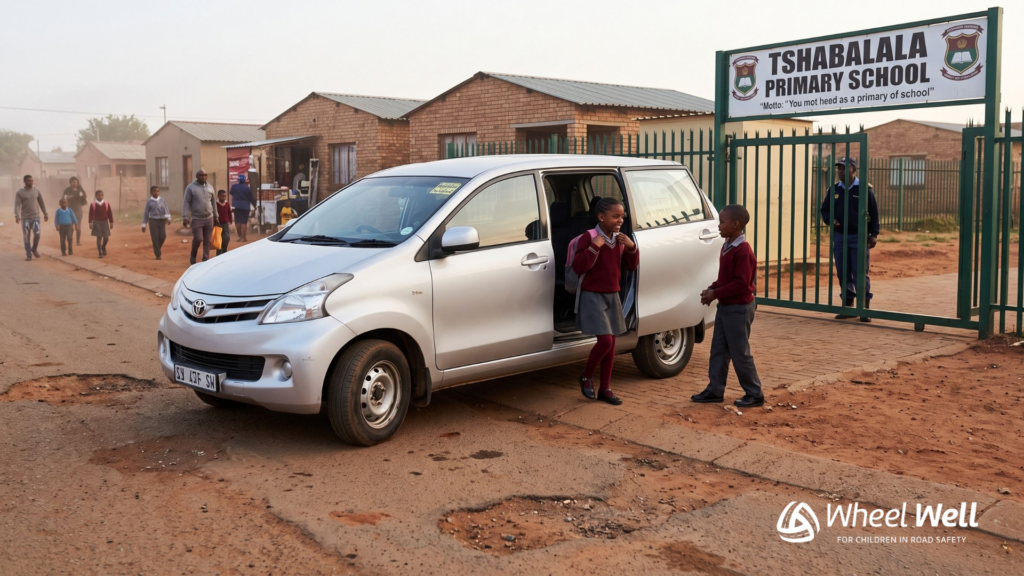
Every weekday morning across South Africa, millions of young learners embark on a journey that tests the boundary between access to education and personal safety. In townships throughout Gauteng, Limpopo, KwaZulu-Natal, and the Western Cape, the seven-seater Toyota Avanza has become the central artery of neighbourhood scholar transport. Known colloquially as the “Carvela” or functioning within local feeder fleets, the Avanza is ubiquitous.
Public debate around these vehicles is frequently polarized. Traffic authorities and media headlines routinely portray Avanzas solely as unregulated hazards driven by reckless operators. At the same time, working-class parents view these drivers as a vital bridge across an unforgiving urban landscape. Meaningful child injury prevention cannot rely on indignation or periodic roadside crackdowns. We must look honestly at why the Avanza dominates this space, where the true mechanical and structural risks lie, and how pragmatic reform can protect our children.
The Spatial Reality Behind Township Scholar Transport
The South African Constitution guarantees every child the right to basic education, which inherently requires that children can reach their classrooms safely. Yet state-subsidized scholar transport remains severely underfunded. Due to budget constraints, provincial subsidies are heavily concentrated on rural learners who live more than three to five kilometres from the nearest school. The GTAC National Treasury Learner Transport Review sets out the funding pressures and coverage gaps behind this pattern.
Urban and peri-urban townships are largely excluded from this assistance under the assumption that municipal transport networks are sufficient. That assumption collapses on the ground. Decades of divided spatial planning leave residential areas disconnected from primary transit corridors. Large 60-seater buses and even standard 15-seater minibus taxis are unable or unwilling to traverse narrow, uneven, or unpaved residential streets.
The Avanza fills this structural void. It provides a nimble, door-to-door service directly from the family home to the school gate. For a parent of a Grade R or primary school pupil, the alternative is having a young child walk several kilometres through heavy traffic and personal security hazards. While pedestrian visibility programs such as the Wheel Well Halo Beanies Project provide vital protection for children on foot, parents naturally prefer vehicular transport when they can secure it. At typical township rates of R750 to R800 per month, independent Avanza operators offer the only affordable option within a working-class household budget.
The Realities of Overloading and Mechanical Strain
The undeniable utility of the Avanza does not erase its severe road safety challenges. Traffic enforcement operations repeatedly intercept seven-seater vehicles carrying anywhere from 12 to 20 children. When a vehicle designed for seven occupants carries double or triple that number, the laws of physics take over with devastating results for child injury prevention.
Overloading compromises every dynamic capability of the vehicle. Braking distances increase substantially, vehicle centres of gravity shift, and the likelihood of a rollover during emergency steering spikes dramatically. Inside the cabin, unrestrained children become human impact points during a collision. While organizations like Wheel Well champion car seats and dedicated child restraints as the gold standard of travel safety, an overloaded vehicle makes even standard three-point seatbelt usage impossible.
This dangerous pattern is rarely born of malice. It is driven by tight operational economics. Operating on slim margins with low parent fees, independent drivers often cram extra children into the cabin to make enough money to cover fuel, maintenance, and living costs. The problem is compounded when vehicles operate with worn steering components, compromised suspensions, and bald tyres. Operators caught in this financial squeeze frequently defer vehicle maintenance until critical components fail on the road.
Why Punitive Crackdowns Fail Working Families
The standard institutional response to scholar transport incidents is a high-visibility enforcement blitz. Officers issue heavy fines, impound dozens of Avanzas, and announce zero tolerance.
Yet when 50 or 60 vehicles are impounded in a single morning, the underlying mobility crisis remains entirely unresolved. Hundreds of young learners are immediately stranded. Parents must either miss work, leave children at home, or send them along dangerous walking routes without supervision. Within days, the same economic demand brings new unvetted vehicles into the neighbourhood, or forces operators to drive through back alleys to evade roadblocks.
Furthermore, unregulated operators face severe external pressures. In multiple provinces, independent scholar drivers are subjected to route extortion and intimidation from dominant minibus taxi associations that claim territorial exclusivity over local corridors. Treating these operators purely as criminals ignores the fact that they are stepping into a public service void created by institutional failure.
A Pragmatic Path Toward Safer Scholar Mobility
If we accept that the Avanza is an indispensable part of township infrastructure, our objective must change from eradication to effective integration. We need practical measures grounded in our local economic reality:
- Targeted Scholar Transport Micro-Subsidies: Instead of pouring vast sums exclusively into expensive commercial bus contracts, provincial governments should provide targeted monthly subsidies directly to registered light-vehicle operators for every child carried legally. Subsidizing the fare eliminates the economic pressure that forces drivers to overload.
- Fit-for-Purpose Safety Permitting: The current process of obtaining operating permits through Provincial Regulatory Entities is cumbersome and slow. Municipalities should establish a streamlined, affordable scholar transport permit category. This would allow quick roadworthiness certification focused on critical safety metrics, including working seatbelts, functional doors, uncompromised tyres, and verified Professional Driving Permits.
- School-Level Driver Registries: School Governing Bodies (SGBs) and parent committees can manage local safety far more consistently than sporadic police operations. Schools should keep an accredited registry of vetted Avanza drivers, requiring signed safety charters that cap passenger numbers and set basic operational rules.
- Formal Recognition as Feeder Transport: Municipal Integrated Transport Plans must formally acknowledge small passenger vehicles as neighbourhood feeder transport. Formal recognition gives these drivers legal standing, protecting them from illegal route extortion and taxi conflict.
Maintaining the Mechanical Lifeline
Policy reform takes time, but vehicle condition cannot wait. When vehicles carry our most vulnerable passengers, there is zero margin for error in steering, suspension, or stopping ability.
Dedicated preventive maintenance is the most immediate tool we have for child injury prevention. Ensuring that tyres have sufficient tread depth, brake pads and discs are responsive, and shock absorbers keep tyres firmly planted on uneven roads is critical to avoiding preventable crashes. For scholar transport operators and parents alike, regular multi-point safety checks at Supa Quick Fitment Centres across South Africa provide an accessible, professional way to ensure that tyres, brakes, and shocks are in dependable condition before children climb aboard.
Protecting Children Through Practical Collaboration
South Africa’s road safety crisis will not be solved by wishing our economic realities away. The Toyota Avanza is serving our communities because our towns and cities require agile, affordable local transport. By pairing realistic governance and micro-subsidies with rigorous vehicle maintenance and parent involvement, we can ensure every child arrives at school safe and sound. If you want to assist us in building safer transport environments for children across our communities, please feel free to reach out and talk to Wheel Well.
Wheel Well is a proud winner of the Prince Michael International Road Safety Awards, recognizing achievement and innovation which improves road safety.