Child Road Safety

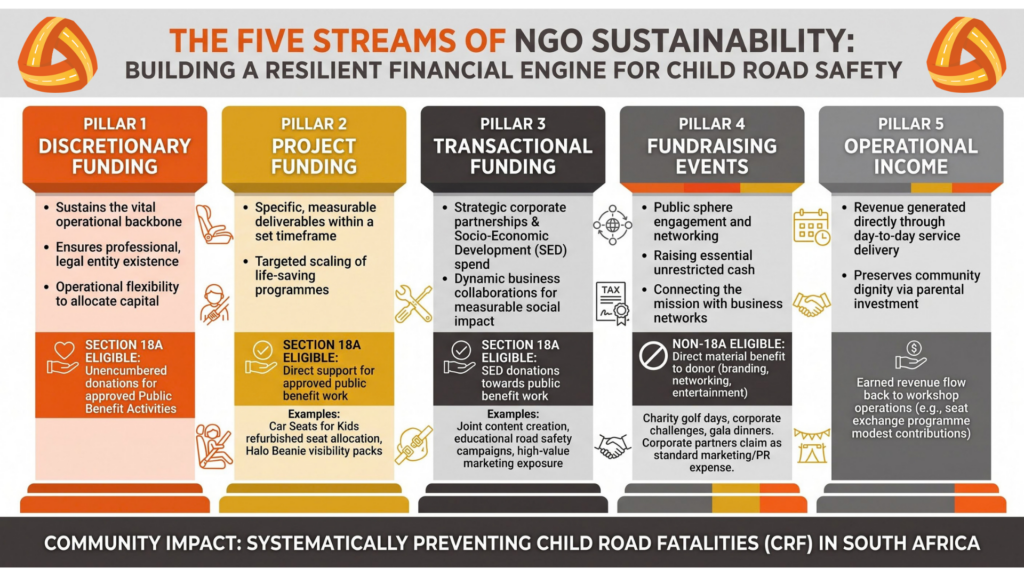
Diagram illustrating the five revenue streams of sustainable non-profit child road safety initiatives.

The Five Streams of NGO Sustainability: Building a Resilient Financial Engine for Child Road Safety
Diagram illustrating the five revenue streams of sustainable non-profit child road safety initiatives.

By Peggie Mars
Founder, Wheel Well – Child Road Safety NGO

Running a non-profit organisation in a developing economy is fundamentally an exercise in logistics, regulatory compliance, and meticulous resource management. While the public face of Wheel Well is often captured in that singular, reassuring moment when a child is buckled safely into an inspected, clean car seat, that outcome is merely the final step of an intricate operational machine.

Behind every child protected sits a rigorous logistical network: collection runs, technical stress checks, sanitisation, secure administrative record-keeping, and continuous caregiver education. To keep that machinery turning, an organisation cannot survive on good intentions or unpredictable charity alone. Just as a resilient investment portfolio relies on diversification, an effective social enterprise must balance multiple income streams. Each stream serves a distinct operational purpose, and each carries its own set of practical, legal, and tax realities.


Moving Beyond the Ten Percent Myth: The Reality of Full Cost Recovery

For decades, non-profit governance has been burdened by the counterproductive belief that a healthy NGO should restrict administrative overhead to 10 or 15 percent. Rigorous independent research across the global philanthropic sector demonstrates a very different truth: actual indirect operating costs for high-performing non-profits sit realistically between 20 and 35 percent.

In the field of child injury prevention, operational costs are never abstract administrative waste. They pay the living wages of skilled technicians who inspect car seats for hairline stress fractures. They cover the fuel for collection vehicles transporting bulky safety gear between depots and communities. They fund database connectivity, workshop sanitising agents, and the essential liability insurance required to operate legally, ethically, and safely.

To deliver lasting child injury prevention, professional non-profits must practice Full Cost Recovery. The fuel in the delivery van, technical training, and workshop facilities are direct, indispensable ingredients of community impact. Recognising this operational truth allows us to approach funding streams with clarity and strategic intent.

Confronting the Systemic Crisis of Child Road Fatalities (CRF)

The necessity of an uninterrupted operational engine becomes undeniable when examining the acute crisis on South African roads. We must confront Child Road Fatalities (CRF) with uncompromising institutional weight, moral gravity, and urgency.

Child road deaths must never be dismissed as unavoidable “accidents.” Every single instance of CRF represents a preventable systemic failure: a breakdown in adult supervision, poor pedestrian infrastructure, absent traffic law enforcement, or economic barriers that put certified child restraints out of reach for working-class families. In South Africa, where 411 child passengers and 734 child pedestrians under 14 lost their lives in a single year, CRF is not merely private family grief. It represents an unacceptable loss of future human capital and a severe, ongoing public health crisis.

Challenging official lethargy and holding road users, transport operators, and civic authorities accountable requires an organisation that is professionally staffed and financially resilient. An NGO trapped in perpetual hand-to-mouth panic cannot lead long-term policy advocacy or sustain daily technical interventions. A sound financial architecture is our primary defence against CRF.

The Five Vital Funding Streams

A sustainable non-profit distributes its operational weight across five distinct pillars, aligning compliance, tax efficiency, and community impact.

  1. Discretionary Funding: The Core Engine (Section 18A Eligible)

Discretionary or unrestricted funding is the lifeblood of an organisation. While often the hardest to secure, it sustains the vital operational backbone that allows an NGO to exist as a professional, legal entity. Because discretionary funding consists of unencumbered donations given to advance approved Public Benefit Activities, it qualifies for a Section 18A tax certificate under South African tax law. This provides corporate and individual donors with a legitimate tax deduction while giving the non-profit the operational flexibility to allocate capital wherever the mission needs it most.

  1. Project Funding: Targeted Scale (Section 18A Eligible)

Project funding is dedicated to achieving specific, measurable deliverables within a set timeframe. A corporate partner or philanthropic trust might fund the refurbishment and allocation of child seats through our Car Seats for Kids programme, or sponsor visibility packs for the Halo Beanie Project to safeguard young pedestrians walking during low-visibility hours. Because these contributions directly support approved public benefit work with auditable outcomes, they qualify for Section 18A certificates. Project funding delivers its highest return on investment when it lands within an organisation that already possesses a fully funded operational backbone.

  1. Transactional Funding: Content Creation, Strategic Exposure, and SED (Section 18A Eligible)

Transactional funding sits at the intersection of commercial strategy and measurable social impact. This includes Socio-Economic Development (SED) spend under B-BBEE codes and structured corporate partnerships. Far from being a passive compliance exercise, these relationships represent some of our most dynamic collaborations. Beyond direct capital investment, transactional partnerships allow us to collaborate with businesses on impactful joint content creation, educational road safety campaigns, and co-branded awareness drives. Corporate partners gain high-value marketing exposure and positive brand alignment through authentic social impact storytelling, while the NGO secures long-term resources and logistical reach. When structured as socio-economic development donations toward public benefit work, these contributions qualify for Section 18A certificates.

  1. Fundraising Events: Public Engagement and Networking (Non-18A Eligible)

Events like charity golf days, corporate challenges, and gala dinners play a major role in bringing our mission into the public sphere. They raise essential unrestricted cash and connect the organisation with business networks in an approachable setting. However, events operate under distinct tax regulations. Under South African law, a Section 18A certificate can only be issued for a bona fide donation where the donor receives no material benefit in return. When a business purchases a four-ball, sponsors a hole, or secures dinner seats, they receive commercial branding, networking access, and client entertainment. Because there is a direct benefit to the business, event sponsorships do not qualify for Section 18A certificates. Instead, corporate partners claim these payments as standard marketing or public relations expenses.

  1. Operational Income: Earned Revenue and Community Dignity

Operational income is revenue generated directly through day-to-day service delivery. In our seat exchange programme, parents who receive a refurbished, safety-checked restraint make a modest contribution based on what their household can afford. This model preserves community dignity. A nominal contribution transforms the dynamic from a charitable handout into an empowered parental investment in child passenger safety. These contributions flow directly back to the workshop floor to purchase replacement harness straps, buckle tongues, and sanitisation supplies. Earned revenue serves as a practical shock absorber between corporate funding cycles and proves that our service is deeply valued by the families we serve.

Total Vehicle Safety: Protecting Young Passengers on the Road

Preventing child road injuries requires looking beyond the restraint itself. Even a properly installed, high-calibre child seat cannot protect young passengers if the vehicle carrying them suffers catastrophic mechanical failure during an emergency manoeuvre. Comprehensive passenger protection demands a vehicle that is mechanically sound in every respect.

We urge all parents, caregivers, and family transport operators to prioritise preventative vehicle maintenance. Routine inspections of tyres, shock absorbers, and brake systems at certified fitment specialists such as Supa Quick are fundamental to road safety. Ensuring adequate tyre tread depth, correct inflation pressure, and responsive braking components significantly reduces stopping distances and preserves vehicle stability, preventing collisions before crash forces can impact the vehicle cabin.

When collisions do take place, families often face severe emotional and financial distress. Navigating legal claims and Road Accident Fund processes can be overwhelming for recovering or grieving caregivers. Dedicated assistance through services like RoadCover helps road accident victims secure their rightful compensation without losing significant portions of their settlement to exorbitant contingency fees. Having professional administrative backing offers vital protection and dignity when families need it most.

A Balanced Ecosystem for Lasting Impact

A high-performing non-profit functions best when these five financial streams operate in balance. Operational income keeps daily workshop consumables stocked. Fundraising events introduce the mission to fresh corporate networks. Transactional partnerships provide strategic socio-economic development, joint educational content creation, and valuable brand alignment. Project grants scale life-saving programmes into new communities. Discretionary donations ensure that skilled technicians remain employed, logistics vehicles stay fuelled, and compliance standards never slip.

When funders, corporate leaders, and social enterprises collaborate with mutual professional respect, interventions become resilient, sustainable, and effective on the ground. To partner with us or learn more about our road safety initiatives, please connect with our team.

Wheel Well is a proud winner of the Prince Michael International Road Safety Awards, recognizing achievement and innovation which improves road safety.
The Five Streams of NGO Sustainability: Building a Resilient Financial Engine for Child Road Safety Read More »

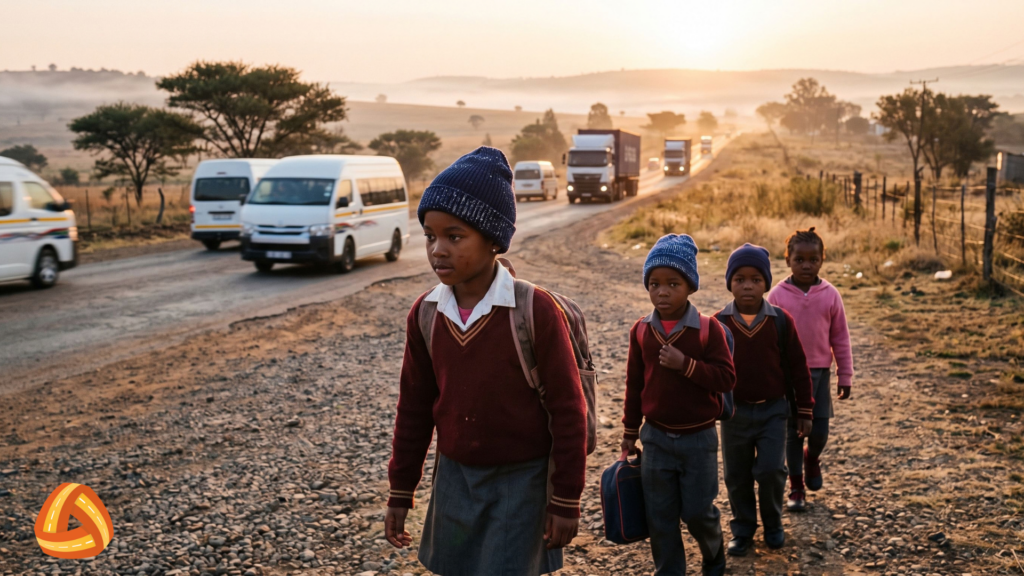
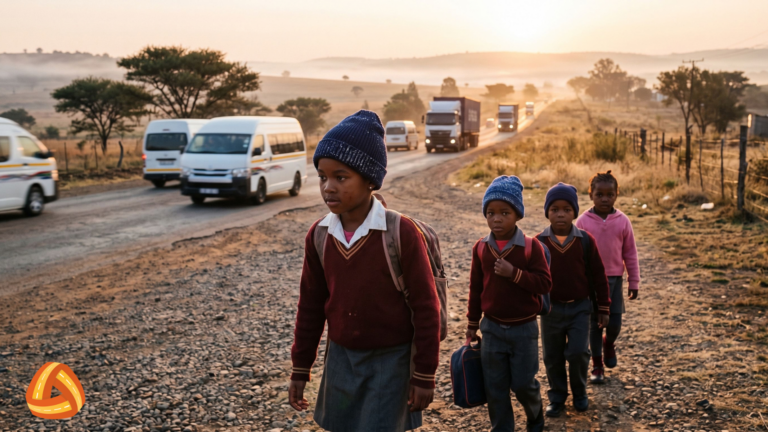
Young South African schoolchildren walking along an unpaved high-speed road corridor during low visibility sunrise.

Transport Month demands a safe Systems approach to Child Road fatalities

Young South African schoolchildren walking along an unpaved high-speed road corridor during low visibility sunrise.

By Peggie Mars
Founder, Wheel Well – Child Road Safety NGO

South Africa observes October Transport Month under the recurring theme of “Building a safe, sustainable, reliable and affordable transport system”. The official launch communications released by the Department of Transport and GCIS reveal an institutional vision detached from the daily realities facing road users. Under the headline “Advance a Safer, Sustainable Transport System,” the public announcement reads like a state-owned enterprise balance sheet. It highlights Transnet port operational efficiencies, ACSA airport upgrades, SANRAL highway contracts, and PRASA rail revivals, presenting macroeconomic logistics as the primary benchmark of a modern transit network.

While functional supply chains and efficient freight corridors are necessary for economic survival, confusing bulk freight turnaround times with transport safety reveals an acute lack of institutional imagination. A transport network cannot be considered safe simply because iron ore or export fruit reaches a container terminal on schedule. Real transport sustainability must be evaluated by whether our everyday citizens, particularly the most vulnerable, can navigate their communities without paying with their lives. When a national campaign packages transport as corporate infrastructure while omitting the human toll on our tarmac, it abdicates its primary moral responsibility.

The Moral Gravity and National Toll of Child Road Fatalities

The most devastating omission in this official framing is the complete erasure of Child Road Fatalities (CRF). In South Africa, CRF demands the exact same institutional weight, moral gravity, and cross-sector urgency that our society rightly assigns to Gender-Based Violence (GBV).

Child road deaths must never be dismissed as random accidents or unfortunate acts of fate. In every single instance, a CRF is the direct consequence of a preventable systemic failure across adult responsibility, roadway planning, law enforcement, or passenger restraint use. Dismissing these losses as ordinary road trauma conceals the profound nature of this crisis. In a developing economy, CRF is not merely private family grief. It represents a devastating, permanent loss of future human capital and a catastrophic public health emergency.

The evidence is clear and distressing. In 2025 alone, 1,034 children under the age of 14 lost their lives on South African roads. Of these young lives, 343 died as passengers inside vehicles, and 691 were killed as defenceless pedestrians. Most heartbreaking of all, across both passenger and pedestrian categories, children under four years of age were the most heavily affected. When more than a thousand children are killed within twelve months, official policy cannot hide behind generic digital globe graphics, abstract network nodes, and press release bullet points.

Reframing Transport Through a Safe Systems Approach

Slogans and ribbon-cutting ceremonies will not alter these grim outcomes. South Africa urgently requires an unyielding commitment to a Safe Systems approach.

The Safe Systems philosophy accepts two foundational premises: human beings inevitably make mistakes, and the human body, particularly that of a toddler or young child, has very strict physiological limits for tolerating physical impact forces. Children lack the physical stature, peripheral vision, and cognitive ability to judge the speed and distance of oncoming traffic. In a Safe Systems framework, we do not blame the child for an error of judgment. Instead, road design, speed limits, vehicle safety standards, and roadside environments must be engineered so that when an error occurs, the physical energy transferred remains well below the threshold of death or severe trauma.

This is where infrastructure investment must match community reality. If SANRAL is expanding high-speed freight corridors through populated rural and peri-urban areas, a Safe Systems approach dictates that continuous, separated pedestrian footpaths, raised pedestrian tables, and safe crossing bridges must precede ribbon-cutting ceremonies. child injury prevention cannot remain an afterthought tacked onto civil engineering contracts.

At Wheel Well, our work focuses on practical, evidence-based child injury prevention tailored to the socio-economic conditions of our communities. Through our affordable car seat exchange program, we recondition donated seats to make certified passenger restraints accessible to families who cannot afford steep retail markups. On our streets, where pedestrian crashes account for the majority of young lives lost, our Halo Beanie initiative utilizes 360-degree reflective yarn to ensure child pedestrians remain visible to motorists during high-risk dawn and dusk commutes. These are concrete, proven measures that address the structural realities of road trauma.

Demanding Accountability Across the Entire Transport Network

Challenging official lethargy requires demanding direct accountability across every tier of the transport sector. Planning authorities must integrate child protection into transport blueprints, traffic police must actively enforce speed thresholds in school precincts, and national regulations must require appropriate child restraints for all children under 1.5 meters in height. To support these systemic initiatives, we encourage parents, educators, and community leaders to connect with our advocacy team as we push for legislative and engineering reforms.

Individual motorists must also take responsibility for their role in the road system. Even the most forgiving road design cannot compensate for a vehicle that cannot stop in time. Worn tyre treads, compromised brake pads, and failing shock absorbers significantly lengthen stopping distances, turning an unexpected crossing by a small child into an avoidable tragedy. Proactive, regular vehicle maintenance is an essential civic duty. Motorists can schedule a comprehensive vehicle safety check by visiting their nearest specialist workshop using the Supa Quick store locator, ensuring that tyres, brakes, and suspension components perform reliably when emergency stops are required.

When collisions do take place, families often face severe administrative and economic hardship while trying to care for injured dependents. Accessing structured assistance through RoadCover offers vital legal and procedural relief, helping road crash victims navigate statutory Road Accident Fund claims without losing substantial portions of their payout to unnecessary fees.

Transport Month must evolve beyond corporate press statements and logistical metrics. An infrastructure agenda that celebrates freight efficiency while child casualties climb is an agenda that has lost its moral compass. South Africa will have a truly safe and sustainable transport network only when the physical survival of our children is made the non-negotiable benchmark of national delivery.

Wheel Well is a proud winner of the Prince Michael International Road Safety Awards, recognizing achievement and innovation which improves road safety.
Transport Month demands a safe Systems approach to Child Road fatalities Read More »

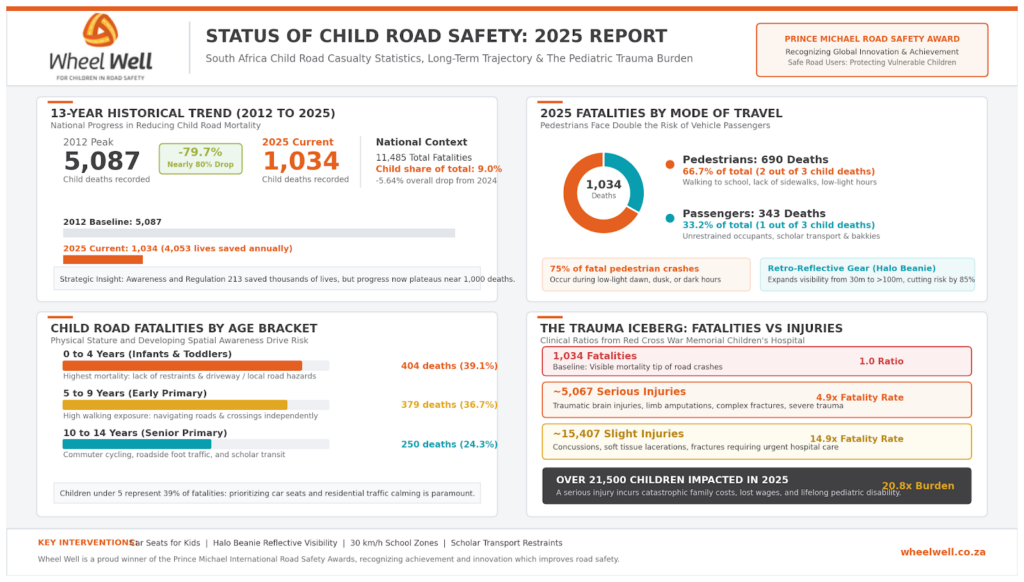
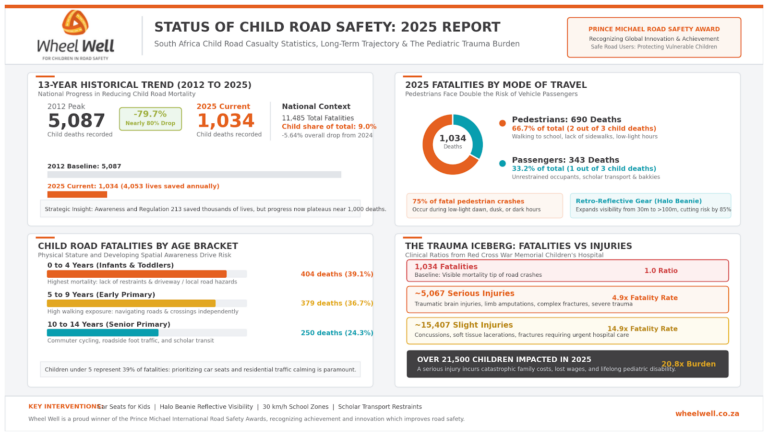
Wheel Well 2025 child road safety report infographic highlighting road casualty statistics in South Africa.

Child Road Safety in South Africa: The 2025 Status Report

Wheel Well 2025 child road safety report infographic highlighting road casualty statistics in South Africa.

By Peggie Mars
Founder, Wheel Well – Child Road Safety NGO

Introduction: Practical Evidence and Developing Realities

At Wheel Well, our mission has always cantered on a warm, thoughtful, and deeply practical approach to protecting young commuters across South Africa. Road safety in a developing economy cannot be solved with generic slogans or social media outrage. It is shaped by daily economic pressures, public transport networks, pedestrian infrastructure, and human behaviour.

Our 2025 annual review examines empirical road safety data to establish what is working, where our systems fall short, and how targeted physical solutions can protect our most vulnerable road users. By grounding our advocacy in evidence, we aim to provide parents, educators, transport operators, and policymakers with clear insight into the real-world state of child road safety.

National Road Fatality Trends in 2025

South Africa observed a measurable decrease in overall road fatalities during 2025. Total road deaths declined from 12,172 in 2024 to 11,485 in 2025, marking an annual reduction of 687 lives, or a 5.64 percent drop.

Year

Total Road Fatalities

Net Change

Percentage Shift

2024

12,172

Baseline

Baseline

2025

11,485

-687

-5.64%

While any downward trend indicates that public awareness and enforcement campaigns are having an effect, the national toll remains soberingly high. Road loss of this scale requires relentless focus on systemic safety across every province.

Age and Mode of Travel: Where Children Face the Highest Risk

Children aged 14 and younger accounted for 1,034 road deaths in 2025, representing approximately 9 percent of all road fatalities nationwide. Examining these numbers across developmental age brackets illustrates distinct vulnerability patterns:

Age Bracket

Total Fatalities (2025)

Share of Child Fatalities

0 to 4 Years

404

39.08%

5 to 9 Years

379

36.65%

10 to 14 Years

250

24.27%

Total (0 to 14 Years)

1,034

100.00%

Toddlers and infants in the 0 to 4 age group represent the largest single subset of child road deaths. Their physical vulnerability is acute whether they are unrestrained inside vehicles or walking near active residential driveways and informal settlements. As children enter primary school in the 5 to 9 age bracket, independent mobility increases alongside exposure to busy commuter routes.

The operational mode of travel reveals an even starker reality:

  • Pedestrian Fatalities: 690 child pedestrians lost their lives.
  • Passenger Fatalities: 343 child passengers lost their lives.

Child pedestrians account for twice as many deaths as vehicle passengers. Small physical stature makes young children difficult for drivers to spot over high bonnets or in vehicle blind spots, while developing cognitive skills make it difficult for young minds to judge approaching vehicle speeds accurately.

The Hidden Iceberg: Child Injury Prevention and Paediatric Trauma

Official crash statistics reflect only fatal outcomes. Non-fatal road crash injuries are not comprehensively tracked in standard national casualty databases due to significant reporting constraints.

To bridge this data void and quantify the true scope of child injury prevention, we apply clinical ratios established by the Red Cross War Memorial Children’s Hospital. For every child fatality, our healthcare facilities treat an estimated 4.9 serious injuries and 14.9 slight injuries.

Casualty Category

Ratio per Fatality

2025 Estimated Child Victims

Fatalities

1.0 (Baseline)

1,034

Serious Injuries

4.9

~5,067

Slight Injuries

14.9

~15,407

Total Child Casualties

20.8

~21,508

In 2025 alone, over 5,000 South African children suffered life-altering physical trauma, including traumatic brain injuries, amputations, and complex fractures. More than 15,400 sustained soft tissue trauma, lacerations, or concussions.

Child injury prevention is not solely about medical statistics; it is an urgent economic imperative. Severe paediatric trauma frequently results in months of lost household wages, ongoing rehabilitation costs, and lifelong disability in communities where specialized paediatric care is limited.

When a family faces sudden road trauma, navigating the legal and administrative complexities of the Road Accident Fund can feel insurmountable. Natural support systems such as RoadCover provide an indispensable service, helping victims process claims efficiently so that families receive the post-crash medical and financial assistance they need without losing their hard-earned income to unexpected legal deductions.

A Thirteen-Year Perspective: Celebrating an Eighty Percent Reduction

Taking a longer view provides critical perspective on the impact of sustained road safety work. In 2012, South Africa recorded a peak of 5,087 child road deaths. By 2025, that annual figure dropped to 1,034.

This represents an extraordinary reduction of nearly 80 percent over thirteen years. This achievement reflects the combined efforts of legislative updates, stricter law enforcement, expanding active safety technology in passenger vehicles, and tireless community advocacy. However, losing 1,034 children in a single year reminds us that progress cannot be mistaken for victory. Every single loss represents a family forever altered.

Targeted Interventions: Car Seats for Kids and the Halo Beanie

An NGO cannot claim sole credit for an 80 percent reduction across an entire nation, yet Wheel Well’s core initiatives directly addressed the exact points where children were dying.

Our Car Seats for Kids program addressed the basic laws of motion. In a collision, an unrestrained child becomes a projectile. By collecting, inspecting, refurbishing, and redistributing affordable car seats to families who could not otherwise afford them, we helped remove financial barriers to vehicle occupant safety. This grassroots work also served as a catalyst for legislative change, supporting the implementation of Regulation 213 of the National Road Traffic Act, which made car seats compulsory for infants under three.

Simultaneously, the Halo Beanie Project tackled the reality of child pedestrian exposure. Two out of three child fatalities involve pedestrians, with three-quarters of these fatal crashes occurring during dawn, dusk, or dark hours. In townships and rural settlements where sidewalks and streetlights are scarce, a child walking in dark school clothing is virtually invisible.

By knitting retro-reflective thread into warm beanies, we created a tool children actually want to wear. The reflective material increases a child’s visibility from roughly 30 metres to over 100 metres, giving drivers critical seconds to react and brake safely.

The Strategic Road Ahead to 2030: Overcoming the Plateau

Despite historic gains, child road mortality has begun to plateau around the 1,000-death mark annually. The broader national road safety strategy fell short of its 2025 interim target of 10,300 total fatalities, recording 11,485 instead. If we continue relying solely on broad appeals, child road deaths will remain trapped between 800 and 1,000 casualties each year.

Breaking this plateau requires targeted, systemic action:

  • Informal Scholar Transport: Millions of young learners travel in overcrowded minibus taxis and private bakkies where individual, bulky child seats cannot fit. Solutions must focus on approved, crash-tested harness adaptors such as the Secure-a-Kid system, which adjust adult three-point seat belts across a child’s shoulder and pelvis rather than their neck and stomach.
  • Uniform Integration of Retro-Reflectivity: High-grade reflective elements, such as the Halo Beanie, should be incorporated directly into standard school uniforms and bags to protect pedestrians immediately while long-term municipal lighting backlogs are addressed.
  • Physical Speed Calming in School Zones: Driver error contributes to the vast majority of fatal impacts. Implementing a strict 30 km/h speed limit backed by physical calming, including speed humps, rumble strips, and raised zebra crossings outside schools, engineers safety directly into the road layout.
  • Granular Crash Data: Official road incident tracking must begin recording whether child victims were travelling in private cars, informal scholar transport vehicles, or open bakkies so resources can be directed where they matter most.

If your school, community group, or fleet requires practical guidance on child passenger protection or visibility campaigns, please feel free to Talk to Wheel Well and join our community initiatives.

Mechanical Safety and Road Preparedness: The Supa Quick Standard

Active child injury prevention requires drivers to possess full mechanical control over their vehicles at all times. Even the most attentive driver cannot prevent a collision if their stopping distance is compromised by worn rubber or delayed brake response. Regular vehicle inspections form an essential line of defence against pedestrian impacts and vehicle loss of control. We strongly recommend that parents, community lift clubs, and scholar transport operators take their vehicles to Supa Quick Fitment Centres for routine checks on tyres, braking systems, and shock absorbers. Keeping these foundational safety components in prime condition ensures that your vehicle responds immediately when an unexpected hazard appears in the road ahead.

Wheel Well is a proud winner of the Prince Michael International Road Safety Awards, recognizing achievement and innovation which improves road safety.
Child Road Safety in South Africa: The 2025 Status Report Read More »

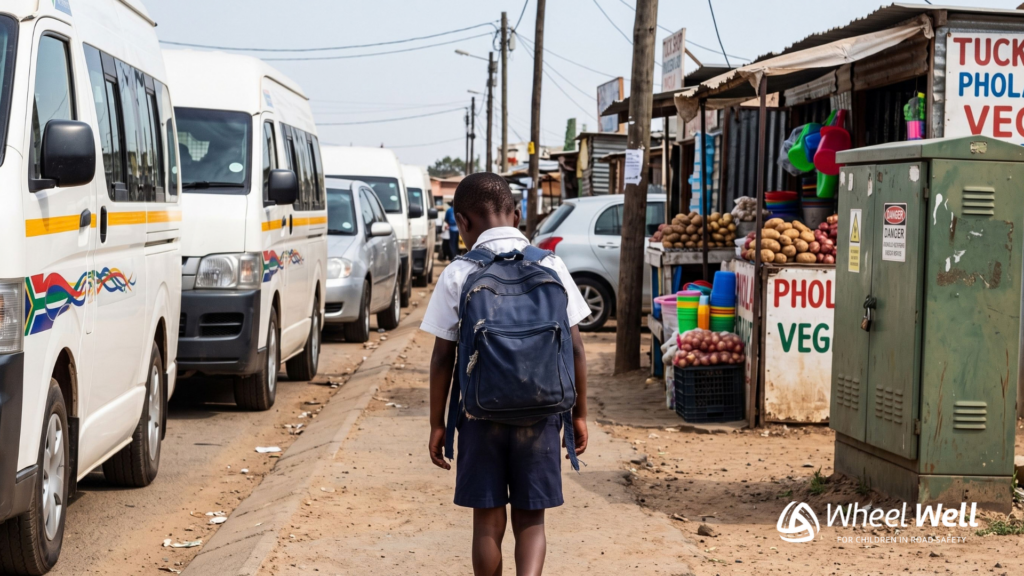
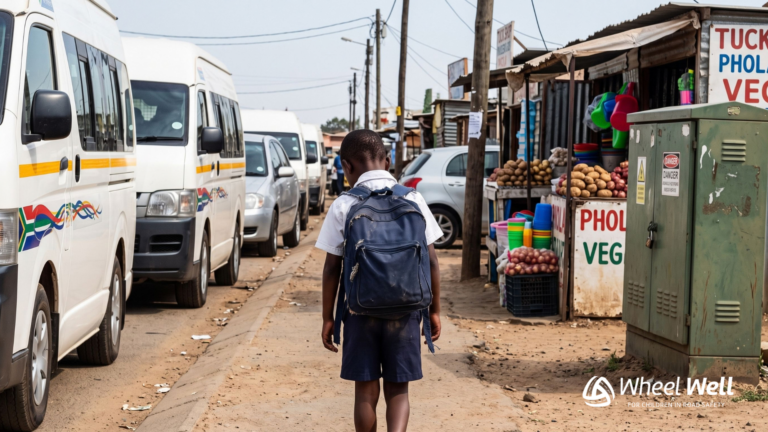
A six-year-old learner with a heavy backpack walking along an unpaved road shoulder beside parked minibus taxis and vendor stalls.

The Should-Be Passengers: Child Passenger Safety Week and the 5km Walking Reality

A six-year-old learner with a heavy backpack walking along an unpaved road shoulder beside parked minibus taxis and vendor stalls.

By Peggie Mars
Founder, Wheel Well – Child Road Safety NGO

When road safety organisations observe Child Passenger Safety Week, the focus is naturally directed toward vehicle interiors. We share life-saving guidance on rear-facing car seats, booster seat progression, seatbelt geometry, and compliant scholar transport vehicles. These conversations are vital, and Wheel Well continues to lead them through our car seat campaigns and child passenger safety initiatives every single day.

Yet in South Africa, a truly honest conversation about child passenger safety must confront an uncomfortable reality: what about the children who should be passengers, but are not?

Every morning, more than 10 million South African children set out for school on foot. For hundreds of thousands of these learners, walking is not a matter of healthy lifestyle choice or living just around the corner. They walk because they fall just short of the administrative criteria required to qualify for state-subsidised scholar transport. They are our should-be passengers. Instead of sitting securely belted inside a roadworthy bus, they navigate live, high-speed traffic corridors on foot, carrying burdens their young bodies and developing minds were never designed to bear.

The 5km Administrative Threshold and the Scholar Transport Dilemma

Under the National Learner Transport Policy, developed jointly by the Department of Transport and the Department of Basic Education, subsidised scholar transport exists to support needy learners attending public schools. In almost every province, qualification hinges on a strict distance rule: a child must live a minimum of 5 kilometres one way from their nearest appropriate school.

In the economic reality of a developing nation, resources are limited. Provincial education and transport departments operate under tight fiscal ceilings. Transporting every learner who asks for a ride is financially difficult, and lowering the eligibility threshold from 5km to 3km would instantly double or triple required transport budgets.

The consequence of this fiscal reality is a rigid, all-or-nothing line. A child living 5.1 kilometres away may be allocated a bus seat. A child living 4.8 kilometres away must walk. That 4.8km trip turns into a 9.6km round trip every single day. Children as young as six years old are expected to walk these distances along unpaved rural verges or congested township roads, simply because an administrative ruler determined they live 200 metres too close to qualify as a passenger.

Biomechanics and Energy: Why Walking is Harder on Small Bodies

Transport policies often treat walking as a uniform activity, as if a kilometre covered by a six-year-old requires the same physical effort as a kilometre covered by an adult. Biomechanical science tells an entirely different story.

Adults walk with a pendulum-like gait that naturally recycles kinetic energy, moving forward at an efficient, relatively low cadence. A six-year-old child operates with much shorter limbs and an underdeveloped musculoskeletal system. To travel the same distance as an adult, a young child must take between 30% and 50% more steps.

Locomotor studies show that the mass-specific energy cost of walking is substantially higher in young children. Per kilogram of body weight, children aged 6 to 10 expend up to 40% more metabolic energy than adults to cover an identical stretch of road.

Now add the weight of a schoolbag. A standard backpack weighing 3kg to 4kg represents 15% to 20% of a six-year-old child’s total body weight. For an adult, an equivalent load would be less than 6% of body mass. By the time a young learner completes a 4km walk to school, often having left home before dawn without a substantial meal, they are suffering from severe physical fatigue. In road safety, fatigue is hazardous. A tired child loses situational awareness, reacts slower to immediate hazards, and is far more likely to stumble or make an impulsive dash across a road.

The Horizon Problem: Sightlines and Everyday Barriers

A six-year-old child stands roughly 1.1 metres tall, with an eye line hovering around one metre above the ground. An adult stands between 1.6 and 1.8 metres tall. This difference completely changes what each pedestrian can see, and critically, who can see them.

For an adult, roadside elements are minor visual inconveniences. For a young child walking along a busy South African road, everyday objects form solid visual barriers:

  • Parked minibus taxis and passenger cars completely conceal a child from oncoming traffic.
  • Informal fruit and vegetable vendor stalls with low awnings block both forward and lateral sightlines.
  • Electrical utility boxes, waste bins, and rubble piles rise well above a child’s head, cutting off views of approaching vehicles.
  • On rural roads, unmaintained verges with tall grass and deep drainage trenches obscure small children completely as vehicles navigate bends.


Drivers sit at an elevated eye level and intuitively scan for hazards at adult height. A six-year-old stepping out from behind a parked minibus taxi remains completely invisible to a driver until the child is already in the active roadway. To help counteract this severe visibility shortfall, Wheel Well provides high-visibility Halo Beanies to young learners, giving drivers a bright, reflective visual cue even when the child’s body is partially obscured.

Cognitive Processing and the Speed-Distance Gap

Even if a route offers clear sightlines, a child’s brain does not process traffic hazards like an adult brain.

Visual attention studies show that adults continuously scan the horizon, tracking vehicle approaches and predicting potential conflicts before they happen. Children, by contrast, are easily distracted by sensory stimulation, such as animals, friends, or roadside activity. Because walking on rough gravel or broken sidewalks requires intense motor concentration, young learners also spend substantial time looking directly down at their feet to avoid tripping.

Auditory localization is another major hurdle. Children under the age of 10 struggle to pinpoint where a sound is coming from when there is competing background noise. In a noisy roadside setting with wind, multiple engines, and passing trucks, a child cannot reliably tell which vehicle is approaching or how close it is.

The greatest cognitive disparity lies in gap acceptance. Adults judge road crossings by integrating distance, closing speed, and acceleration. Children rely almost entirely on simple distance. If a car appears far away, a six-year-old perceives it as safe to cross, completely unable to calculate that a vehicle travelling at 80 km/h on a provincial road closes a 100-metre gap in less than five seconds.

Expanding Child Injury Prevention Beyond the Vehicle

During Child Passenger Safety Week, we must broaden our understanding of child injury prevention. Ensuring child safety cannot begin and end with families who own private vehicles or those lucky enough to secure a seat on a municipal school bus.

We must protect our should-be passengers through actionable, realistic measures:

  • Danger-weighted transport audits: The 5km threshold should never be applied blindly. If a 3.5km route requires an unaccompanied child to walk alongside an 80 km/h arterial road or cross an un-signalised multi-lane freight corridor, that route must be designated as non-walkable and qualify for transport assistance.
  • Community walking buses: Where state-funded transport cannot bridge the gap, organised community walking buses, where groups of younger learners walk under the direct care and supervision of trained parents and volunteers, provide essential cognitive supervision.
  • Strict school zone speed limits: Lowering and enforcing speeds to 30 km/h within school precincts drastically reduces kinetic impact force, giving both drivers and young pedestrians the margin of error needed to survive.

If your school, community, or organisation wants to collaborate on practical pedestrian safety interventions, please reach out to the Wheel Well team.

Support When Tragedy Strikes

Despite our best prevention efforts, pedestrian collisions involving children remain a heartbreaking daily reality on South African roads. When a child is struck by a vehicle, families are thrown into emotional and financial crisis, facing catastrophic medical expenses and long roads to rehabilitation.

Navigating the Road Accident Fund (RAF) claims process during such trauma can be overwhelming, and families frequently fall prey to predatory fee structures. This is where RoadCover plays an invaluable role in child injury advocacy. RoadCover assists road crash victims through the entire RAF claims process, managing legal and administrative complexities without deducting a percentage of the final payout. This ensures that every cent awarded for a child’s medical care and recovery goes directly toward their rehabilitation, giving families the vital support they need when the unthinkable occurs.

Vehicle Maintenance: The Final Safeguard for Walking Children

While we advocate for policy reform and safer walking environments, the mechanical condition of the vehicles sharing our roads serves as the absolute last line of defence. When an exhausted child misjudges traffic and steps into the street, a driver has only split seconds to react. That stop depends entirely on mechanical grip and braking efficiency.

Worn brake pads, degraded shock absorbers, or tyres with shallow tread depth can easily add several metres to an emergency stopping distance, turning a near miss into a fatal collision. Every motorist shares a profound responsibility to protect vulnerable road users. We strongly encourage all drivers to visit their local Supa Quick fitment centre for regular, professional inspections of tyres, brakes, and suspension components. Keeping your vehicle in roadworthy condition ensures that you have the stopping power needed to prevent a tragedy when a child steps into your path.

Wheel Well is a proud winner of the Prince Michael International Road Safety Awards, recognizing achievement and innovation which improves road safety.
The Should-Be Passengers: Child Passenger Safety Week and the 5km Walking Reality Read More »

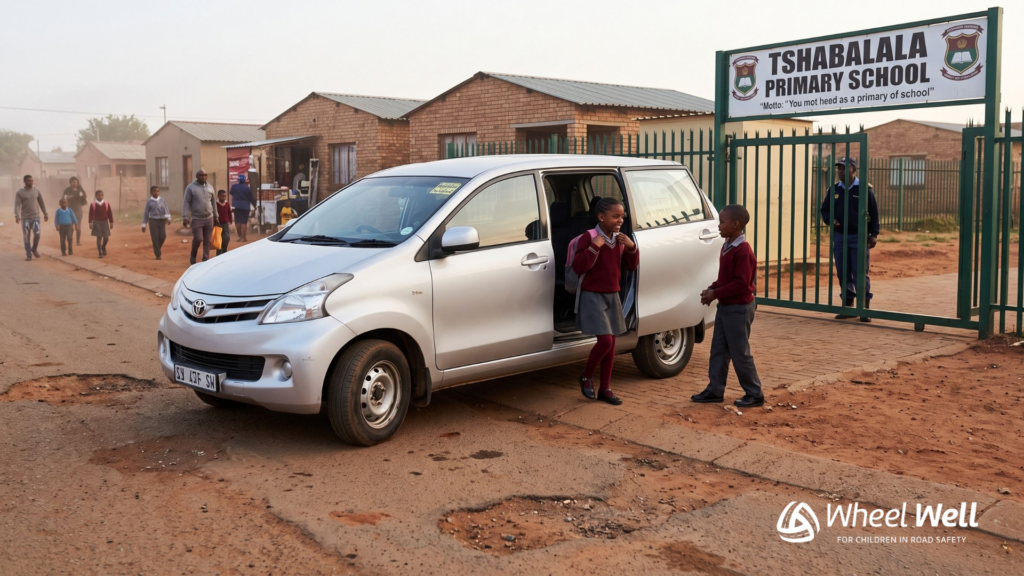
Toyota Avanza dropping off young learners safely at a South African township school gate.

Rethinking the Toyota Avanza in South African Scholar Transport

Toyota Avanza dropping off young learners safely at a South African township school gate.

Every weekday morning across South Africa, millions of young learners embark on a journey that tests the boundary between access to education and personal safety. In townships throughout Gauteng, Limpopo, KwaZulu-Natal, and the Western Cape, the seven-seater Toyota Avanza has become the central artery of neighbourhood scholar transport. Known colloquially as the “Carvela” or functioning within local feeder fleets, the Avanza is ubiquitous.

Public debate around these vehicles is frequently polarized. Traffic authorities and media headlines routinely portray Avanzas solely as unregulated hazards driven by reckless operators. At the same time, working-class parents view these drivers as a vital bridge across an unforgiving urban landscape. Meaningful child injury prevention cannot rely on indignation or periodic roadside crackdowns. We must look honestly at why the Avanza dominates this space, where the true mechanical and structural risks lie, and how pragmatic reform can protect our children.

The Spatial Reality Behind Township Scholar Transport

The South African Constitution guarantees every child the right to basic education, which inherently requires that children can reach their classrooms safely. Yet state-subsidized scholar transport remains severely underfunded. Due to budget constraints, provincial subsidies are heavily concentrated on rural learners who live more than three to five kilometres from the nearest school. The GTAC National Treasury Learner Transport Review sets out the funding pressures and coverage gaps behind this pattern.

Urban and peri-urban townships are largely excluded from this assistance under the assumption that municipal transport networks are sufficient. That assumption collapses on the ground. Decades of divided spatial planning leave residential areas disconnected from primary transit corridors. Large 60-seater buses and even standard 15-seater minibus taxis are unable or unwilling to traverse narrow, uneven, or unpaved residential streets.

The Avanza fills this structural void. It provides a nimble, door-to-door service directly from the family home to the school gate. For a parent of a Grade R or primary school pupil, the alternative is having a young child walk several kilometres through heavy traffic and personal security hazards. While pedestrian visibility programs such as the Wheel Well Halo Beanies Project provide vital protection for children on foot, parents naturally prefer vehicular transport when they can secure it. At typical township rates of R750 to R800 per month, independent Avanza operators offer the only affordable option within a working-class household budget.

The Realities of Overloading and Mechanical Strain

The undeniable utility of the Avanza does not erase its severe road safety challenges. Traffic enforcement operations repeatedly intercept seven-seater vehicles carrying anywhere from 12 to 20 children. When a vehicle designed for seven occupants carries double or triple that number, the laws of physics take over with devastating results for child injury prevention.

Overloading compromises every dynamic capability of the vehicle. Braking distances increase substantially, vehicle centres of gravity shift, and the likelihood of a rollover during emergency steering spikes dramatically. Inside the cabin, unrestrained children become human impact points during a collision. While organizations like Wheel Well champion car seats and dedicated child restraints as the gold standard of travel safety, an overloaded vehicle makes even standard three-point seatbelt usage impossible.

This dangerous pattern is rarely born of malice. It is driven by tight operational economics. Operating on slim margins with low parent fees, independent drivers often cram extra children into the cabin to make enough money to cover fuel, maintenance, and living costs. The problem is compounded when vehicles operate with worn steering components, compromised suspensions, and bald tyres. Operators caught in this financial squeeze frequently defer vehicle maintenance until critical components fail on the road.

Why Punitive Crackdowns Fail Working Families

The standard institutional response to scholar transport incidents is a high-visibility enforcement blitz. Officers issue heavy fines, impound dozens of Avanzas, and announce zero tolerance.

Yet when 50 or 60 vehicles are impounded in a single morning, the underlying mobility crisis remains entirely unresolved. Hundreds of young learners are immediately stranded. Parents must either miss work, leave children at home, or send them along dangerous walking routes without supervision. Within days, the same economic demand brings new unvetted vehicles into the neighbourhood, or forces operators to drive through back alleys to evade roadblocks.

Furthermore, unregulated operators face severe external pressures. In multiple provinces, independent scholar drivers are subjected to route extortion and intimidation from dominant minibus taxi associations that claim territorial exclusivity over local corridors. Treating these operators purely as criminals ignores the fact that they are stepping into a public service void created by institutional failure.

A Pragmatic Path Toward Safer Scholar Mobility

If we accept that the Avanza is an indispensable part of township infrastructure, our objective must change from eradication to effective integration. We need practical measures grounded in our local economic reality:

  • Targeted Scholar Transport Micro-Subsidies: Instead of pouring vast sums exclusively into expensive commercial bus contracts, provincial governments should provide targeted monthly subsidies directly to registered light-vehicle operators for every child carried legally. Subsidizing the fare eliminates the economic pressure that forces drivers to overload.
  • Fit-for-Purpose Safety Permitting: The current process of obtaining operating permits through Provincial Regulatory Entities is cumbersome and slow. Municipalities should establish a streamlined, affordable scholar transport permit category. This would allow quick roadworthiness certification focused on critical safety metrics, including working seatbelts, functional doors, uncompromised tyres, and verified Professional Driving Permits.
  • School-Level Driver Registries: School Governing Bodies (SGBs) and parent committees can manage local safety far more consistently than sporadic police operations. Schools should keep an accredited registry of vetted Avanza drivers, requiring signed safety charters that cap passenger numbers and set basic operational rules.
  • Formal Recognition as Feeder Transport: Municipal Integrated Transport Plans must formally acknowledge small passenger vehicles as neighbourhood feeder transport. Formal recognition gives these drivers legal standing, protecting them from illegal route extortion and taxi conflict.

Maintaining the Mechanical Lifeline

Policy reform takes time, but vehicle condition cannot wait. When vehicles carry our most vulnerable passengers, there is zero margin for error in steering, suspension, or stopping ability.

Dedicated preventive maintenance is the most immediate tool we have for child injury prevention. Ensuring that tyres have sufficient tread depth, brake pads and discs are responsive, and shock absorbers keep tyres firmly planted on uneven roads is critical to avoiding preventable crashes. For scholar transport operators and parents alike, regular multi-point safety checks at Supa Quick Fitment Centres across South Africa provide an accessible, professional way to ensure that tyres, brakes, and shocks are in dependable condition before children climb aboard.

Protecting Children Through Practical Collaboration

South Africa’s road safety crisis will not be solved by wishing our economic realities away. The Toyota Avanza is serving our communities because our towns and cities require agile, affordable local transport. By pairing realistic governance and micro-subsidies with rigorous vehicle maintenance and parent involvement, we can ensure every child arrives at school safe and sound. If you want to assist us in building safer transport environments for children across our communities, please feel free to reach out and talk to Wheel Well.

Wheel Well is a proud winner of the Prince Michael International Road Safety Awards, recognizing achievement and innovation which improves road safety.
Rethinking the Toyota Avanza in South African Scholar Transport Read More »

Scroll to Top