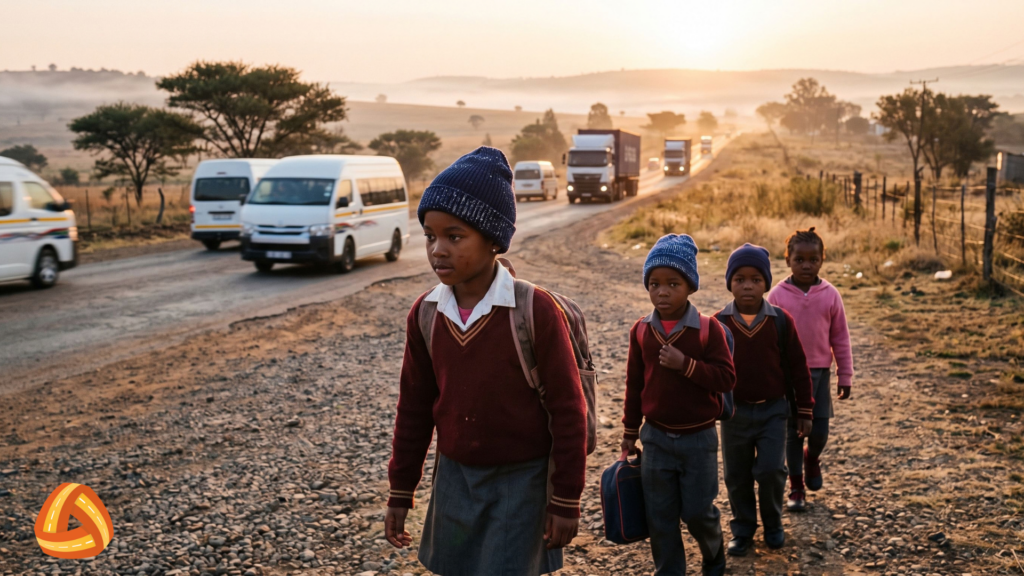
Transport Month demands a safe Systems approach to Child Road fatalities
By Peggie Mars
Founder, Wheel Well – Child Road Safety NGO
South Africa observes October Transport Month under the recurring theme of “Building a safe, sustainable, reliable and affordable transport system”. The official launch communications released by the Department of Transport and GCIS reveal an institutional vision detached from the daily realities facing road users. Under the headline “Advance a Safer, Sustainable Transport System,” the public announcement reads like a state-owned enterprise balance sheet. It highlights Transnet port operational efficiencies, ACSA airport upgrades, SANRAL highway contracts, and PRASA rail revivals, presenting macroeconomic logistics as the primary benchmark of a modern transit network.
While functional supply chains and efficient freight corridors are necessary for economic survival, confusing bulk freight turnaround times with transport safety reveals an acute lack of institutional imagination. A transport network cannot be considered safe simply because iron ore or export fruit reaches a container terminal on schedule. Real transport sustainability must be evaluated by whether our everyday citizens, particularly the most vulnerable, can navigate their communities without paying with their lives. When a national campaign packages transport as corporate infrastructure while omitting the human toll on our tarmac, it abdicates its primary moral responsibility.
The Moral Gravity and National Toll of Child Road Fatalities
The most devastating omission in this official framing is the complete erasure of Child Road Fatalities (CRF). In South Africa, CRF demands the exact same institutional weight, moral gravity, and cross-sector urgency that our society rightly assigns to Gender-Based Violence (GBV).
Child road deaths must never be dismissed as random accidents or unfortunate acts of fate. In every single instance, a CRF is the direct consequence of a preventable systemic failure across adult responsibility, roadway planning, law enforcement, or passenger restraint use. Dismissing these losses as ordinary road trauma conceals the profound nature of this crisis. In a developing economy, CRF is not merely private family grief. It represents a devastating, permanent loss of future human capital and a catastrophic public health emergency.
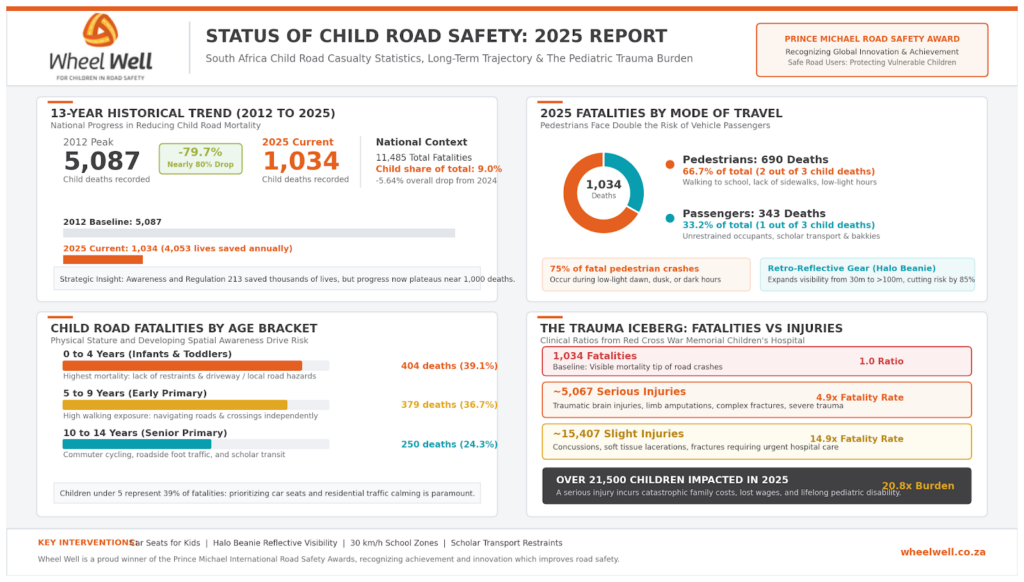
The evidence is clear and distressing. In 2025 alone, 1,034 children under the age of 14 lost their lives on South African roads. Of these young lives, 343 died as passengers inside vehicles, and 691 were killed as defenceless pedestrians. Most heartbreaking of all, across both passenger and pedestrian categories, children under four years of age were the most heavily affected. When more than a thousand children are killed within twelve months, official policy cannot hide behind generic digital globe graphics, abstract network nodes, and press release bullet points.
Reframing Transport Through a Safe Systems Approach
Slogans and ribbon-cutting ceremonies will not alter these grim outcomes. South Africa urgently requires an unyielding commitment to a Safe Systems approach.
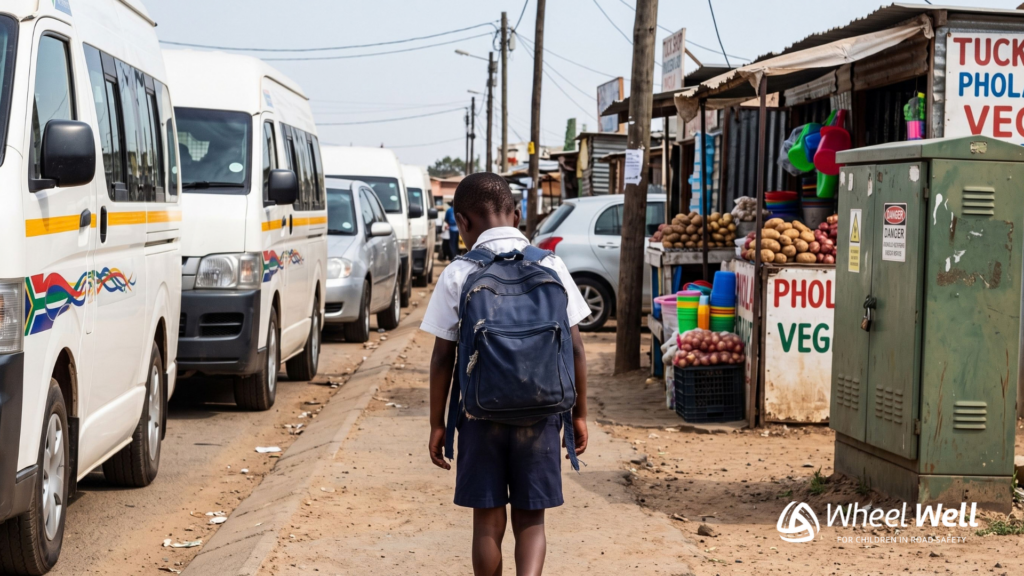
The Safe Systems philosophy accepts two foundational premises: human beings inevitably make mistakes, and the human body, particularly that of a toddler or young child, has very strict physiological limits for tolerating physical impact forces. Children lack the physical stature, peripheral vision, and cognitive ability to judge the speed and distance of oncoming traffic. In a Safe Systems framework, we do not blame the child for an error of judgment. Instead, road design, speed limits, vehicle safety standards, and roadside environments must be engineered so that when an error occurs, the physical energy transferred remains well below the threshold of death or severe trauma.
This is where infrastructure investment must match community reality. If SANRAL is expanding high-speed freight corridors through populated rural and peri-urban areas, a Safe Systems approach dictates that continuous, separated pedestrian footpaths, raised pedestrian tables, and safe crossing bridges must precede ribbon-cutting ceremonies. child injury prevention cannot remain an afterthought tacked onto civil engineering contracts.
At Wheel Well, our work focuses on practical, evidence-based child injury prevention tailored to the socio-economic conditions of our communities. Through our affordable car seat exchange program, we recondition donated seats to make certified passenger restraints accessible to families who cannot afford steep retail markups. On our streets, where pedestrian crashes account for the majority of young lives lost, our Halo Beanie initiative utilizes 360-degree reflective yarn to ensure child pedestrians remain visible to motorists during high-risk dawn and dusk commutes. These are concrete, proven measures that address the structural realities of road trauma.
Demanding Accountability Across the Entire Transport Network
Challenging official lethargy requires demanding direct accountability across every tier of the transport sector. Planning authorities must integrate child protection into transport blueprints, traffic police must actively enforce speed thresholds in school precincts, and national regulations must require appropriate child restraints for all children under 1.5 meters in height. To support these systemic initiatives, we encourage parents, educators, and community leaders to connect with our advocacy team as we push for legislative and engineering reforms.
Individual motorists must also take responsibility for their role in the road system. Even the most forgiving road design cannot compensate for a vehicle that cannot stop in time. Worn tyre treads, compromised brake pads, and failing shock absorbers significantly lengthen stopping distances, turning an unexpected crossing by a small child into an avoidable tragedy. Proactive, regular vehicle maintenance is an essential civic duty. Motorists can schedule a comprehensive vehicle safety check by visiting their nearest specialist workshop using the Supa Quick store locator, ensuring that tyres, brakes, and suspension components perform reliably when emergency stops are required.
When collisions do take place, families often face severe administrative and economic hardship while trying to care for injured dependents. Accessing structured assistance through RoadCover offers vital legal and procedural relief, helping road crash victims navigate statutory Road Accident Fund claims without losing substantial portions of their payout to unnecessary fees.
Transport Month must evolve beyond corporate press statements and logistical metrics. An infrastructure agenda that celebrates freight efficiency while child casualties climb is an agenda that has lost its moral compass. South Africa will have a truly safe and sustainable transport network only when the physical survival of our children is made the non-negotiable benchmark of national delivery.
Wheel Well is a proud winner of the Prince Michael International Road Safety Awards, recognizing achievement and innovation which improves road safety.
Transport Month demands a safe Systems approach to Child Road fatalities Read More »