
By Peggie Mars
Founder, Wheel Well – Child Road Safety NGO
When road safety organisations observe Child Passenger Safety Week, the focus is naturally directed toward vehicle interiors. We share life-saving guidance on rear-facing car seats, booster seat progression, seatbelt geometry, and compliant scholar transport vehicles. These conversations are vital, and Wheel Well continues to lead them through our car seat campaigns and child passenger safety initiatives every single day.
Yet in South Africa, a truly honest conversation about child passenger safety must confront an uncomfortable reality: what about the children who should be passengers, but are not?
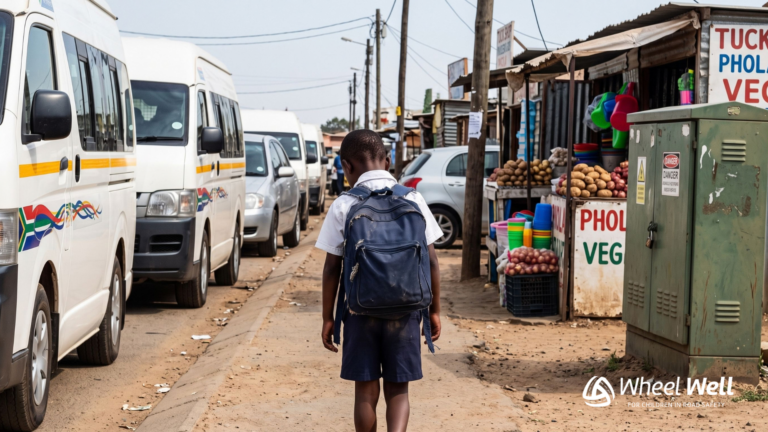
Every morning, more than 10 million South African children set out for school on foot. For hundreds of thousands of these learners, walking is not a matter of healthy lifestyle choice or living just around the corner. They walk because they fall just short of the administrative criteria required to qualify for state-subsidised scholar transport. They are our should-be passengers. Instead of sitting securely belted inside a roadworthy bus, they navigate live, high-speed traffic corridors on foot, carrying burdens their young bodies and developing minds were never designed to bear.
The 5km Administrative Threshold and the Scholar Transport Dilemma
Under the National Learner Transport Policy, developed jointly by the Department of Transport and the Department of Basic Education, subsidised scholar transport exists to support needy learners attending public schools. In almost every province, qualification hinges on a strict distance rule: a child must live a minimum of 5 kilometres one way from their nearest appropriate school.
In the economic reality of a developing nation, resources are limited. Provincial education and transport departments operate under tight fiscal ceilings. Transporting every learner who asks for a ride is financially difficult, and lowering the eligibility threshold from 5km to 3km would instantly double or triple required transport budgets.
The consequence of this fiscal reality is a rigid, all-or-nothing line. A child living 5.1 kilometres away may be allocated a bus seat. A child living 4.8 kilometres away must walk. That 4.8km trip turns into a 9.6km round trip every single day. Children as young as six years old are expected to walk these distances along unpaved rural verges or congested township roads, simply because an administrative ruler determined they live 200 metres too close to qualify as a passenger.
Biomechanics and Energy: Why Walking is Harder on Small Bodies
Transport policies often treat walking as a uniform activity, as if a kilometre covered by a six-year-old requires the same physical effort as a kilometre covered by an adult. Biomechanical science tells an entirely different story.
Adults walk with a pendulum-like gait that naturally recycles kinetic energy, moving forward at an efficient, relatively low cadence. A six-year-old child operates with much shorter limbs and an underdeveloped musculoskeletal system. To travel the same distance as an adult, a young child must take between 30% and 50% more steps.
Locomotor studies show that the mass-specific energy cost of walking is substantially higher in young children. Per kilogram of body weight, children aged 6 to 10 expend up to 40% more metabolic energy than adults to cover an identical stretch of road.
Now add the weight of a schoolbag. A standard backpack weighing 3kg to 4kg represents 15% to 20% of a six-year-old child’s total body weight. For an adult, an equivalent load would be less than 6% of body mass. By the time a young learner completes a 4km walk to school, often having left home before dawn without a substantial meal, they are suffering from severe physical fatigue. In road safety, fatigue is hazardous. A tired child loses situational awareness, reacts slower to immediate hazards, and is far more likely to stumble or make an impulsive dash across a road.
The Horizon Problem: Sightlines and Everyday Barriers
A six-year-old child stands roughly 1.1 metres tall, with an eye line hovering around one metre above the ground. An adult stands between 1.6 and 1.8 metres tall. This difference completely changes what each pedestrian can see, and critically, who can see them.
For an adult, roadside elements are minor visual inconveniences. For a young child walking along a busy South African road, everyday objects form solid visual barriers:
- Parked minibus taxis and passenger cars completely conceal a child from oncoming traffic.
- Informal fruit and vegetable vendor stalls with low awnings block both forward and lateral sightlines.
- Electrical utility boxes, waste bins, and rubble piles rise well above a child’s head, cutting off views of approaching vehicles.
- On rural roads, unmaintained verges with tall grass and deep drainage trenches obscure small children completely as vehicles navigate bends.
Drivers sit at an elevated eye level and intuitively scan for hazards at adult height. A six-year-old stepping out from behind a parked minibus taxi remains completely invisible to a driver until the child is already in the active roadway. To help counteract this severe visibility shortfall, Wheel Well provides high-visibility Halo Beanies to young learners, giving drivers a bright, reflective visual cue even when the child’s body is partially obscured.
Cognitive Processing and the Speed-Distance Gap
Even if a route offers clear sightlines, a child’s brain does not process traffic hazards like an adult brain.
Visual attention studies show that adults continuously scan the horizon, tracking vehicle approaches and predicting potential conflicts before they happen. Children, by contrast, are easily distracted by sensory stimulation, such as animals, friends, or roadside activity. Because walking on rough gravel or broken sidewalks requires intense motor concentration, young learners also spend substantial time looking directly down at their feet to avoid tripping.
Auditory localization is another major hurdle. Children under the age of 10 struggle to pinpoint where a sound is coming from when there is competing background noise. In a noisy roadside setting with wind, multiple engines, and passing trucks, a child cannot reliably tell which vehicle is approaching or how close it is.
The greatest cognitive disparity lies in gap acceptance. Adults judge road crossings by integrating distance, closing speed, and acceleration. Children rely almost entirely on simple distance. If a car appears far away, a six-year-old perceives it as safe to cross, completely unable to calculate that a vehicle travelling at 80 km/h on a provincial road closes a 100-metre gap in less than five seconds.
Expanding Child Injury Prevention Beyond the Vehicle
During Child Passenger Safety Week, we must broaden our understanding of child injury prevention. Ensuring child safety cannot begin and end with families who own private vehicles or those lucky enough to secure a seat on a municipal school bus.
We must protect our should-be passengers through actionable, realistic measures:
- Danger-weighted transport audits: The 5km threshold should never be applied blindly. If a 3.5km route requires an unaccompanied child to walk alongside an 80 km/h arterial road or cross an un-signalised multi-lane freight corridor, that route must be designated as non-walkable and qualify for transport assistance.
- Community walking buses: Where state-funded transport cannot bridge the gap, organised community walking buses, where groups of younger learners walk under the direct care and supervision of trained parents and volunteers, provide essential cognitive supervision.
- Strict school zone speed limits: Lowering and enforcing speeds to 30 km/h within school precincts drastically reduces kinetic impact force, giving both drivers and young pedestrians the margin of error needed to survive.
If your school, community, or organisation wants to collaborate on practical pedestrian safety interventions, please reach out to the Wheel Well team.
Support When Tragedy Strikes
Despite our best prevention efforts, pedestrian collisions involving children remain a heartbreaking daily reality on South African roads. When a child is struck by a vehicle, families are thrown into emotional and financial crisis, facing catastrophic medical expenses and long roads to rehabilitation.
Navigating the Road Accident Fund (RAF) claims process during such trauma can be overwhelming, and families frequently fall prey to predatory fee structures. This is where RoadCover plays an invaluable role in child injury advocacy. RoadCover assists road crash victims through the entire RAF claims process, managing legal and administrative complexities without deducting a percentage of the final payout. This ensures that every cent awarded for a child’s medical care and recovery goes directly toward their rehabilitation, giving families the vital support they need when the unthinkable occurs.
Vehicle Maintenance: The Final Safeguard for Walking Children
While we advocate for policy reform and safer walking environments, the mechanical condition of the vehicles sharing our roads serves as the absolute last line of defence. When an exhausted child misjudges traffic and steps into the street, a driver has only split seconds to react. That stop depends entirely on mechanical grip and braking efficiency.
Worn brake pads, degraded shock absorbers, or tyres with shallow tread depth can easily add several metres to an emergency stopping distance, turning a near miss into a fatal collision. Every motorist shares a profound responsibility to protect vulnerable road users. We strongly encourage all drivers to visit their local Supa Quick fitment centre for regular, professional inspections of tyres, brakes, and suspension components. Keeping your vehicle in roadworthy condition ensures that you have the stopping power needed to prevent a tragedy when a child steps into your path.
Wheel Well is a proud winner of the Prince Michael International Road Safety Awards, recognizing achievement and innovation which improves road safety.