
By Peggie Mars
Founder, Wheel Well – Child Road Safety NGO
Two separate crashes in two different provinces within days of each other have once again laid bare the horrific reality of South Africa’s scholar transport crisis.
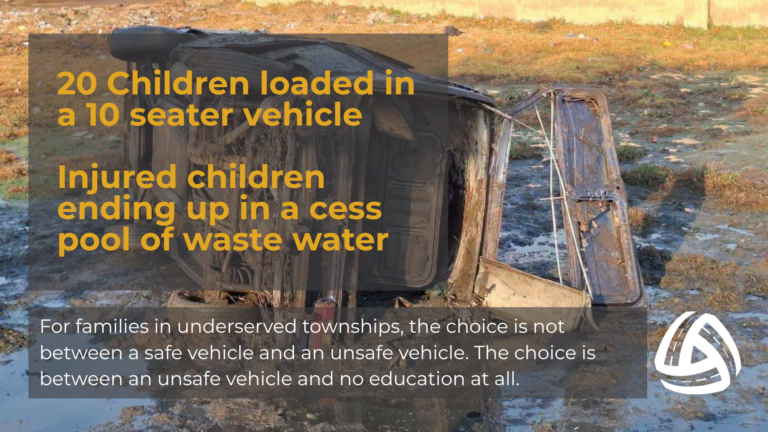
In Dididi Village, Vhembe District, a 15-year-old boy lost his life and 25 other learners were injured after a Toyota Hilux bakkie overturned. Twelve occupants, including the driver, were critically hurt. In Katlehong, Gauteng, a Volkswagen microbus with a seating capacity of 10 was crammed with 20 human beings when it collided with another vehicle, injuring several children and leaving the vehicle belly-up in a muddy cesspool of runoff water. Two children waiting on the pavement for their own transport were also struck.
These are not isolated misfortunes. They are the predictable outcome of a broken, unmonitored transport system that treats the lives of our children as an acceptable gamble.
The Myth of Invisibility: Where Was Enforcement?
In the wake of the Vhembe fatality, local government officials issued the standard political playbook: strong condemnation and public shock. Statements reminding the public that “bakkies are goods vehicles not designed to carry children” sound reasonable in a press release. But they ignore an obvious truth: that bakkie did not start transporting 26 children yesterday.
It drove those same roads, past the same communities, and through the same law enforcement jurisdictions morning after morning. Regulation 250 of the National Road Traffic Act has explicitly prohibited transporting schoolchildren in the load bay of a vehicle for reward since May 2017. The law exists. The vehicles are broad daylight realities. The lack of traffic law enforcement is what allows these dangerous operations to continue until a child dies.
Tomorrow, in communities across South Africa, traumatized children who watched their schoolmates bleeding on the side of the road will climb right back onto the back of another bakkie. Why? Because for millions of families in developing economies and underserved townships, the choice is not between a safe vehicle and an unsafe vehicle. The choice is between an unsafe vehicle and no education at all.
Why a Blind Clampdown Will Backfire
The answer to this crisis is emphatically not a heavy-handed, indiscriminate clampdown that impounds every informal vehicle overnight without providing an immediate alternative. Simply impounding bakkies and mini-buses in a punitive vacuum ignores the desperate reality of parents who have no other way to get their children to school. A rigid enforcement blitz that leaves thousands of learners stranded on the side of the road only punishes the families and deprives children of their fundamental right to education.
What is required instead is an intelligent, compassionate transition that puts local communities at the center of the design process. Parents, school governing bodies, local civic structures, and existing informal operators know the daily terrain better than anyone sitting in a provincial department office. They know exactly which routes are underserved, where the dangerous drop-offs occur, and what practical resources are needed to make vehicles safe.
Real solutions must be built with these communities, not imposed upon them from above.
From Vhembe to Gauteng: A Nationwide System Failure
While our recent analysis of the Gauteng Integrated Implementation Plan highlighted the mathematical impossibility of 83 children per single subsidized vehicle, these latest crashes prove that the scholar transport crisis respects no provincial borders.
Whether it is overloading a 10-seater minibus to double its safe capacity in Katlehong or packing 26 children into the open load bay of a light delivery vehicle in Limpopo, the underlying systemic engine is identical:
- Severe state under-capacity forces parents into the unregulated informal market.
- Lack of structural oversight allows unroadworthy, overloaded, and inappropriate vehicles to operate without support or supervision.
- Absence of targeted subsidies leaves small-scale operators scrambling to make ends meet by over-packing vehicles and racing against the clock.
In Katlehong, injured children with open wounds ended up thrown into a filthy ditch of polluted wastewater alongside a flipped vehicle. It is a grotesque, visual representation of how little safeguard our transport ecosystem currently provides for young road users.
A Direct Call to Minister Barbara Creecy and Provincial Leadership
We do not need another round of press releases offering condolences to grieving families. We do not need official statements expressing shock at practices that are openly visible on our roads every single morning.
We need immediate, coordinated, and structural action from National Transport Minister Barbara Creecy, alongside provincial MECs, local authorities, and community representatives:
- Direct Community Consultation & Route Audits: Engage directly with local communities, SGBs, and parents to map actual transport demand. Communities know where the gaps are; government must listen and build solutions around those real-world needs.
- Formalize and Subsidize Local Operators: Transition informal bakkie and minibus operators into a structured, subsidized gross-cost contracting framework. Offer pathways, financial support, and grants for operators to upgrade to safe, passenger-approved vehicles rather than simply criminalizing them.
- Targeted, Safety-First Regulation: Enforce Regulation 250 by providing immediate alternative transit options where unsafe vehicles are removed, ensuring no child is left stranded.
- Mandatory Vehicle Audits and Telematics: Tie all public and private scholar transport permits to mandatory roadworthiness certification and active speed tracking.
Demand Action, Not Sympathy
At Wheel Well, we advocate for practical, grounded road safety solutions because we know the physical cost of failure. Protecting children requires more than policy frameworks and moral outrage; it requires safe vehicles, practical enforcement, and functional public infrastructure built in partnership with the people who rely on it daily.
Keeping scholar transport fleets mechanically sound is essential. Responsible operators who require reliable vehicle checks, roadworthy tyres, and professional maintenance rely on service partners like Supa Quick to help ensure every journey is a safe one. Go for your free Safety Check today.
We cannot continue to accept the death of 15-year-olds as the price of an education. The time for clutching pearls and offering sympathies is over. Minister Creecy and provincial transport leaders must listen to our communities and fix the system now.
Wheel Well is a proud winner of the Prince Michael International Road Safety Awards, recognizing achievement and innovation which improves road safety.