
By Peggie Mars
Founder, Wheel Well – Child Road Safety NGO
Introduction: Practical Evidence and Developing Realities
At Wheel Well, our mission has always cantered on a warm, thoughtful, and deeply practical approach to protecting young commuters across South Africa. Road safety in a developing economy cannot be solved with generic slogans or social media outrage. It is shaped by daily economic pressures, public transport networks, pedestrian infrastructure, and human behaviour.
Our 2025 annual review examines empirical road safety data to establish what is working, where our systems fall short, and how targeted physical solutions can protect our most vulnerable road users. By grounding our advocacy in evidence, we aim to provide parents, educators, transport operators, and policymakers with clear insight into the real-world state of child road safety.
National Road Fatality Trends in 2025
South Africa observed a measurable decrease in overall road fatalities during 2025. Total road deaths declined from 12,172 in 2024 to 11,485 in 2025, marking an annual reduction of 687 lives, or a 5.64 percent drop.
Year | Total Road Fatalities | Net Change | Percentage Shift |
2024 | 12,172 | Baseline | Baseline |
2025 | 11,485 | -687 | -5.64% |
While any downward trend indicates that public awareness and enforcement campaigns are having an effect, the national toll remains soberingly high. Road loss of this scale requires relentless focus on systemic safety across every province.
Age and Mode of Travel: Where Children Face the Highest Risk
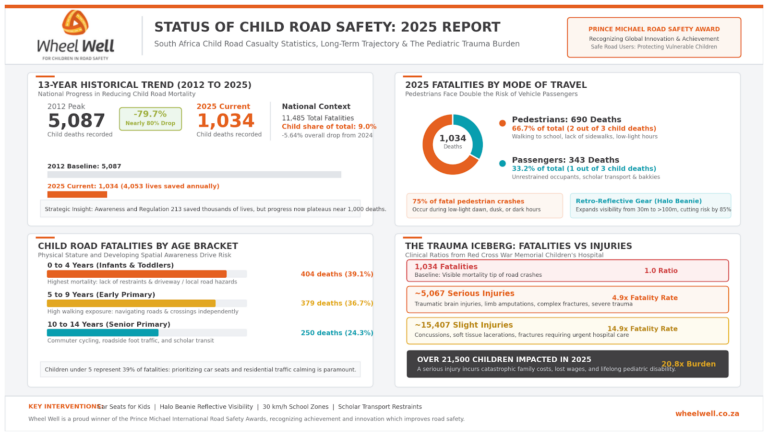
Children aged 14 and younger accounted for 1,034 road deaths in 2025, representing approximately 9 percent of all road fatalities nationwide. Examining these numbers across developmental age brackets illustrates distinct vulnerability patterns:
Age Bracket | Total Fatalities (2025) | Share of Child Fatalities |
0 to 4 Years | 404 | 39.08% |
5 to 9 Years | 379 | 36.65% |
10 to 14 Years | 250 | 24.27% |
Total (0 to 14 Years) | 1,034 | 100.00% |
Toddlers and infants in the 0 to 4 age group represent the largest single subset of child road deaths. Their physical vulnerability is acute whether they are unrestrained inside vehicles or walking near active residential driveways and informal settlements. As children enter primary school in the 5 to 9 age bracket, independent mobility increases alongside exposure to busy commuter routes.
The operational mode of travel reveals an even starker reality:
- Pedestrian Fatalities: 690 child pedestrians lost their lives.
- Passenger Fatalities: 343 child passengers lost their lives.
Child pedestrians account for twice as many deaths as vehicle passengers. Small physical stature makes young children difficult for drivers to spot over high bonnets or in vehicle blind spots, while developing cognitive skills make it difficult for young minds to judge approaching vehicle speeds accurately.
The Hidden Iceberg: Child Injury Prevention and Paediatric Trauma
Official crash statistics reflect only fatal outcomes. Non-fatal road crash injuries are not comprehensively tracked in standard national casualty databases due to significant reporting constraints.
To bridge this data void and quantify the true scope of child injury prevention, we apply clinical ratios established by the Red Cross War Memorial Children’s Hospital. For every child fatality, our healthcare facilities treat an estimated 4.9 serious injuries and 14.9 slight injuries.
Casualty Category | Ratio per Fatality | 2025 Estimated Child Victims |
Fatalities | 1.0 (Baseline) | 1,034 |
Serious Injuries | 4.9 | ~5,067 |
Slight Injuries | 14.9 | ~15,407 |
Total Child Casualties | 20.8 | ~21,508 |
In 2025 alone, over 5,000 South African children suffered life-altering physical trauma, including traumatic brain injuries, amputations, and complex fractures. More than 15,400 sustained soft tissue trauma, lacerations, or concussions.
Child injury prevention is not solely about medical statistics; it is an urgent economic imperative. Severe paediatric trauma frequently results in months of lost household wages, ongoing rehabilitation costs, and lifelong disability in communities where specialized paediatric care is limited.
When a family faces sudden road trauma, navigating the legal and administrative complexities of the Road Accident Fund can feel insurmountable. Natural support systems such as RoadCover provide an indispensable service, helping victims process claims efficiently so that families receive the post-crash medical and financial assistance they need without losing their hard-earned income to unexpected legal deductions.
A Thirteen-Year Perspective: Celebrating an Eighty Percent Reduction
Taking a longer view provides critical perspective on the impact of sustained road safety work. In 2012, South Africa recorded a peak of 5,087 child road deaths. By 2025, that annual figure dropped to 1,034.
This represents an extraordinary reduction of nearly 80 percent over thirteen years. This achievement reflects the combined efforts of legislative updates, stricter law enforcement, expanding active safety technology in passenger vehicles, and tireless community advocacy. However, losing 1,034 children in a single year reminds us that progress cannot be mistaken for victory. Every single loss represents a family forever altered.
Targeted Interventions: Car Seats for Kids and the Halo Beanie
An NGO cannot claim sole credit for an 80 percent reduction across an entire nation, yet Wheel Well’s core initiatives directly addressed the exact points where children were dying.
Our Car Seats for Kids program addressed the basic laws of motion. In a collision, an unrestrained child becomes a projectile. By collecting, inspecting, refurbishing, and redistributing affordable car seats to families who could not otherwise afford them, we helped remove financial barriers to vehicle occupant safety. This grassroots work also served as a catalyst for legislative change, supporting the implementation of Regulation 213 of the National Road Traffic Act, which made car seats compulsory for infants under three.
Simultaneously, the Halo Beanie Project tackled the reality of child pedestrian exposure. Two out of three child fatalities involve pedestrians, with three-quarters of these fatal crashes occurring during dawn, dusk, or dark hours. In townships and rural settlements where sidewalks and streetlights are scarce, a child walking in dark school clothing is virtually invisible.
By knitting retro-reflective thread into warm beanies, we created a tool children actually want to wear. The reflective material increases a child’s visibility from roughly 30 metres to over 100 metres, giving drivers critical seconds to react and brake safely.
The Strategic Road Ahead to 2030: Overcoming the Plateau
Despite historic gains, child road mortality has begun to plateau around the 1,000-death mark annually. The broader national road safety strategy fell short of its 2025 interim target of 10,300 total fatalities, recording 11,485 instead. If we continue relying solely on broad appeals, child road deaths will remain trapped between 800 and 1,000 casualties each year.
Breaking this plateau requires targeted, systemic action:
- Informal Scholar Transport: Millions of young learners travel in overcrowded minibus taxis and private bakkies where individual, bulky child seats cannot fit. Solutions must focus on approved, crash-tested harness adaptors such as the Secure-a-Kid system, which adjust adult three-point seat belts across a child’s shoulder and pelvis rather than their neck and stomach.
- Uniform Integration of Retro-Reflectivity: High-grade reflective elements, such as the Halo Beanie, should be incorporated directly into standard school uniforms and bags to protect pedestrians immediately while long-term municipal lighting backlogs are addressed.
- Physical Speed Calming in School Zones: Driver error contributes to the vast majority of fatal impacts. Implementing a strict 30 km/h speed limit backed by physical calming, including speed humps, rumble strips, and raised zebra crossings outside schools, engineers safety directly into the road layout.
- Granular Crash Data: Official road incident tracking must begin recording whether child victims were travelling in private cars, informal scholar transport vehicles, or open bakkies so resources can be directed where they matter most.
If your school, community group, or fleet requires practical guidance on child passenger protection or visibility campaigns, please feel free to Talk to Wheel Well and join our community initiatives.
Mechanical Safety and Road Preparedness: The Supa Quick Standard
Active child injury prevention requires drivers to possess full mechanical control over their vehicles at all times. Even the most attentive driver cannot prevent a collision if their stopping distance is compromised by worn rubber or delayed brake response. Regular vehicle inspections form an essential line of defence against pedestrian impacts and vehicle loss of control. We strongly recommend that parents, community lift clubs, and scholar transport operators take their vehicles to Supa Quick Fitment Centres for routine checks on tyres, braking systems, and shock absorbers. Keeping these foundational safety components in prime condition ensures that your vehicle responds immediately when an unexpected hazard appears in the road ahead.
Wheel Well is a proud winner of the Prince Michael International Road Safety Awards, recognizing achievement and innovation which improves road safety.