
By Peggie Mars
Founder, Wheel Well – Child Road Safety NGO
The Gauteng Department of Roads and Transport has announced the suspension of three critical application requirements on the Gauteng Public Transport Regulatory Information System (GPTRIS) until 30 April 2027.
The three suspended requirements are:
- Police Clearance Certificates: Applicants applying for public transport operating licences are exempt from submitting criminal record clearances during this grace period.
- Labour Law Compliance Undertakings: Applicants no longer need to submit a formal undertaking confirming compliance with the Basic Conditions of Employment Act and the Labour Relations Act.
- Professional Driving Permits (PrDPs) for Non-Driving Owners: Applicants who own public transport vehicles or licences purely as business assets, and who do not drive the vehicles themselves, are exempt from holding a PrDP.
This policy shift follows mounting administrative friction, severe processing backlogs at provincial Transport Operating Licence Administrative Bodies (TOLABs), and pushback from operator associations. While parts of this intervention reflect sensible administrative rationalisation, the broader suspension creates unacceptable compromises for child passenger safety.
Sensible Relief Versus Non-Negotiable Child Safeguards
Administrative efficiency should eliminate useless friction, but it must never dismantle baseline protection.
Scrapping the requirement for non-driving owners to hold a Professional Driving Permit is a sensible, overdue correction. Demanding a Category P PrDP and medical fitness certificate from a silent investor, a fleet financier, or an elderly relative who owns a family minibus but never gets behind the steering wheel was administrative overreach. It burdened testing centres and created pointless paperwork hurdles for legitimate vehicle owners. For those who never drive, the PrDP requirement added no measurable safety value.
The physical driver, however, occupies a non-negotiable position of public trust. The individual holding the steering wheel must possess a valid driving licence, an active Category P PrDP, and verified medical clearance confirming cardiovascular health and visual acuity.
The dangerous failure in the department’s blanket suspension lies in treating dedicated scholar transport like general bulk freight. Lumping school transport operators into the same regulatory basket as standard long-distance taxis ignores the distinct physical and social vulnerability of young passengers.
When a scholar transport vehicle displays an official provincial operating licence disc, parents, schools, and communities assume the state has conducted thorough background vetting. By waiving the submission of police clearance certificates, the provincial regulatory system introduces a dangerous false sense of security. Unvetted individuals can operate unsupervised transport runs carrying minor children every morning and afternoon.
The severe backlogs within the South African Police Service (SAPS) Criminal Record Centre are well documented. However, bypassing background checks entirely does not resolve bureaucratic dysfunction. It simply passes the buck down to ordinary parents, voluntary school committees, and teachers. These individuals lack the legal mandates, investigative databases, and biometric equipment necessary to conduct criminal record checks and verify whether a driver appears on the National Register for Sex Offenders or Part B of the Child Protection Register.
Why Labour Compliance is an Inseparable Road Safety Pillar
Labour law compliance is frequently dismissed as administrative red tape, yet it directly influences operational safety on every road.
Under the Labour Relations Act, the Basic Conditions of Employment Act, and Sectoral Determination 11 governing the taxi sector, compliance begins at employee number one. Any operator employing even a single driver or onboard child minder is legally bound to provide written employment contracts, pay statutory minimum wages, and adhere to regulated working hours.
Driver fatigue is engineered through economic exploitation. When operators force hired drivers into gruelling 16-hour split shifts, pay wages below the statutory minimum, and penalise workers by docking pay for mechanical breakdowns, severe physical exhaustion is inevitable. That fatigue manifests as speeding, aggressive overtaking, and delayed braking to meet daily revenue targets.
Systemic corner-cutting follows a predictable pattern. An operator who refuses to register employees for the Unemployment Insurance Fund (UIF) or the Compensation for Occupational Injuries and Diseases Act (COIDA) is the same operator running bald tyres, skipping routine brake services, and ignoring vehicle suspension wear.
This neglect carries severe financial and legal liabilities. Non-compliant transport operators face CCMA compensation orders of up to 12 months salary, personal financial ruin in the event of uninsurable worker injuries, and vehicle attachment by the Sheriff of the Court.
Fair employment standards, vehicle roadworthiness, and active child injury prevention are inextricably linked. Transporting children is not an ordinary commercial hustle. If an operator chooses to derive an income carrying young learners, rigorous vetting, fair employment standards, and strict vehicle maintenance represent the baseline cost of running a legitimate enterprise.
The Reality of the 600-to-54 Application Gap
The current regulatory crisis is rooted in deep operational disconnection. During a provincial stakeholder engagement in Soweto, the department revealed that out of more than 600 licence application forms collected by operators, only 54 completed packs were returned. Over 90 percent of prospective applicants abandoned the licensing journey before submission.
This drop-off does not indicate that nine out of ten operators actively desire to remain illegal. Rather, it illustrates administrative paralysis and paperwork intimidation. Many small operators run micro-enterprises without formal legal counsel or clerical support. Facing multiple disconnected queues across municipal, provincial, and national departments, operators simply give up.
Concurrently, tensions between enforcement agencies and informal operators have flared into service boycotts and protests against impoundments. The provincial government had already met operators halfway by negotiating discounted roadworthy testing fees with private vehicle testing stations. Capitulating on police clearances and basic labour compliance undertakings, however, trades long-term child safety for short-term administrative relief.
Lowering regulatory thresholds because provincial offices cannot process applications on time is a surrender to institutional inefficiency. When systems fail, the solution is not to compromise child safeguarding standards; it is to reform service delivery so compliance becomes accessible.
Framing the Crisis: Child Road Fatalities (CRF) as Systemic Failures
To address this challenge honestly, child road deaths must be viewed with clarity and moral urgency. Within Wheel Well, these incidents are framed through the lens of Child Road Fatalities (CRF).
Every single CRF is a preventable failure of adult responsibility, road infrastructure, vehicle maintenance, or passenger restraint enforcement. These tragedies must never be dismissed as random accidents or bad luck.
CRF represents a devastating national crisis in our developing economy. When hundreds of children lose their lives on South African roads each year, the loss extends far beyond private household grief. It depletes our country of future teachers, engineers, healthcare workers, and innovators. It constitutes a severe, recurring public health emergency that demands institutional accountability from road authorities, operators, and society at large.
Announcing high-profile festive season traffic operations with zero tolerance slogans cannot disguise administrative concessions made at licensing counters. Blue-light roadblocks and midnight roadside fines cannot detect whether a scholar transport driver has been behind the wheel for 15 unbroken hours or possesses an unvetted criminal record. Genuine road safety and child injury prevention begin with proactive administrative vetting long before an operating disc is affixed to a windscreen.
Ensuring safe travel environments requires an integrated approach to passenger safety, whether supporting young pedestrians on morning roads through high-visibility interventions like the Halo Beanie Project or securing infants and primary school learners through dedicated restraint programmes like Wheel Well Car Seats for Kids.
The Solution: Deploying Mobile Compliance Vans with Haste
Instead of an open-ended grace period until April 2027 that normalises unvetted operations, provincial authorities must deploy practical administrative resources directly to the transport industry.
The primary barrier preventing operators from formalising is lost operational time. Scholar transport operators work split shifts: early morning runs from 06:00 to 08:30, followed by afternoon pickups between 13:30 to 16:30. Sitting in day-long queues at distant TOLAB offices means sacrificing a full day of income.
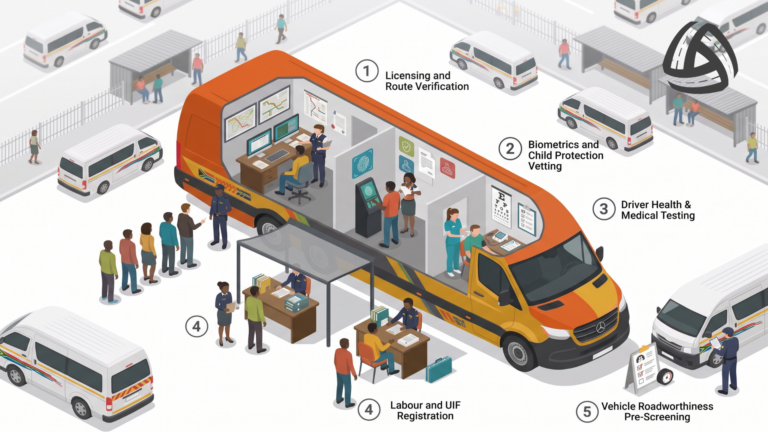
Gauteng must immediately deploy fully equipped Mobile Compliance Vans that rotate through school clusters, taxi ranks, and community halls. Bringing services to operators during their midday operational lull removes the practical friction that drives non-compliance. It turns an adversarial, desk-bound system into active, community-based governance.
Meeting operators where they work closes the 600-to-54 application gap. It replaces administrative intimidation with hands-on assistance, breaks down bureaucratic silos, and eliminates the excuse of inaccessible licensing offices.
The Five Essential Desks Inside a Mobile Compliance Van
To succeed, a mobile compliance unit must operate as a functional, multi-departmental service hub housing five coordinated operational desks:
- Operating Licences and Route Administration (GDRT / TOLAB): Onboard staff connect directly to the GPTRIS database to verify routes, process new applications, manage renewals, and authenticate School Governing Body (SGB) endorsement letters. Crucially, this desk issues verified, tamper-proof temporary receipts that protect operators from vehicle impoundment while their final operating discs are processed.
- Biometric Vetting and Child Safeguarding (SAPS): A digital live-scan fingerprinting station connects directly to the SAPS Criminal Record Centre. Fingerprints are processed electronically on site, cross-referencing both the National Register for Sex Offenders and Part B of the Child Protection Register. An authorised commissioner of oaths verifies supporting affidavits on the spot.
- Driver Health, Fitness, and Permitting (Department of Health and DLTC): A qualified occupational health nurse conducts mandatory medical examinations, screening drivers for hypertension, cardiovascular risks, and chronic illness. Automated visual acuity stations conduct eye tests on site, allowing operators to complete their Category P PrDP medical clearance without private optometrist fees or DLTC delays.
- Labour, UIF, and Injury Compensation (Department of Employment and Labour): Officials register operators and support staff onto the uFiling system and process registrations for the Compensation Fund under COIDA. Plain-language employment contracts compliant with Sectoral Determination 11 are provided free of charge, establishing clear minimum wage and maximum shift-length terms.
- Vehicle Safety Pre-Screening and Roadworthiness Advisory: Technicians conduct a 20-point safety check covering tyre tread depths, brake pads, shock absorbers, seatbelt anchors, emergency exits, and onboard fire extinguishers. Operators receive fast-track booking vouchers for accredited private testing stations offering negotiated provincial discounts, alongside guidance on passenger liability protections.
Where mechanical or human failures do result in roadway collisions, families and transport operators must navigate complex post-crash claims without facing exploitative third-party fees. Navigating the statutory claims process with the Road Accident Fund requires sound professional guidance, which is why services such as RoadCover provide crucial assistance in protecting victims, safeguarding compensation, and securing recovery support for vulnerable passengers.
Maintaining Safety Beyond the Bureaucracy
Administrative compliance creates legal standing, but mechanical reliability preserves lives on the road. Regardless of licence paperwork or policy grace periods, the laws of physics on South African roads remain uncompromising. A worn tyre cannot grip wet asphalt during an emergency stop, and defective shock absorbers lengthen braking distances while destabilising a fully loaded passenger vehicle. Responsible operators protect their passengers by investing in preventative maintenance before mechanical faults cause irreversible tragedy. For thorough wheel alignment, brake system assessments, shock absorber testing, and tyre replacement, operators can locate their nearest certified fitment centre through the Supa Quick Store Locator. Prioritising proactive vehicle maintenance ensures that every transport vehicle operates as a safe, dependable sanctuary for the passengers in its care.
Lowering safety thresholds to accommodate bureaucratic delays places young lives at direct risk. By taking compliance directly to the ranks through coordinated mobile clinics, government can support transport livelihoods while building a reliable, dignified transport sector. To partner with us or explore how communities, schools, and transport operators can collaborate on practical safety programmes, please Contact Wheel Well.
Wheel Well is a proud winner of the Prince Michael International Road Safety Awards, recognizing achievement and innovation which improves road safety.