The Five Streams of NGO Sustainability: Building a Resilient Financial Engine for Child Road Safety
By Peggie Mars
Founder, Wheel Well – Child Road Safety NGO
Running a non-profit organisation in a developing economy is fundamentally an exercise in logistics, regulatory compliance, and meticulous resource management. While the public face of Wheel Well is often captured in that singular, reassuring moment when a child is buckled safely into an inspected, clean car seat, that outcome is merely the final step of an intricate operational machine.
Behind every child protected sits a rigorous logistical network: collection runs, technical stress checks, sanitisation, secure administrative record-keeping, and continuous caregiver education. To keep that machinery turning, an organisation cannot survive on good intentions or unpredictable charity alone. Just as a resilient investment portfolio relies on diversification, an effective social enterprise must balance multiple income streams. Each stream serves a distinct operational purpose, and each carries its own set of practical, legal, and tax realities.
Moving Beyond the Ten Percent Myth: The Reality of Full Cost Recovery
For decades, non-profit governance has been burdened by the counterproductive belief that a healthy NGO should restrict administrative overhead to 10 or 15 percent. Rigorous independent research across the global philanthropic sector demonstrates a very different truth: actual indirect operating costs for high-performing non-profits sit realistically between 20 and 35 percent.
In the field of child injury prevention, operational costs are never abstract administrative waste. They pay the living wages of skilled technicians who inspect car seats for hairline stress fractures. They cover the fuel for collection vehicles transporting bulky safety gear between depots and communities. They fund database connectivity, workshop sanitising agents, and the essential liability insurance required to operate legally, ethically, and safely.
To deliver lasting child injury prevention, professional non-profits must practice Full Cost Recovery. The fuel in the delivery van, technical training, and workshop facilities are direct, indispensable ingredients of community impact. Recognising this operational truth allows us to approach funding streams with clarity and strategic intent.
Confronting the Systemic Crisis of Child Road Fatalities (CRF)
The necessity of an uninterrupted operational engine becomes undeniable when examining the acute crisis on South African roads. We must confront Child Road Fatalities (CRF) with uncompromising institutional weight, moral gravity, and urgency.
Child road deaths must never be dismissed as unavoidable “accidents.” Every single instance of CRF represents a preventable systemic failure: a breakdown in adult supervision, poor pedestrian infrastructure, absent traffic law enforcement, or economic barriers that put certified child restraints out of reach for working-class families. In South Africa, where 411 child passengers and 734 child pedestrians under 14 lost their lives in a single year, CRF is not merely private family grief. It represents an unacceptable loss of future human capital and a severe, ongoing public health crisis.
Challenging official lethargy and holding road users, transport operators, and civic authorities accountable requires an organisation that is professionally staffed and financially resilient. An NGO trapped in perpetual hand-to-mouth panic cannot lead long-term policy advocacy or sustain daily technical interventions. A sound financial architecture is our primary defence against CRF.
The Five Vital Funding Streams
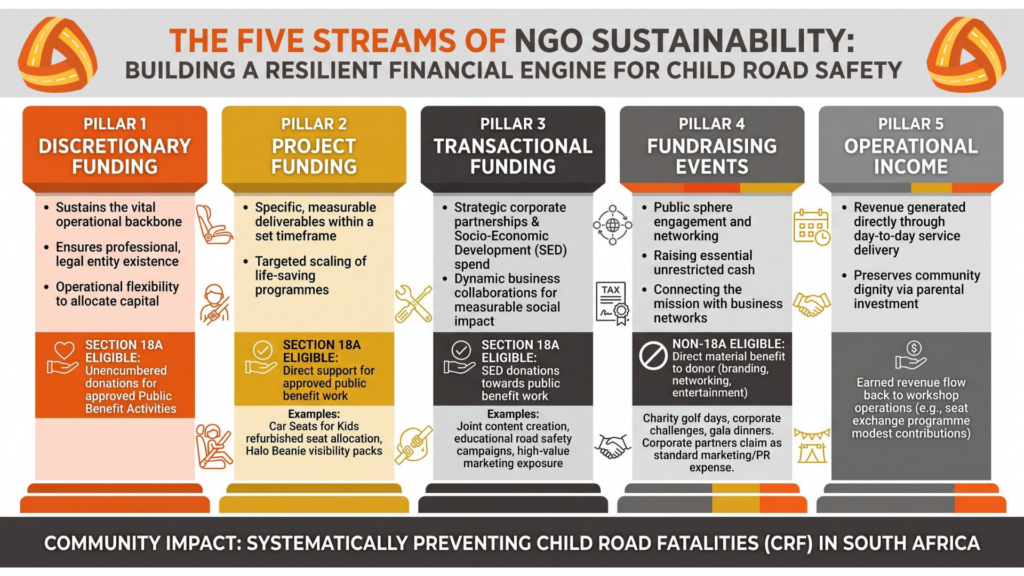
A sustainable non-profit distributes its operational weight across five distinct pillars, aligning compliance, tax efficiency, and community impact.
Discretionary Funding: The Core Engine (Section 18A Eligible)
Discretionary or unrestricted funding is the lifeblood of an organisation. While often the hardest to secure, it sustains the vital operational backbone that allows an NGO to exist as a professional, legal entity. Because discretionary funding consists of unencumbered donations given to advance approved Public Benefit Activities, it qualifies for a Section 18A tax certificate under South African tax law. This provides corporate and individual donors with a legitimate tax deduction while giving the non-profit the operational flexibility to allocate capital wherever the mission needs it most.
Project Funding: Targeted Scale (Section 18A Eligible)
Project funding is dedicated to achieving specific, measurable deliverables within a set timeframe. A corporate partner or philanthropic trust might fund the refurbishment and allocation of child seats through our Car Seats for Kids programme, or sponsor visibility packs for the Halo Beanie Project to safeguard young pedestrians walking during low-visibility hours. Because these contributions directly support approved public benefit work with auditable outcomes, they qualify for Section 18A certificates. Project funding delivers its highest return on investment when it lands within an organisation that already possesses a fully funded operational backbone.
Transactional Funding: Content Creation, Strategic Exposure, and SED (Section 18A Eligible)
Transactional funding sits at the intersection of commercial strategy and measurable social impact. This includes Socio-Economic Development (SED) spend under B-BBEE codes and structured corporate partnerships. Far from being a passive compliance exercise, these relationships represent some of our most dynamic collaborations. Beyond direct capital investment, transactional partnerships allow us to collaborate with businesses on impactful joint content creation, educational road safety campaigns, and co-branded awareness drives. Corporate partners gain high-value marketing exposure and positive brand alignment through authentic social impact storytelling, while the NGO secures long-term resources and logistical reach. When structured as socio-economic development donations toward public benefit work, these contributions qualify for Section 18A certificates.
Fundraising Events: Public Engagement and Networking (Non-18A Eligible)
Events like charity golf days, corporate challenges, and gala dinners play a major role in bringing our mission into the public sphere. They raise essential unrestricted cash and connect the organisation with business networks in an approachable setting. However, events operate under distinct tax regulations. Under South African law, a Section 18A certificate can only be issued for a bona fide donation where the donor receives no material benefit in return. When a business purchases a four-ball, sponsors a hole, or secures dinner seats, they receive commercial branding, networking access, and client entertainment. Because there is a direct benefit to the business, event sponsorships do not qualify for Section 18A certificates. Instead, corporate partners claim these payments as standard marketing or public relations expenses.
Operational Income: Earned Revenue and Community Dignity
Operational income is revenue generated directly through day-to-day service delivery. In our seat exchange programme, parents who receive a refurbished, safety-checked restraint make a modest contribution based on what their household can afford. This model preserves community dignity. A nominal contribution transforms the dynamic from a charitable handout into an empowered parental investment in child passenger safety. These contributions flow directly back to the workshop floor to purchase replacement harness straps, buckle tongues, and sanitisation supplies. Earned revenue serves as a practical shock absorber between corporate funding cycles and proves that our service is deeply valued by the families we serve.
Total Vehicle Safety: Protecting Young Passengers on the Road
Preventing child road injuries requires looking beyond the restraint itself. Even a properly installed, high-calibre child seat cannot protect young passengers if the vehicle carrying them suffers catastrophic mechanical failure during an emergency manoeuvre. Comprehensive passenger protection demands a vehicle that is mechanically sound in every respect.
We urge all parents, caregivers, and family transport operators to prioritise preventative vehicle maintenance. Routine inspections of tyres, shock absorbers, and brake systems at certified fitment specialists such as Supa Quick are fundamental to road safety. Ensuring adequate tyre tread depth, correct inflation pressure, and responsive braking components significantly reduces stopping distances and preserves vehicle stability, preventing collisions before crash forces can impact the vehicle cabin.
When collisions do take place, families often face severe emotional and financial distress. Navigating legal claims and Road Accident Fund processes can be overwhelming for recovering or grieving caregivers. Dedicated assistance through services like RoadCover helps road accident victims secure their rightful compensation without losing significant portions of their settlement to exorbitant contingency fees. Having professional administrative backing offers vital protection and dignity when families need it most.
A Balanced Ecosystem for Lasting Impact
A high-performing non-profit functions best when these five financial streams operate in balance. Operational income keeps daily workshop consumables stocked. Fundraising events introduce the mission to fresh corporate networks. Transactional partnerships provide strategic socio-economic development, joint educational content creation, and valuable brand alignment. Project grants scale life-saving programmes into new communities. Discretionary donations ensure that skilled technicians remain employed, logistics vehicles stay fuelled, and compliance standards never slip.
When funders, corporate leaders, and social enterprises collaborate with mutual professional respect, interventions become resilient, sustainable, and effective on the ground. To partner with us or learn more about our road safety initiatives, please connect with our team.
Wheel Well is a proud winner of the Prince Michael International Road Safety Awards, recognizing achievement and innovation which improves road safety.