• Child Passenger Safety Week

Wheel Well 2025 child road safety report infographic highlighting road casualty statistics in South Africa.

Child Road Safety in South Africa: The 2025 Status Report
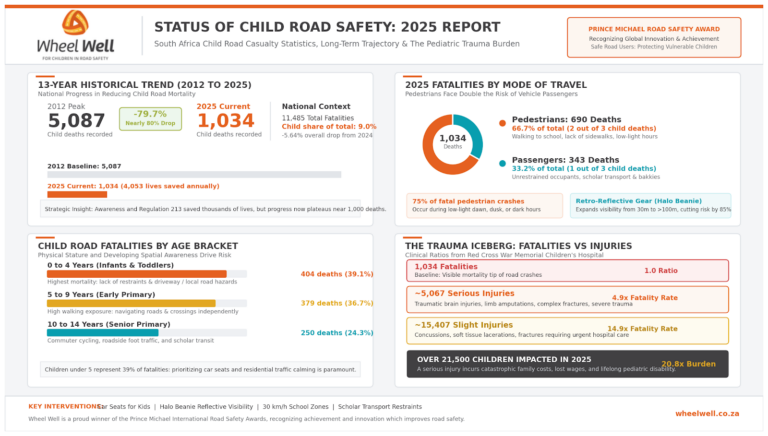
Wheel Well 2025 child road safety report infographic highlighting road casualty statistics in South Africa.

By Peggie Mars
Founder, Wheel Well – Child Road Safety NGO

Introduction: Practical Evidence and Developing Realities

At Wheel Well, our mission has always cantered on a warm, thoughtful, and deeply practical approach to protecting young commuters across South Africa. Road safety in a developing economy cannot be solved with generic slogans or social media outrage. It is shaped by daily economic pressures, public transport networks, pedestrian infrastructure, and human behaviour.

Our 2025 annual review examines empirical road safety data to establish what is working, where our systems fall short, and how targeted physical solutions can protect our most vulnerable road users. By grounding our advocacy in evidence, we aim to provide parents, educators, transport operators, and policymakers with clear insight into the real-world state of child road safety.

National Road Fatality Trends in 2025

South Africa observed a measurable decrease in overall road fatalities during 2025. Total road deaths declined from 12,172 in 2024 to 11,485 in 2025, marking an annual reduction of 687 lives, or a 5.64 percent drop.

Year

Total Road Fatalities

Net Change

Percentage Shift

2024

12,172

Baseline

Baseline

2025

11,485

-687

-5.64%

While any downward trend indicates that public awareness and enforcement campaigns are having an effect, the national toll remains soberingly high. Road loss of this scale requires relentless focus on systemic safety across every province.

Age and Mode of Travel: Where Children Face the Highest Risk

Children aged 14 and younger accounted for 1,034 road deaths in 2025, representing approximately 9 percent of all road fatalities nationwide. Examining these numbers across developmental age brackets illustrates distinct vulnerability patterns:

Age Bracket

Total Fatalities (2025)

Share of Child Fatalities

0 to 4 Years

404

39.08%

5 to 9 Years

379

36.65%

10 to 14 Years

250

24.27%

Total (0 to 14 Years)

1,034

100.00%

Toddlers and infants in the 0 to 4 age group represent the largest single subset of child road deaths. Their physical vulnerability is acute whether they are unrestrained inside vehicles or walking near active residential driveways and informal settlements. As children enter primary school in the 5 to 9 age bracket, independent mobility increases alongside exposure to busy commuter routes.

The operational mode of travel reveals an even starker reality:

  • Pedestrian Fatalities: 690 child pedestrians lost their lives.
  • Passenger Fatalities: 343 child passengers lost their lives.

Child pedestrians account for twice as many deaths as vehicle passengers. Small physical stature makes young children difficult for drivers to spot over high bonnets or in vehicle blind spots, while developing cognitive skills make it difficult for young minds to judge approaching vehicle speeds accurately.

The Hidden Iceberg: Child Injury Prevention and Paediatric Trauma

Official crash statistics reflect only fatal outcomes. Non-fatal road crash injuries are not comprehensively tracked in standard national casualty databases due to significant reporting constraints.

To bridge this data void and quantify the true scope of child injury prevention, we apply clinical ratios established by the Red Cross War Memorial Children’s Hospital. For every child fatality, our healthcare facilities treat an estimated 4.9 serious injuries and 14.9 slight injuries.

Casualty Category

Ratio per Fatality

2025 Estimated Child Victims

Fatalities

1.0 (Baseline)

1,034

Serious Injuries

4.9

~5,067

Slight Injuries

14.9

~15,407

Total Child Casualties

20.8

~21,508

In 2025 alone, over 5,000 South African children suffered life-altering physical trauma, including traumatic brain injuries, amputations, and complex fractures. More than 15,400 sustained soft tissue trauma, lacerations, or concussions.

Child injury prevention is not solely about medical statistics; it is an urgent economic imperative. Severe paediatric trauma frequently results in months of lost household wages, ongoing rehabilitation costs, and lifelong disability in communities where specialized paediatric care is limited.

When a family faces sudden road trauma, navigating the legal and administrative complexities of the Road Accident Fund can feel insurmountable. Natural support systems such as RoadCover provide an indispensable service, helping victims process claims efficiently so that families receive the post-crash medical and financial assistance they need without losing their hard-earned income to unexpected legal deductions.

A Thirteen-Year Perspective: Celebrating an Eighty Percent Reduction

Taking a longer view provides critical perspective on the impact of sustained road safety work. In 2012, South Africa recorded a peak of 5,087 child road deaths. By 2025, that annual figure dropped to 1,034.

This represents an extraordinary reduction of nearly 80 percent over thirteen years. This achievement reflects the combined efforts of legislative updates, stricter law enforcement, expanding active safety technology in passenger vehicles, and tireless community advocacy. However, losing 1,034 children in a single year reminds us that progress cannot be mistaken for victory. Every single loss represents a family forever altered.

Targeted Interventions: Car Seats for Kids and the Halo Beanie

An NGO cannot claim sole credit for an 80 percent reduction across an entire nation, yet Wheel Well’s core initiatives directly addressed the exact points where children were dying.

Our Car Seats for Kids program addressed the basic laws of motion. In a collision, an unrestrained child becomes a projectile. By collecting, inspecting, refurbishing, and redistributing affordable car seats to families who could not otherwise afford them, we helped remove financial barriers to vehicle occupant safety. This grassroots work also served as a catalyst for legislative change, supporting the implementation of Regulation 213 of the National Road Traffic Act, which made car seats compulsory for infants under three.

Simultaneously, the Halo Beanie Project tackled the reality of child pedestrian exposure. Two out of three child fatalities involve pedestrians, with three-quarters of these fatal crashes occurring during dawn, dusk, or dark hours. In townships and rural settlements where sidewalks and streetlights are scarce, a child walking in dark school clothing is virtually invisible.

By knitting retro-reflective thread into warm beanies, we created a tool children actually want to wear. The reflective material increases a child’s visibility from roughly 30 metres to over 100 metres, giving drivers critical seconds to react and brake safely.

The Strategic Road Ahead to 2030: Overcoming the Plateau

Despite historic gains, child road mortality has begun to plateau around the 1,000-death mark annually. The broader national road safety strategy fell short of its 2025 interim target of 10,300 total fatalities, recording 11,485 instead. If we continue relying solely on broad appeals, child road deaths will remain trapped between 800 and 1,000 casualties each year.

Breaking this plateau requires targeted, systemic action:

  • Informal Scholar Transport: Millions of young learners travel in overcrowded minibus taxis and private bakkies where individual, bulky child seats cannot fit. Solutions must focus on approved, crash-tested harness adaptors such as the Secure-a-Kid system, which adjust adult three-point seat belts across a child’s shoulder and pelvis rather than their neck and stomach.
  • Uniform Integration of Retro-Reflectivity: High-grade reflective elements, such as the Halo Beanie, should be incorporated directly into standard school uniforms and bags to protect pedestrians immediately while long-term municipal lighting backlogs are addressed.
  • Physical Speed Calming in School Zones: Driver error contributes to the vast majority of fatal impacts. Implementing a strict 30 km/h speed limit backed by physical calming, including speed humps, rumble strips, and raised zebra crossings outside schools, engineers safety directly into the road layout.
  • Granular Crash Data: Official road incident tracking must begin recording whether child victims were travelling in private cars, informal scholar transport vehicles, or open bakkies so resources can be directed where they matter most.

If your school, community group, or fleet requires practical guidance on child passenger protection or visibility campaigns, please feel free to Talk to Wheel Well and join our community initiatives.

Mechanical Safety and Road Preparedness: The Supa Quick Standard

Active child injury prevention requires drivers to possess full mechanical control over their vehicles at all times. Even the most attentive driver cannot prevent a collision if their stopping distance is compromised by worn rubber or delayed brake response. Regular vehicle inspections form an essential line of defence against pedestrian impacts and vehicle loss of control. We strongly recommend that parents, community lift clubs, and scholar transport operators take their vehicles to Supa Quick Fitment Centres for routine checks on tyres, braking systems, and shock absorbers. Keeping these foundational safety components in prime condition ensures that your vehicle responds immediately when an unexpected hazard appears in the road ahead.

Wheel Well is a proud winner of the Prince Michael International Road Safety Awards, recognizing achievement and innovation which improves road safety.

Child Road Safety in South Africa: The 2025 Status Report Read More »
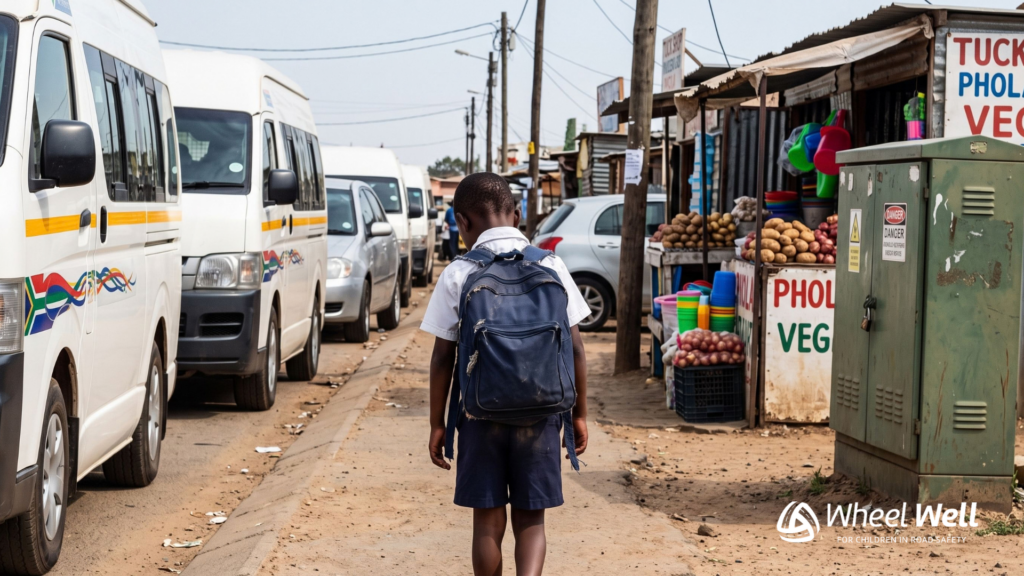
A six-year-old learner with a heavy backpack walking along an unpaved road shoulder beside parked minibus taxis and vendor stalls.

The Should-Be Passengers: Child Passenger Safety Week and the 5km Walking Reality

A six-year-old learner with a heavy backpack walking along an unpaved road shoulder beside parked minibus taxis and vendor stalls.

By Peggie Mars
Founder, Wheel Well – Child Road Safety NGO

When road safety organisations observe Child Passenger Safety Week, the focus is naturally directed toward vehicle interiors. We share life-saving guidance on rear-facing car seats, booster seat progression, seatbelt geometry, and compliant scholar transport vehicles. These conversations are vital, and Wheel Well continues to lead them through our car seat campaigns and child passenger safety initiatives every single day.

Yet in South Africa, a truly honest conversation about child passenger safety must confront an uncomfortable reality: what about the children who should be passengers, but are not?

Every morning, more than 10 million South African children set out for school on foot. For hundreds of thousands of these learners, walking is not a matter of healthy lifestyle choice or living just around the corner. They walk because they fall just short of the administrative criteria required to qualify for state-subsidised scholar transport. They are our should-be passengers. Instead of sitting securely belted inside a roadworthy bus, they navigate live, high-speed traffic corridors on foot, carrying burdens their young bodies and developing minds were never designed to bear.

The 5km Administrative Threshold and the Scholar Transport Dilemma

Under the National Learner Transport Policy, developed jointly by the Department of Transport and the Department of Basic Education, subsidised scholar transport exists to support needy learners attending public schools. In almost every province, qualification hinges on a strict distance rule: a child must live a minimum of 5 kilometres one way from their nearest appropriate school.

In the economic reality of a developing nation, resources are limited. Provincial education and transport departments operate under tight fiscal ceilings. Transporting every learner who asks for a ride is financially difficult, and lowering the eligibility threshold from 5km to 3km would instantly double or triple required transport budgets.

The consequence of this fiscal reality is a rigid, all-or-nothing line. A child living 5.1 kilometres away may be allocated a bus seat. A child living 4.8 kilometres away must walk. That 4.8km trip turns into a 9.6km round trip every single day. Children as young as six years old are expected to walk these distances along unpaved rural verges or congested township roads, simply because an administrative ruler determined they live 200 metres too close to qualify as a passenger.

Biomechanics and Energy: Why Walking is Harder on Small Bodies

Transport policies often treat walking as a uniform activity, as if a kilometre covered by a six-year-old requires the same physical effort as a kilometre covered by an adult. Biomechanical science tells an entirely different story.

Adults walk with a pendulum-like gait that naturally recycles kinetic energy, moving forward at an efficient, relatively low cadence. A six-year-old child operates with much shorter limbs and an underdeveloped musculoskeletal system. To travel the same distance as an adult, a young child must take between 30% and 50% more steps.

Locomotor studies show that the mass-specific energy cost of walking is substantially higher in young children. Per kilogram of body weight, children aged 6 to 10 expend up to 40% more metabolic energy than adults to cover an identical stretch of road.

Now add the weight of a schoolbag. A standard backpack weighing 3kg to 4kg represents 15% to 20% of a six-year-old child’s total body weight. For an adult, an equivalent load would be less than 6% of body mass. By the time a young learner completes a 4km walk to school, often having left home before dawn without a substantial meal, they are suffering from severe physical fatigue. In road safety, fatigue is hazardous. A tired child loses situational awareness, reacts slower to immediate hazards, and is far more likely to stumble or make an impulsive dash across a road.

The Horizon Problem: Sightlines and Everyday Barriers

A six-year-old child stands roughly 1.1 metres tall, with an eye line hovering around one metre above the ground. An adult stands between 1.6 and 1.8 metres tall. This difference completely changes what each pedestrian can see, and critically, who can see them.

For an adult, roadside elements are minor visual inconveniences. For a young child walking along a busy South African road, everyday objects form solid visual barriers:

  • Parked minibus taxis and passenger cars completely conceal a child from oncoming traffic.
  • Informal fruit and vegetable vendor stalls with low awnings block both forward and lateral sightlines.
  • Electrical utility boxes, waste bins, and rubble piles rise well above a child’s head, cutting off views of approaching vehicles.
  • On rural roads, unmaintained verges with tall grass and deep drainage trenches obscure small children completely as vehicles navigate bends.


Drivers sit at an elevated eye level and intuitively scan for hazards at adult height. A six-year-old stepping out from behind a parked minibus taxi remains completely invisible to a driver until the child is already in the active roadway. To help counteract this severe visibility shortfall, Wheel Well provides high-visibility Halo Beanies to young learners, giving drivers a bright, reflective visual cue even when the child’s body is partially obscured.

Cognitive Processing and the Speed-Distance Gap

Even if a route offers clear sightlines, a child’s brain does not process traffic hazards like an adult brain.

Visual attention studies show that adults continuously scan the horizon, tracking vehicle approaches and predicting potential conflicts before they happen. Children, by contrast, are easily distracted by sensory stimulation, such as animals, friends, or roadside activity. Because walking on rough gravel or broken sidewalks requires intense motor concentration, young learners also spend substantial time looking directly down at their feet to avoid tripping.

Auditory localization is another major hurdle. Children under the age of 10 struggle to pinpoint where a sound is coming from when there is competing background noise. In a noisy roadside setting with wind, multiple engines, and passing trucks, a child cannot reliably tell which vehicle is approaching or how close it is.

The greatest cognitive disparity lies in gap acceptance. Adults judge road crossings by integrating distance, closing speed, and acceleration. Children rely almost entirely on simple distance. If a car appears far away, a six-year-old perceives it as safe to cross, completely unable to calculate that a vehicle travelling at 80 km/h on a provincial road closes a 100-metre gap in less than five seconds.

Expanding Child Injury Prevention Beyond the Vehicle

During Child Passenger Safety Week, we must broaden our understanding of child injury prevention. Ensuring child safety cannot begin and end with families who own private vehicles or those lucky enough to secure a seat on a municipal school bus.

We must protect our should-be passengers through actionable, realistic measures:

  • Danger-weighted transport audits: The 5km threshold should never be applied blindly. If a 3.5km route requires an unaccompanied child to walk alongside an 80 km/h arterial road or cross an un-signalised multi-lane freight corridor, that route must be designated as non-walkable and qualify for transport assistance.
  • Community walking buses: Where state-funded transport cannot bridge the gap, organised community walking buses, where groups of younger learners walk under the direct care and supervision of trained parents and volunteers, provide essential cognitive supervision.
  • Strict school zone speed limits: Lowering and enforcing speeds to 30 km/h within school precincts drastically reduces kinetic impact force, giving both drivers and young pedestrians the margin of error needed to survive.

If your school, community, or organisation wants to collaborate on practical pedestrian safety interventions, please reach out to the Wheel Well team.

Support When Tragedy Strikes

Despite our best prevention efforts, pedestrian collisions involving children remain a heartbreaking daily reality on South African roads. When a child is struck by a vehicle, families are thrown into emotional and financial crisis, facing catastrophic medical expenses and long roads to rehabilitation.

Navigating the Road Accident Fund (RAF) claims process during such trauma can be overwhelming, and families frequently fall prey to predatory fee structures. This is where RoadCover plays an invaluable role in child injury advocacy. RoadCover assists road crash victims through the entire RAF claims process, managing legal and administrative complexities without deducting a percentage of the final payout. This ensures that every cent awarded for a child’s medical care and recovery goes directly toward their rehabilitation, giving families the vital support they need when the unthinkable occurs.

Vehicle Maintenance: The Final Safeguard for Walking Children

While we advocate for policy reform and safer walking environments, the mechanical condition of the vehicles sharing our roads serves as the absolute last line of defence. When an exhausted child misjudges traffic and steps into the street, a driver has only split seconds to react. That stop depends entirely on mechanical grip and braking efficiency.

Worn brake pads, degraded shock absorbers, or tyres with shallow tread depth can easily add several metres to an emergency stopping distance, turning a near miss into a fatal collision. Every motorist shares a profound responsibility to protect vulnerable road users. We strongly encourage all drivers to visit their local Supa Quick fitment centre for regular, professional inspections of tyres, brakes, and suspension components. Keeping your vehicle in roadworthy condition ensures that you have the stopping power needed to prevent a tragedy when a child steps into your path.

Wheel Well is a proud winner of the Prince Michael International Road Safety Awards, recognizing achievement and innovation which improves road safety.

The Should-Be Passengers: Child Passenger Safety Week and the 5km Walking Reality Read More »

Scroll to Top