road traffic fatalities

Africa’s New Era of Road Safety
Africa’s New Era of Road Safety

Africa’s New Era of Road Safety

By Peggie Mars
Founder, Wheel Well – Child Road Safety NGO

On 12 March 2026, a historic line was drawn in the sand for the African continent. The African Road Safety Charter officially entered into force, marking the first continental and legally binding road safety framework designed to end the carnage on our roads.

While 15 African Union Member States, including our neighbours Namibia, Mozambique, and Eswatini, have stepped up to lead this charge, South Africa is notably absent from the list.

At Wheel Well, we focus exclusively on the safety of children. For years, we have advocated for stricter enforcement and better education. Now, we are setting a challenge for the South African government: prove that the lives of our children are a priority by ratifying this Charter.

The High Cost of Inaction

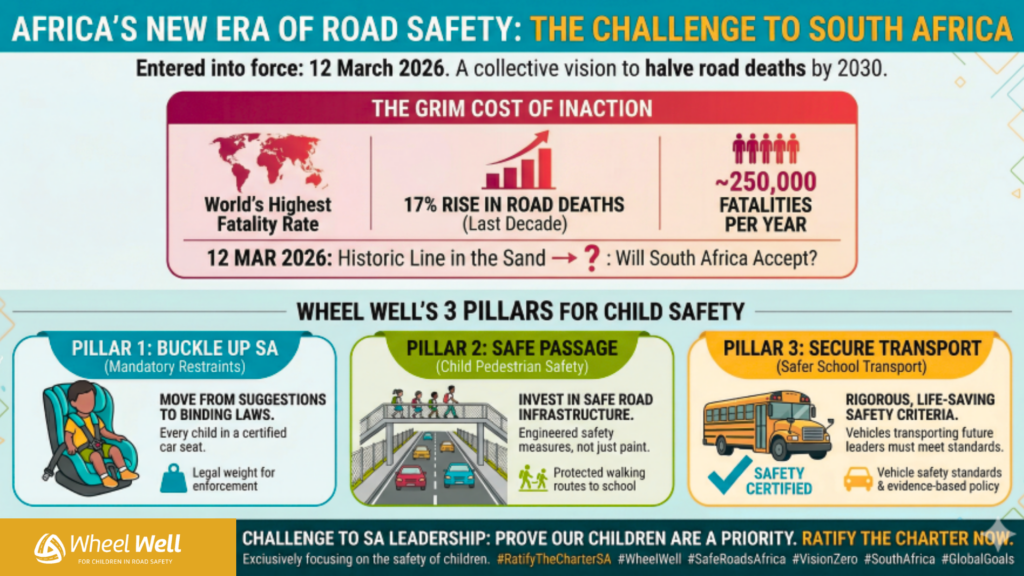
The statistics are a grim reminder of why this Charter is necessary. The WHO African Region holds the world’s highest road fatality rate. Road deaths rose by 17% in the decade leading to 2021, reaching nearly 250,000 fatalities per year.

The Charter is not just a document. It is a strong political statement and a legal foundation to hold governments accountable. By remaining outside this framework, South Africa is effectively opting out of a collective continental vision to halve road deaths and injuries by 2030.

The Blueprint for Child Safety: Our Three Pillars

The Charter compels signatories to take actions that align with global best practices. For Wheel Well, ratification would provide the legal weight needed to enforce our core pillars:

  • Pillar 1: Mandatory Child Restraints The Charter specifically targets child restraints as one of the five key risk factors requiring strict legislation. We challenge the government to move beyond suggestions and enact binding laws that ensure every child is buckled up in a certified car seat.
  • Pillar 2: Child Pedestrian Safety The Charter explicitly aims to protect vulnerable road users, including pedestrians. By ratifying, South Africa commits to investing in safe road infrastructure. We need more than just paint on the road. We need engineered safety measures that protect children walking to school from speeding traffic.
  • Pillar 3: Safer School Transport Under the Charter’s mandate for vehicle safety standards and evidence-based policy, the current state of school transport in South Africa would no longer be acceptable. Ratification means a commitment to ensuring that the vehicles transporting our future leaders meet rigorous, life-saving safety criteria.

No More Excuses

The road map has been provided. The WHO and the African Union have laid out the tools, from improved emergency care to accurate accident analysis. Mozambique recently became the critical 15th country to ratify the Charter, triggering its implementation across the continent.

The question for South African leadership is simple: Why are we not leading this?

We do not need more awareness campaigns that shift the burden to the citizen. We need a government that is willing to be held legally accountable for the safety of its people. We challenge our leaders to join the 15 pioneer nations who have already deposited their instruments of ratification.

South Africa’s silence on the African Road Safety Charter is a choice. It is time to choose the lives of our children.

Africa’s New Era of Road Safety Read More »

Why "Safety Theatre" is Failing Our Children

Road Safety: Why “Safety Theatre” is Failing Our Children (and What Actually Works)

Why "Safety Theatre" is Failing Our Children

By Peggie Mars
Founder, Wheel Well – Child Road Safety NGO

In the world of corporate social responsibility (CSR), there is a growing “effectiveness gap.”

On one side, we see campaigns designed for social media engagement: coloring competitions, catchy songs, and “awareness” posters. On the other side is the grim reality of road trauma, which remains a leading cause of death for children globally. As we approach high-risk travel periods like Easter, it’s time for a deep, evidence-based analysis of which interventions actually save lives and which ones are merely “Safety Theatre.”

  1. The “Safety Theatre” Trap: Why Coloring Competitions Fail

A recent industry shift perfectly illustrates the problem: a corporate pivot from providing life-saving car seats and safety harnesses to hosting a school colouring competition. While photogenic, this fails the most basic test of road safety science: Knowledge does not equal Behavior.

Research from the World Health Organization (WHO) and SWOV Institute for Road Safety Research consistently shows that passive awareness campaigns have negligible impact on casualty rates. These programs mistakenly task the child with their own safety, ignoring the biological reality of child development.

The Cognitive Profile of a Child

Children are not “small adults.” Their brains are physically incapable of navigating complex traffic safely due to:

  • Peripheral Vision Limitations: Children have roughly 1/3 less peripheral vision than adults.
  • Auditory Localization: Most children cannot accurately locate the direction of a vehicle’s sound until age 10.
  • Underdeveloped Impulse Control: The prefrontal cortex is still developing; a child who “knows” the rules may still dart into traffic to retrieve a ball or greet a friend.

The Verdict: When we ask a child to “colour themselves safe,” we shift the burden of responsibility from the adult to the victim.

  1. The Gold Standard: Physical Protection & Restraints

Evidence-based road safety points to one primary solution for child survival: Occupant Restraints.

Correctly installed car seats reduce the risk of death for infants by 71% and for toddlers by 54%. In low-income areas, low restraint usage is rarely due to a lack of “awareness” – it is a lack of access. A harness or car seat handout is not a marketing gesture; it is a life-saving intervention.

  1. High-Impact Education: The “Safety Literacy” Model

Education is vital only when it moves from “Awareness” to Hazard Literacy. In our collaborative school programs with partners like Bridgestone, we target senior secondary learners with a “Consequential Reality” model based on three pillars:

  1. Vehicle Integrity (The Physics of Prevention): We conduct hands-on tire safety checks and a pre-trip inspection. Teaching a learner to identify a “smooth” tire or check tread depth turns them into a “Safety Officer” and not just a passenger.
  2. Survival Basics (Secondary Crash Prevention): We demonstrate the essential kit every vehicle must carry: the wheel jack, spanner, fire extinguisher, reflective triangle, and high-visibility gear. This empowers youth to manage the aftermath of a breakdown and prevent lethal secondary collisions.
  3. Affective Education (The Messenger Effect): Adolescents often possess an “invincibility bias.” Hearing the lived experience of survivors like Zweli (TV personality) creates an emotional anchor that no textbook can replicate.
  4. The Vital Cog: Why Corporates Must Consult NGOs

Designing road safety projects in a vacuum lead to wasted budgets. To move from “optics” to “impact,” companies must partner with established NGOs for two reasons:

  • Expertise Over Aesthetics: NGOs understand the specific risks of the local landscape and the “Profile of a Child.”
  • Systemic Support: Supporting an NGO ensures CSR budgets fund validated, evidence-based interventions rather than “feel-good” activities.
  1. Ranking Road Safety Interventions for Efficacy

Efficacy Rank

Intervention Type

Real-World Impact

🥇 GOLD

Physical Restraints & Engineering

High. Directly prevents mortality in collisions.

🥈 SILVER

Hazard Literacy & Survivor Testimony

Moderate-High. Provides tangible skills and emotional resonance.

🥉 BRONZE

Adult-Focused Enforcement

Moderate. Targets the person in control of the vehicle.

❌ FAIL

Passive Child Awareness (Coloring/Songs)

Zero. Optimized for social media “likes,” not lives.

A Call to Action for CSR Leaders

If your road safety budget is spent on crayons instead of car seats, or posters instead of reflective gear, you aren’t investing in safety – you’re investing in optics.

Children learn from repeated, consistent, and adult-led messages. They are protected by the physical barriers we put between them and a ton of moving metal. Let’s stop asking children to draw their way to safety and start doing the heavy lifting ourselves.

Get Involved: We are proud to work with partners who choose impact over optics. To see the organizations making a real difference in child road safety, View Our Sponsors Page Here.

#RoadSafety #ChildSafety #CSR #VisionZero #SafeSystem #SustainableDevelopment

Road Safety: Why “Safety Theatre” is Failing Our Children (and What Actually Works) Read More »

Pedestrian safety South Africa

Pedestrian Safety’s Missing Link: Why Visibility is the Answer We Aren’t Talking About.

Pedestrian safety South Africa

By Peggie Mars
Founder, Wheel Well – Child Road Safety NGO

We regularly hear about road safety in South Africa. We hear about Easter safety campaigns, festive season roadblocks, and crackdowns on drunk driving. Recently, I attended a presentation by the Deputy Minister of Transport where these traditional strategies were once again the focus.

Law enforcement is essential. Education campaigns are necessary. However, I left the session feeling that a vital part of the conversation was missing. If we truly want to stop the carnage on our roads, we must address the “visibility gap.”

As a nation, we need to focus on visibility gear for pedestrians, especially for our children.

The Invisible Victims: Counting the Cost

The numbers from the Road Traffic Management Corporation (RTMC) tell a tragic story. In South Africa, pedestrians are not just one category of road users, they are the most vulnerable and often the majority of victims.

On an annual basis, pedestrians make up between 40% and 47% of all road fatalities. During peak travel periods like Easter, that number has hit the highest end of that spectrum. In 2025, nearly 5,000 pedestrians lost their lives on South African roads.

When we look closer at the demographics, a disturbing pattern emerges:

  • Children are at extreme risk. Children under the age of 14 consistently account for about 10% to 12% of pedestrian deaths. The ages of 5 to 9 are the highest-risk group within this category. Many of these deaths happen as children walk to or from school, often on high-speed roads with no sidewalks.
  • Commuters are vulnerable. Working-age adults between 25 and 44 are the most affected group.

The timing of these accidents is critical. The vast majority of fatal pedestrian crashes occur between dusk and early night (19:00 to 21:00) and peak over weekends. In simple terms, people are dying because it is dark and they cannot be seen.

The Seconds That Save Lives: The Science of Visibility

Current government policy focuses heavily on changing behaviour (stopping jaywalking) and enforcement (speed traps). These are slow, expensive battles to fight.

Focusing on visibility offers a micro-intervention with immediate, massive results. The solution comes down to physics and human reaction time.

A driver’s ability to react is determined by the distance at which they can detect an object. At a speed of 100km/h, a vehicle is moving at roughly 28 meters every single second.

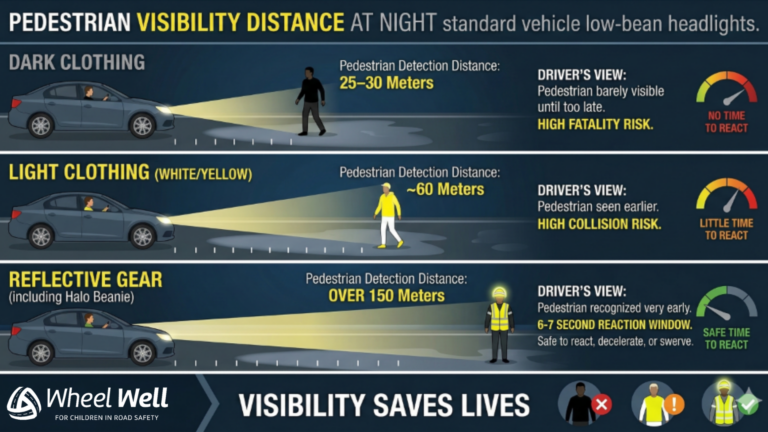
Let’s look at the detection distances in darkness under standard low-beam headlights:

  • Dark Clothing: A driver might only see a pedestrian at 25 to 30 meters. By the time the driver reacts, the vehicle has already travelled that distance. It is almost always fatal.
  • Light Clothing (White/Yellow): Visibility increases to perhaps 60 meters. This still leaves a very high risk of collision.
  • Reflective Gear: Visibility surges to over 150 meters. This gives the driver a 6 to 7-second window to react, decelerate, or swerve safely.

Research suggests that simply wearing high-visibility or retro-reflective gear can reduce a pedestrian’s collision risk by up to 85%. Despite this, there is no major national mandate or program to get this lifesaving gear onto our most vulnerable citizens.

Elevating the Solution: The Case for Halo Beanies

The standard solution has always been to suggest people wear a high-vis construction vest. While effective in theory, this approach often fails because people (especially children) find them uncomfortable or socially unappealing. Furthermore, vests can be obscured by backpacks.

This is where the Halo Beanie campaign shifts the strategy. A beanie addresses the critical psychology of compliance and the physics of the problem:

  1. High User Adoption: In South Africa’s colder winter months, when the days are shortest, children and adults already wear beanies. A safety beanie is an easy substitute for an existing habit, rather than an extra, “uncool” accessory.
  2. Visible at the Highest Point: This is the technical advantage. Drivers can be blinded or have their line of sight blocked by parked cars, tall grass, or roadside clutter. Reflective gear at the waist (vest) or feet is easily hidden. A reflective “halo” on the head is at the driver’s eye level and is often the first thing that emerges from behind an obstacle.
  3. 360-Degree Visibility: Unlike directional reflective sashes, which can move, or vests, which can be covered by a jacket, a continuous reflective band around the head ensures a child is visible from every angle, even if they are playing or running.
  4. Amplified Recognition: A person’s head moves constantly. This erratic movement makes a driver recognize that the object is a “person” much faster than a static reflective dot on a road sign.

A Call for Action

If we truly want a breakthrough in pedestrian safety, we cannot rely solely on roadblocks and television ads. While those tactics have a role, they react to a problem that has already happened. Visibility gear is proactive.

It costs less than R50 to equip a child with a high-quality reflective beanie or sash. Compare that to the economic and emotional toll of a single road fatality.

The state has the power to act. They can incentivize the production of reflective school wear and mandate visibility gear for high-risk workers.

For our part, we are focusing on the Halo Beanie campaign to prove that effective road safety can also be practical and accessible. It is time to turn the conversation to visibility and stop allowing the missing link in road safety to cost lives.

What is your take on visibility gear as a primary road safety strategy? Is your company integrating high-vis into workwear? Let’s discuss.

Pedestrian Safety’s Missing Link: Why Visibility is the Answer We Aren’t Talking About. Read More »

Scroll to Top